Photon Energy
E = hf and why frequency matters
Do Now: Radio waves pass through you all day. X-rays are carefully limited at the dentist. Both are electromagnetic waves traveling at the speed of light. What makes X-rays different?
Frequency. X-rays have a far higher frequency, so each X-ray photon carries far more energy — enough to knock electrons out of atoms.
A. The Electromagnetic Spectrum
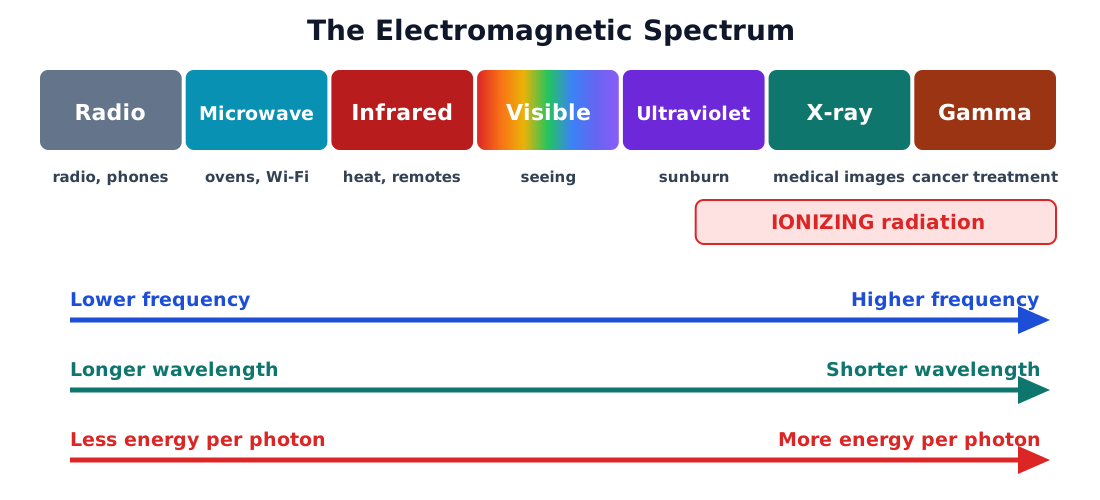
All EM waves travel at the speed of light, c = 3.00 × 10⁸ m/s, in a vacuum.
Higher frequency means shorter wavelength: c = fλ
B. Light Comes in Packets: Photons
Light is absorbed by matter one photon at a time. The energy of each photon depends only on its frequency:
h = Planck’s constant = 6.63 × 10⁻³⁴ J•s
Energy is often given in electron-volts (eV): 1 eV = 1.60 × 10⁻¹⁹ J
Double the frequency → double the energy of each photon.
C. Worked Examples
Find the energy of a photon of green light with a frequency of 5.0 × 10¹⁴ Hz, in joules and in electron-volts.
E = hf = (6.63 × 10⁻³⁴ J•s)(5.0 × 10¹⁴ Hz)
E = 3.3 × 10⁻¹⁹ J
E = 3.3 × 10⁻¹⁹ J1.60 × 10−19 J/eV = 2.1 eV
An X-ray has a frequency of 3.0 × 10¹⁸ Hz. How many times more energy does each X-ray photon carry than a green-light photon?
Energy is proportional to frequency, so compare the frequencies.
3.0 × 10¹⁸ Hz5.0 × 1014 Hz = 6,000 times more energy per photon
That’s about 12,000 eV — far more than the roughly 10 eV needed to knock an electron out of an atom.
Ultraviolet-B light has a wavelength of 300 nm (3.00 × 10⁻⁷ m). Find the photon energy in eV.
f = cλ = 3.00 × 10⁸ m/s3.00 × 10−7 m = 1.00 × 10¹⁵ Hz
E = hf = (6.63 × 10⁻³⁴)(1.00 × 10¹⁵) = 6.63 × 10⁻¹⁹ J
E = 6.63 × 10⁻¹⁹ / 1.60 × 10−19 = 4.1 eV — enough to damage DNA
D. Comparing Photon Energies
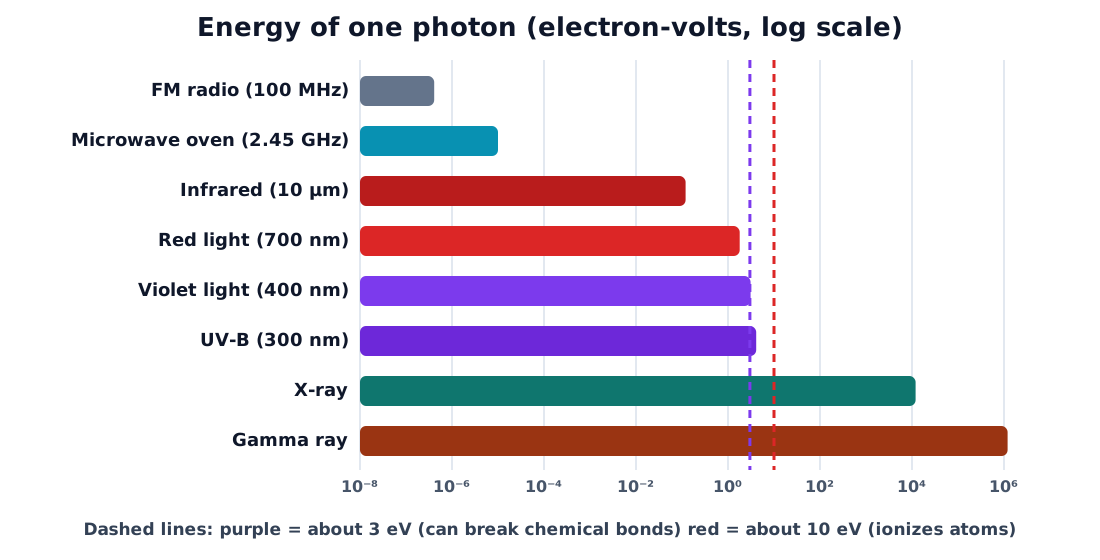
Radio and microwave photons carry less than a thousandth of an eV. Visible light carries about 2–3 eV. X-rays and gamma rays carry thousands to millions of eV.
Explore: The EM Spectrum
Slide from radio waves to gamma rays and watch the energy of one photon change.
1. Find the frequency where photons first reach about 3 eV. What part of the spectrum is it?
2. Find where radiation becomes ionizing (about 10 eV).
3. What is the energy of a microwave-oven photon?
1. The violet edge of visible light, just before ultraviolet (about 7–8 × 10¹⁴ Hz). 2. In the ultraviolet, around 2–3 × 10¹⁵ Hz. 3. About 10−5 eV — roughly a million times too small to ionize.
E. Practice
Find the energy of a photon from an FM radio station broadcasting at 1.0 × 10⁸ Hz.
E = (6.63 × 10⁻³⁴)(1.0 × 10⁸) = 6.6 × 10⁻²⁶ J (about 4 × 10⁻⁷ eV)
A photon has an energy of 4.0 × 10⁻¹⁹ J. Find its frequency.
f = E/h = 4.0 × 10⁻¹⁹ / 6.63 × 10−34 = 6.0 × 10¹⁴ Hz (visible light)
Photon A has twice the frequency of photon B. Compare their energies and wavelengths.
A has twice the energy and half the wavelength of B.
Check Your Understanding
5 quick questions — pick an answer to see if you’re right.
1. The energy of a single photon depends on its
2. Which photon carries the most energy?
3. A photon has a frequency of 6.0 × 10¹⁴ Hz. Its energy is about
4. As the wavelength of EM radiation decreases, the energy of each photon
5. All electromagnetic waves in a vacuum have the same