Radiation & Your Body
What each kind of radiation does when it is absorbed
Do Now: The word “radiation” sounds scary. But light from your phone screen is radiation too. Is all radiation dangerous?
No. What radiation does depends on the energy of each photon. Low-energy radiation mostly causes heating. Only high-energy radiation can break molecules or ionize atoms.
A. Brightness vs. Frequency
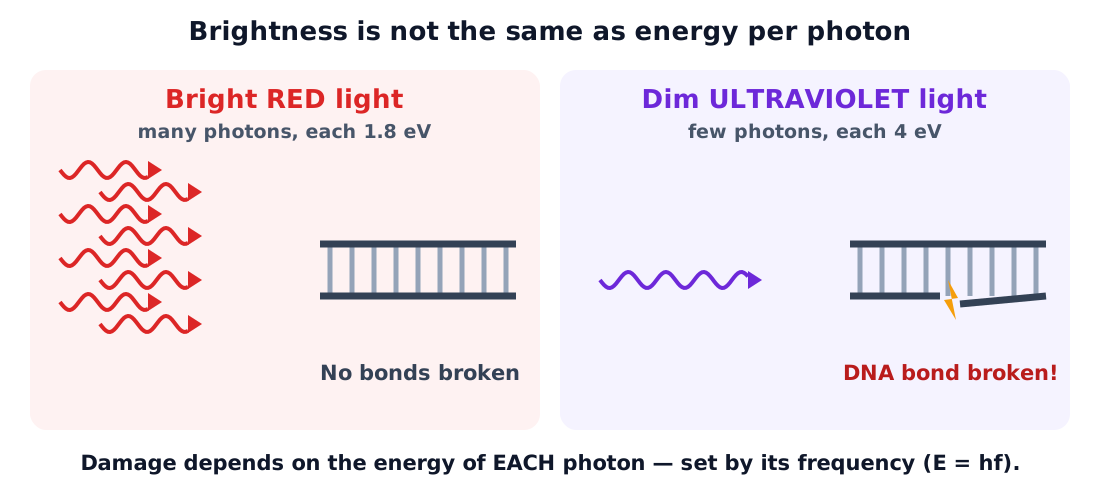
Intensity (brightness) = how many photons arrive. More photons means more total energy, often felt as heat.
Frequency = how much energy each photon has. This decides whether a photon can break a bond or ionize an atom.
Bright red light can’t knock electrons off zinc, but dim ultraviolet light can. One photon interacts with one electron, so the energy per photon is what counts.
B. What Each Kind of Radiation Does
| Radiation | Photon Energy | What Happens When Absorbed | Uses |
|---|---|---|---|
| Radio | < 0.000001 eV | Mostly passes through; tiny heating | Radio, TV, cell phones |
| Microwave | ~0.00001 eV | Makes water molecules rotate → heating | Cooking, Wi-Fi, radar |
| Infrared | ~0.001–1.7 eV | Molecules vibrate faster → warming | Heat lamps, remotes, night vision |
| Visible | ~2–3 eV | Changes molecules in the retina and in leaves | Vision, photosynthesis |
| Ultraviolet | ~3–100 eV | Breaks bonds in DNA; highest UV ionizes | Sterilizing, vitamin D; causes sunburn |
| X-ray | ~100–100,000 eV | Ionizing — can damage DNA | Medical and dental imaging |
| Gamma | > 100,000 eV | Ionizing — strongly damaging | Killing cancer cells, sterilizing food and tools |
C. Protecting Yourself
Sunscreen absorbs or reflects UV before it reaches skin cells. SPF rates protection from UV-B; “broad spectrum” also blocks UV-A.
UV-blocking sunglasses protect the eyes from cataracts.
Lead aprons at the dentist absorb X-rays; technicians step behind a shield because they take X-rays all day.
Microwave ovens have a metal mesh in the door. The holes are much smaller than the 12-cm microwaves, so the waves stay inside.
Explore
Slide from radio waves to gamma rays and watch the energy of one photon change.
Check Your Understanding
5 quick questions — pick an answer to see if you’re right.
1. Ionizing radiation is radiation that
2. Which of these is ionizing radiation?
3. A microwave oven heats food mainly by
4. A very bright red light and a dim ultraviolet light shine on skin. Which is more likely to damage DNA?
5. Why does a dental technician stand behind a shield during X-rays?