Fission & Fusion
Splitting heavy nuclei and joining light ones
Do Now: A nuclear power plant and the Sun both get energy from the nucleus. But one splits nuclei apart and the other joins them together. Which is which?
Power plants split heavy nuclei like uranium (fission). The Sun joins light nuclei like hydrogen (fusion).
A. Fission
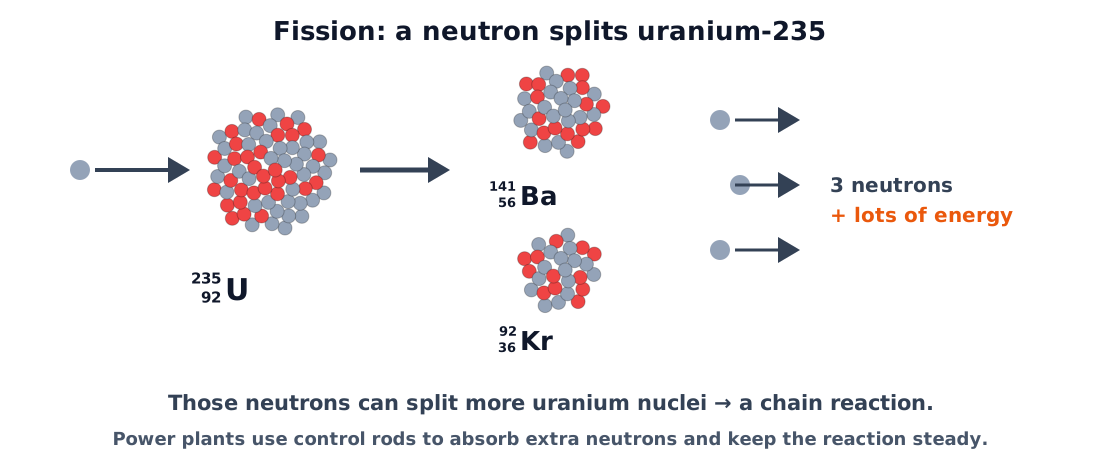
Check that this equation balances.
Top: 1 + 235 = 236 141 + 92 + 3(1) = 236 ✓
Bottom: 0 + 92 = 92 56 + 36 + 3(0) = 92 ✓
Chain reaction: each fission releases 2–3 neutrons that can split more uranium nuclei.
Nuclear power plants use control rods that absorb extra neutrons, keeping the reaction steady. The heat boils water, and the steam spins a turbine and generator.
B. Fusion
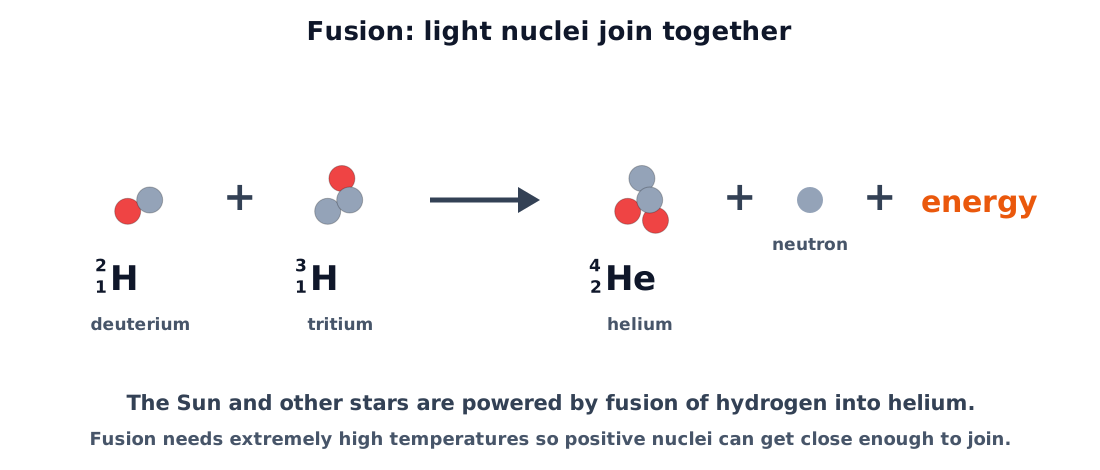
Nuclei are positive and repel, so fusion needs extremely high temperatures (millions of degrees) to slam them together.
Stars like the Sun fuse hydrogen into helium. Scientists are working to build fusion power plants on Earth.
C. Where Does the Energy Come From?
Review: Conservation of Mass and Energy
| Fission | Fusion | |
|---|---|---|
| What happens | Heavy nucleus splits | Light nuclei join |
| Example fuel | Uranium-235 | Hydrogen isotopes |
| Where | Nuclear power plants | The Sun and stars |
| Waste | Radioactive waste that lasts thousands of years | Much less long-lived waste |
Check Your Understanding
5 quick questions — pick an answer to see if you’re right.
1. Fission is when
2. What powers the Sun?
3. In a chain reaction, each fission
4. Control rods in a nuclear reactor
5. Where does the energy released in fission and fusion come from?