Explaining the Photoelectric Effect
Quantum theory and the discrete transfer of light energy
|
II. Explaining photoelectric effect using quantum theory
A. Quantum Theory
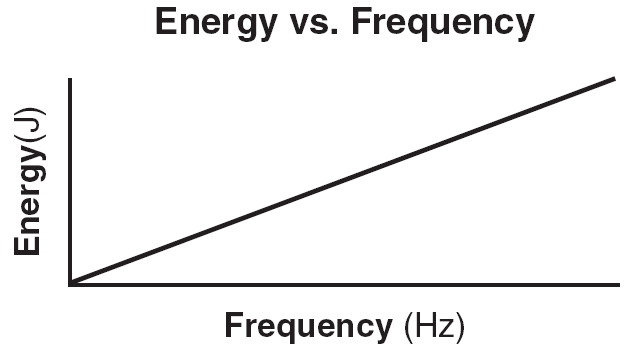
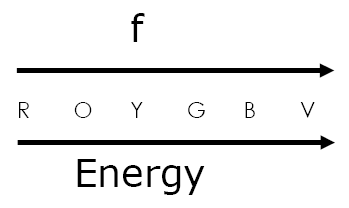
1) electrons can only absorb or emit energy in discrete amounts called quanta (packets) 2) Energy of each quanta (photon) is proportional to frequency of radiation
Energy of a Quanta
June 2004 #40
Since: c = fλ c = 3 x 10⁸ m/s
And f = c/λ
|
|||||


Check Your Understanding
5 quick questions — pick an answer to see if you’re right.
1. In quantum theory, electrons absorb or emit energy in discrete packets called…
2. The energy of a photon is…
3. Find the energy of a photon with frequency 1.0 × 10¹⁵ Hz. (h = 6.63 × 10⁻³⁴ J·s)
4. If a photon's frequency is doubled, its energy…
5. Light A has a longer wavelength than light B. Which photon has more energy?
Wave Predictions vs. Observations
Scientists compared what the classical wave model predicted about the photoelectric effect with what experiments actually showed.
Table 1: Predictions vs. Observations
| Variable Changed | Wave Model Prediction | Observed Result |
|---|---|---|
| Brighter light | Electrons gain more energy | More electrons; same max KE |
| Higher frequency | No effect on energy | Max KE increases |
| Very dim light | Delay before emission | Emission is immediate |
| Low-frequency light | Emission if bright enough | No emission below a threshold |
Which conclusion is best supported by Table 1?
▶ Want a challenge? Open 6 more Regents-style questions (harder · mixed formats)
Challenge score: 0 / 6
C1. Place a check mark in three boxes to indicate ideas of the photon model that explain the observed results in Table 1.
C2. Why is emission immediate even in very dim light?
C3. Violet light has a frequency of 7.5 × 10¹⁴ Hz. Substitute numerical values into a mathematical representation that can be used to determine the energy of one violet photon in electronvolts. Then calculate the energy. (h = 6.63 × 10⁻³⁴ J·s; 1 eV = 1.60 × 10⁻¹⁹ J)
C4. A student makes the following claim.
Place a check mark in either the Support or Refute box. Justify your response using a mathematical relationship.
C5. What happens if light below the threshold frequency is made 100 times brighter?
C6. Describe an investigation to test the “Higher frequency” row of Table 1. Identify the independent variable, the dependent variable, and one variable that must be kept constant, and state the result that would support the photon model.