Bohr Model Examples
Applying quantized energy levels to absorption and emission
|
showmethephysics.com
Ex) How much energy is absorbed when an electron in hydrogen moves from the energy levels n = 2 to n = 5?
Subtract the absolute values to find the energy needed to be absorbed
Answer
3.4 eV - .54 eV = 2.86 eV
Ex) How much energy is needed for an electron in the n = 1 energy level to move to the n = 2 energy level?
n = 1 -13.6 eV
Throw out the
= 13.6 eV - 3.4 eV
Frequency of photon absorbed E = hf
h = 6.63 x 10⁻³⁴ Js
E = 10.2 eV
Convert eV to Joules page 1 Reference
1 eV = 1.6 x 10⁻¹⁹ J
E = 10.2 eV x 1.6 x 10-19 J
= 1.6 x 10⁻¹⁸ Joules
E = hf
1.6 x 10⁻¹⁸ Joules =
f = 2.4 x 10¹⁵ Hz
Ex) Which energy level transition in MERCURY will produce a photon emission of .22 ev?
c to b transition
(Difference in energy
5) Ionization Energy - minimum energy needed to remove an electron from an atom.
Ionization Energy -
Ionization Energy of Hydrogen
n = 1
13.6 eV or greater
n = 2
3.4 eV or greater
n = 3
1.51 eV or greater
Ex) A photon having an energy of 15.5 electron volts is incident upon a hydrogen atom in the ground state. The photon may be absorbed by the atom and
a) ionize the atom
b) excite the atom to n = 3
c) excite the atom to n = 2
d) excite the atom to n = 4
a) ionize the atom
Bohr Energy Transitions / Ionization
|
|

Check Your Understanding
5 quick questions — pick an answer to see if you’re right.
1. How much energy is needed to move a hydrogen electron from n = 1 (−13.6 eV) to n = 2 (−3.40 eV)?
2. How much energy is absorbed when a hydrogen electron moves from n = 2 (−3.40 eV) to n = 5 (−0.54 eV)?
3. What is ionization energy?
4. What is the minimum energy needed to ionize a hydrogen atom whose electron is in n = 2?
5. A 15.5 eV photon hits a hydrogen atom in the ground state (−13.6 eV). The photon can…
Which Photons Can Hydrogen Absorb?
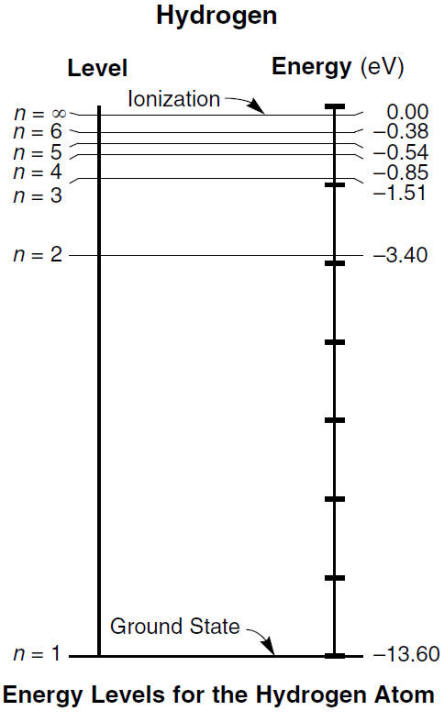
A sample of hydrogen atoms in the ground state (n = 1) is exposed to photons of several different energies. Use the energy levels in Table 1.
Table 1: Hydrogen Energy Levels
| Level (n) | Energy (eV) |
|---|---|
| ∞ | 0.00 |
| 6 | −0.38 |
| 5 | −0.54 |
| 4 | −0.85 |
| 3 | −1.51 |
| 2 | −3.40 |
| 1 (ground) | −13.60 |
Which photon could be absorbed by a ground-state hydrogen atom?
▶ Want a challenge? Open 6 more Regents-style questions (harder · mixed formats)
Challenge score: 0 / 6
C1. How many different photon energies could be emitted as electrons fall from n = 4 to the ground state by all possible paths?
C2. Place a check mark in three boxes to indicate photon energies that could be absorbed by a hydrogen atom in the ground state (n = 1).
C3. A student makes the following claim.
Place a check mark in either the Support or Refute box. Justify your response using data from Table 1.
C4. Substitute numerical values from Table 1 into a mathematical representation that can be used to determine the energy of the photon emitted when an electron drops from n = 3 to n = 1. Then calculate the energy.
C5. A ground-state atom absorbs a 14.0-eV photon. What happens?
C6. A laboratory wants to use a tunable laser to raise ground-state hydrogen atoms to the n = 3 level. State the photon energy the laser must deliver, and identify every photon energy the atoms could then emit as they return to the ground state.