The Gravitational Field
g = F/m, field lines, and the inverse square law
Do Now: The Moon is 384,000 km away, with nothing in between. How can Earth pull on it without touching it?
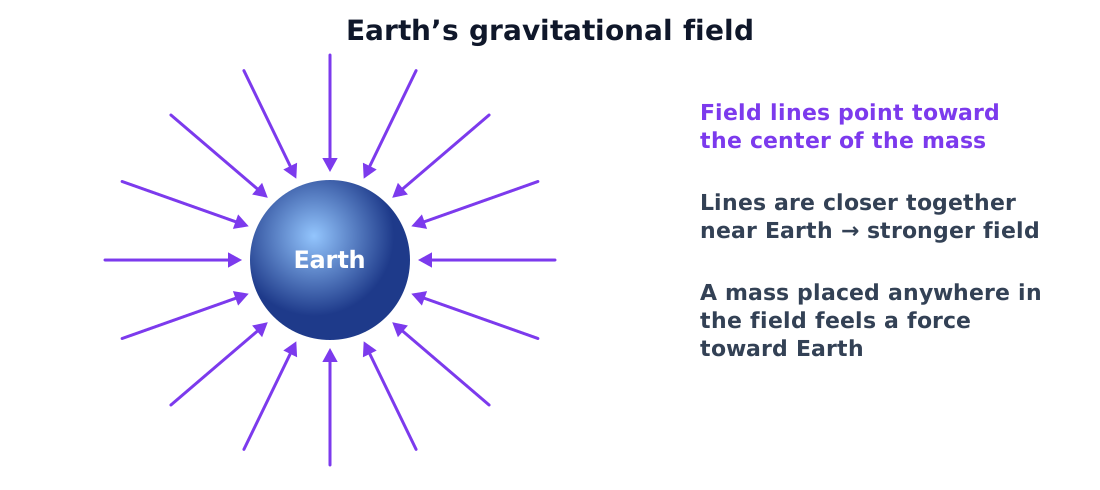
Through its gravitational field. Every mass creates a field in the space around it. Any other mass in that field feels a force.
A. What Is a Field?
B. Field Strength
Gravitational field strength (N/kg)
g = force per kilogram on a test mass. It does not depend on the test mass.
At Earth’s surface, g = 9.81 N/kg. Since 1 N/kg = 1 m/s², that’s also the acceleration of free fall.
C. Where Does g Come From?
Start with Newton’s law of gravitation and divide by the test mass:
Fg = Gm1m2r2 → g = Fgm2 = Gm1r2
m = mass making the field, r = distance from its center, G = 6.67 × 10⁻¹¹ N•m²/kg²
Earth’s mass is 5.97 × 1024 kg and its radius is 6.37 × 10⁶ m. Find g at the surface.
g = (6.67 × 10⁻¹¹)(5.97 × 1024)(6.37 × 10⁶)2
g = 9.81 N/kg ✓
Mars has a mass of 6.42 × 10²³ kg and a radius of 3.39 × 10⁶ m. Find g on Mars, and the weight of a 60.-kg student there.
g = (6.67 × 10⁻¹¹)(6.42 × 10²³)(3.39 × 10⁶)2
g = 3.73 N/kg
Fg = mg = (60. kg)(3.73 N/kg) = 224 N — about 38% of the student’s weight on Earth
D. The Inverse Square Law
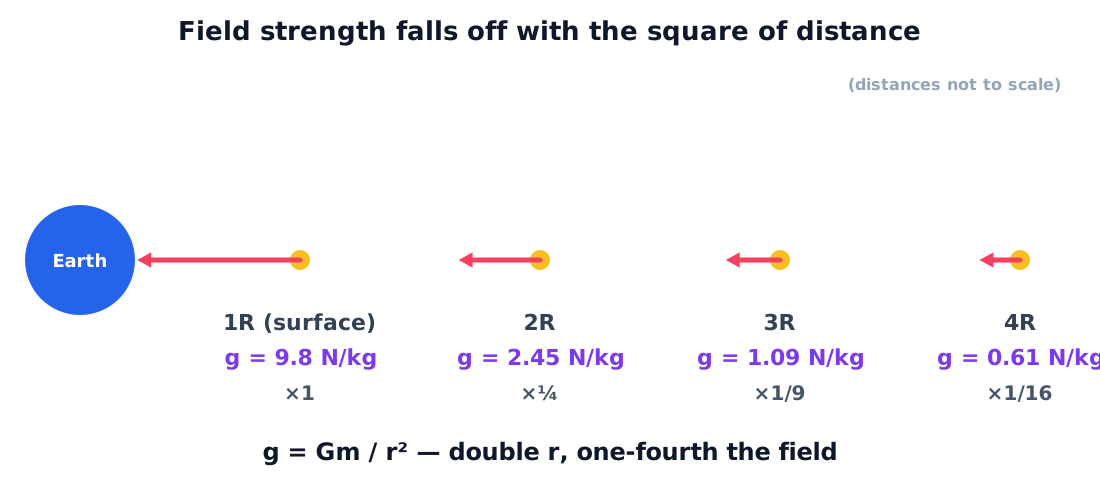
The Space Station orbits about 400 km above Earth, at about 6,770 km from Earth’s center. Compare g there to the surface value.
Earth’s radius is 6,370 km.
g = 9.81 × (6,3706,770)2 = 8.7 N/kg — about 89% of surface gravity!
The astronauts float because they are in free fall, not because gravity is gone.
Explore: Field Explorer
Drag the test mass around the planet. Change the planet and the mass.
1. Change the test mass. Does g change? Does Fg change?
2. Drag the mass from 1R to 2R. What happens to g?
3. Compare g at the surface of each planet.
1. g stays the same; Fg changes in proportion to the mass. g belongs to the field, not the test mass. 2. g drops to one-fourth. 3. Moon 1.62, Mars 3.73, Earth 9.81, Jupiter about 24.8 N/kg.
E. Practice
A 50.-kg astronaut stands on the Moon, where g = 1.62 N/kg. Find her weight.
Fg = (50. kg)(1.62 N/kg) = 81 N
What is g at 3 Earth radii from Earth’s center?
9.81 ÷ 32 = 1.09 N/kg
A 2.0-kg mass feels a 7.4-N gravitational force on a planet. Find g.
g = 7.4 / 2.0 = 3.7 N/kg (about the same as Mars)
A planet has twice Earth’s mass and twice Earth’s radius. Compare its surface g to Earth’s.
×2 for mass, ÷22 = ÷4 for radius → half of Earth’s: about 4.9 N/kg
Check Your Understanding
5 quick questions — pick an answer to see if you’re right.
1. Gravitational field strength is measured in
2. Doubling a test mass at the same location makes g
3. If you move to 2 Earth radii from Earth’s center, g becomes
4. Field lines around a planet point
5. Astronauts on the Space Station feel weightless because