Energy in Fields
How fields store energy
Do Now: You lift a book onto a high shelf. You did work on it, but the book isn’t moving. Where did the energy go?
It’s stored in the gravitational field between the book and Earth, as gravitational potential energy. Knock the book off and the field turns that energy into kinetic energy.
A. Fields Store Energy
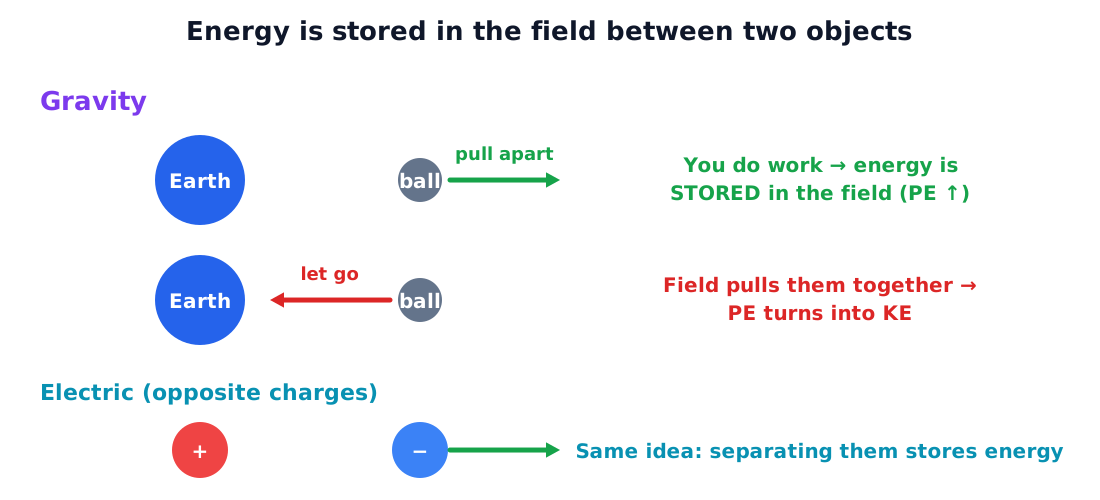
When two objects that attract are pulled apart, you do work against the field. That energy is stored in the field as potential energy.
When they are let go, the field pulls them together and the stored energy becomes kinetic energy.
The potential energy belongs to the system (Earth + book), not to the book alone.
B. Near Earth’s Surface
A 2.0-kg book is lifted 1.5 m. How much energy is stored in the field? If it falls back down, how fast is it moving just before it lands?
m = 2.0 kg, g = 9.81 N/kg, Δh = 1.5 m
ΔPE = (2.0)(9.81)(1.5) = 29 J stored
Falling: KE = 29 J = ½(2.0)v2 → v = 5.4 m/s
C. The Same Idea Everywhere
| Situation | Field | Energy Stored When… |
|---|---|---|
| Roller coaster lift hill | Gravitational | the cars are pulled up, away from Earth |
| Water behind a dam | Gravitational | water is held high above the river |
| Opposite charges | Electric | they are pulled apart |
| Like charges | Electric | they are pushed together |
| Two magnets (N to S) | Magnetic | they are pulled apart |
Energy is stored whenever you push objects against the direction the field wants them to move.
D. Practice
How much potential energy is stored when a 60.-kg student climbs 4.0 m of stairs?
ΔPE = (60.)(9.81)(4.0) = 2,350 J (about 2.4 × 10³ J)
Two positive charges are pushed closer together. Does the energy stored in their field go up or down? Why?
Up. Like charges repel, so pushing them together works against the field and stores energy. Let go and they fly apart.
Where does the kinetic energy of a falling apple come from?
From the gravitational field between the apple and Earth. Stored potential energy becomes kinetic energy as the field pulls them together.
Check Your Understanding
5 quick questions — pick an answer to see if you’re right.
1. When you lift a box, the energy you add is stored
2. Two objects that attract are pulled farther apart. Their stored potential energy
3. Two like charges are pushed closer together. Their stored energy
4. A 3.0-kg object is lifted 2.0 m. About how much energy is stored?
5. A dropped ball speeds up because
A Crane Lifts a Steel Beam
A construction crane lifts a 500.-kg steel beam at constant speed from the ground to a height of 20. m. The crane’s motor has a power output of 2000 W.
Where is the energy stored when the beam is lifted?
▶ Want a challenge? Open 6 more Regents-style questions (harder · mixed formats)
Challenge score: 0 / 6
C1. Substitute numerical values into a mathematical representation that can be used to determine the gravitational potential energy gained by the Earth–beam system. Then calculate it.
C2. Two positive charges are pushed closer together. What happens to the energy stored in their electric field?
C3. The cable breaks when the beam is at 20. m, and the beam falls. Construct an energy bar graph for the Earth–beam system when the beam is 10. m above the ground. The zero level for potential energy is the ground; neglect air resistance.
Click a box to set each bar’s height; click it again to clear the bar to 0. The ET bar is drawn for you.
C4. A site manager makes the following claim.
Place a check mark in either the Support or Refute box. Justify your response using a mathematical relationship.
C5. Why can PE = mgh not be used to calculate the energy needed to launch a satellite to 20,000 km?
C6. In a real test, the 2000-W crane actually takes 70. s to lift the beam 20. m. Describe what happened to the energy that did not end up stored in the Earth–beam system, and suggest one design improvement.