Forces Not at 90°
Finding the Resultant & Equilibrant When Concurrent Forces Meet at Any Angle

Angle ≠ 90° — when concurrent forces don't meet at a right angle, the resultant can't be found with the Pythagorean theorem. It must be found graphically.
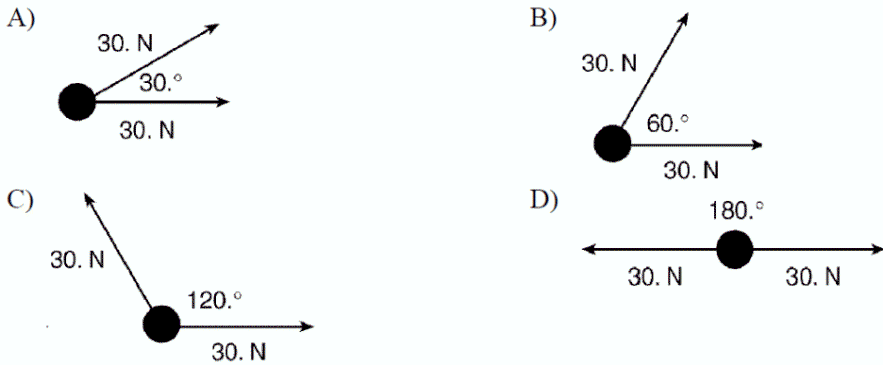
F. Resultants When the Angle Between Forces ≠ 90°
5 N North & 3 N 30° S of E act concurrently (on a single point).
Find the resultant & equilibrant.
Angle not 90 degrees, can't use Pythagorean theorem
Graphical Method
1. Draw vectors to scale
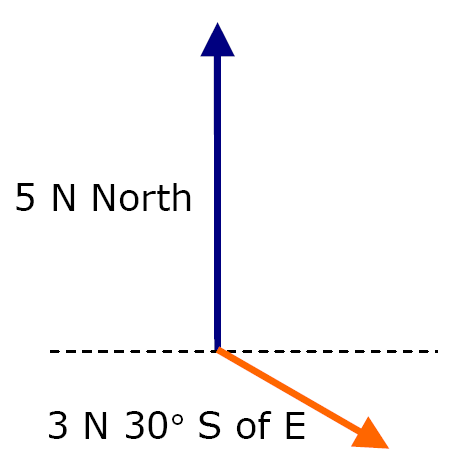
2. Make parallelogram
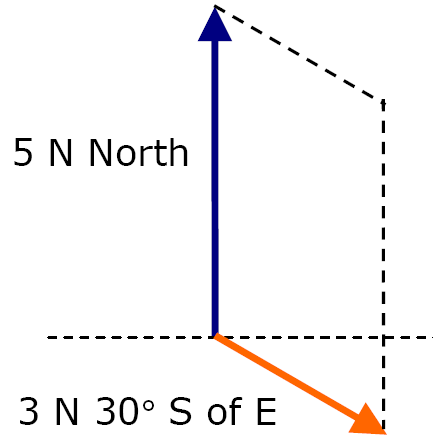
3. Draw diagonal (resultant)
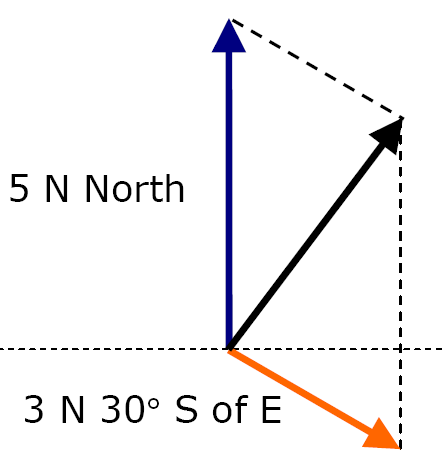
4. Find magnitude & direction of vector
Graphical Method
1. Measure length, convert to Newtons using scale 1 cm = 1 N
2. Measure angle vector makes with horizontal
Try This at Home
You can do this with a ping pong ball and a hair dryer
St. Mary's U. Astronomy and Physics Dept.
When a fluid moves in a single direction, it exerts very little pressure perpendicular to the direction of its flow. The external air pressure keeps the ball in place.
Check Your Understanding
5 quick questions — pick an answer to see if you’re right.
1. Why can't the Pythagorean theorem find the resultant of two forces at 30° to each other?
2. In the parallelogram method, after drawing both vectors to scale from one point, the resultant is
3. Using a scale of 1 cm = 1 N, a resultant drawn with the graphical method measures 4.5 cm. What is its magnitude?
4. A resultant is 4.5 N, 53° N of E. What is the equilibrant?
5. Forces of 5 N and 3 N act on a point at an angle other than 0°, 90° or 180°. Which resultant is possible?