Equilibrium
When the Net Force on an Object Equals Zero

Equilibrium — the state in which the resultant (net) force acting on an object equals zero

What is the resultant of these 2 forces?
Video Instruction
showmethephysics.com
G. Equilibrium
resultant = 0 N

Ex 1
What is the resultant of these 2 forces?


Velocity is Constant (rest or constant v)
Ex 2
Could the forces of 8 N, 6 N and 4 N ever produce a state of equilibrium?
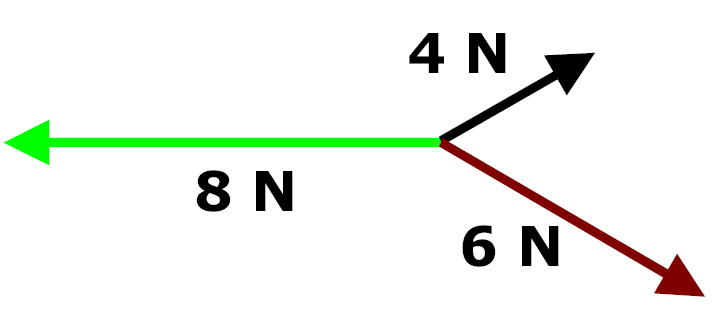
If so, find the resultant of the forces 4 N and 6 N.
Ex 3
Could the angles of these forces ever be arranged to produce equilibrium?
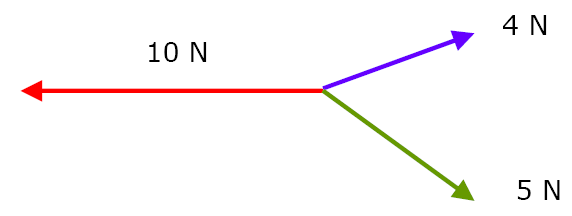
Ex 4
Could these forces ever be in equilibrium?


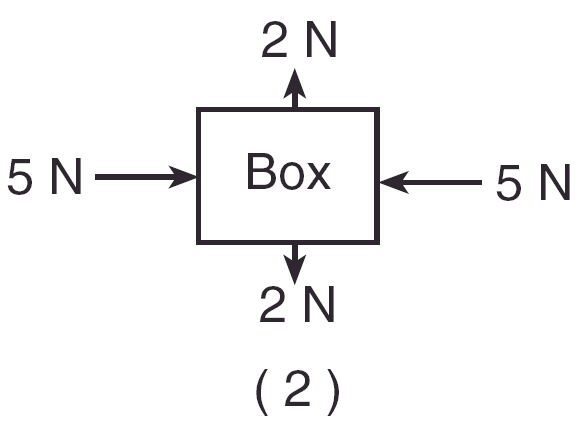
Which Diagram Shows Equilibrium?

Which diagram represents a box in equilibrium?
Diagram 1
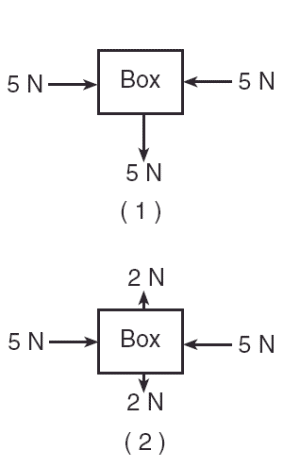
Diagram 2

Show Me The Physics's YouTube Channel
Check Your Understanding
5 quick questions — pick an answer to see if you’re right.
1. When is an object in equilibrium?
2. A hockey puck slides across frictionless ice at a constant 5 m/s. Is it in equilibrium?
3. Which pair of forces, acting alone on an object, could produce equilibrium?
4. Forces of 8 N, 6 N and 4 N act on an object. Could they produce equilibrium?
5. Forces of 4 N and 5 N act on an object. What third force could put it in equilibrium?
Hanging a Traffic Light
A traffic light with a weight of 200. N hangs at rest from two identical cables. Each cable makes an angle of 30.° above the horizontal, as shown in Diagram 1.
Diagram 1: Traffic Light Support
Which statement correctly describes the forces acting on the traffic light?
▶ Want a challenge? Open 6 more Regents-style questions (harder · mixed formats)
Challenge score: 0 / 6
C1. Two forces, 30. N east and 40. N north, act on an object. Which single force would put the object in equilibrium?
C2. Each cable pulls on the light with a tension of 200. N at 30.° above the horizontal. Determine the magnitude of the horizontal component of the tension in one cable.
C3. A student makes the following claim.
Place a check mark in either the Support or Refute box. Justify your response using a mathematical relationship.
C4. A different intersection uses the same 200.-N light, but each cable makes 45° above the horizontal. Substitute numerical values into a mathematical representation that can be used to determine the tension in each cable. Then calculate the tension.
C5. Three forces act on an object. Which set of force magnitudes could produce equilibrium?
C6. A city engineer must choose between nearly horizontal cables (10.° above horizontal) and steeper cables (30.°) that require taller poles. Identify one benefit and one drawback of choosing the nearly horizontal cables.