Resolution of Forces
Breaking a Single Force into Perpendicular x/y Components

Resolving a force means breaking a single vector into perpendicular horizontal (Fx) and vertical (Fy) components


Rank the resultants from smallest to largest.
Hint: 0 degrees - Max R
St. Mary's U. Astronomy and Physics Dept.
What crushed this can?
When the can is immersed in the water, the pressure inside the can is lower than the pressure outside
Review
Click on the button and play ...
One of these things is not like the other!


Video Instruction
showmethephysics.com


H. Resolution of Forces
Breaking down a single vector into 2 or more vectors

Show Me The Physics


Which component is responsible for making this cart move?
If the angle were increased, how would it change the size of the:
Vertical component?
Horizontal component?
Video Instruction
showmethephysics.com
Ex 1
A car is pulled with a force of 60. N at angle of 37° from the horizontal.
Find: the vertical and horizontal components of the applied force
Scale: 1 cm = 10 N


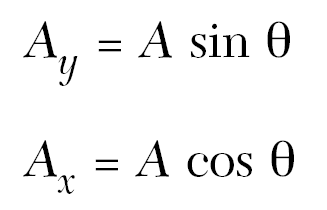
Using Trigonometry

| Sinθ = | Opp | = | Fy |
| Hyp | F |
Cross Multiply
“One size fits all”
Ex 2
Weight of Cart = 80 N

Horizontal Component of Weight Force?
Vertical Component of Weight Force?
Ex 3
A 50. N force at an angle of 80° has its angle changed to 10.°.
Find: How will the vertical and horizontal components change?

Flash [HTML5]
Show me The Physics Website
Rank the Vertical Components from least to greatest.

Ex 4
Parallel & perpendicular components


Find the force holding the cart on the ramp and the force that acts down the ramp
Rank the parallel component from greatest to smallest.

Rank the perpendicular component from greatest to smallest.
Finding a horizontal component
Box on a Ramp
Show Me The Physics
YouTube Channel
Drag and Drop the forces on the center of the box
Check Your Understanding
5 quick questions — pick an answer to see if you’re right.
1. What does it mean to resolve a force?
2. A car is pulled with a 60. N force at 37° above the horizontal. What is the vertical component? (sin 37° ≈ 0.60)
3. A cart is pulled along a level floor by a rope at an angle. Which part of the pull makes the cart move along the floor?
4. A 50. N pull is lowered from 80° to 10° above the horizontal. How do its components change?
5. A box weighing 10. N sits on a 30° ramp. What is the component of its weight parallel to the ramp?
Pulling a Rolling Suitcase
A traveler pulls a rolling suitcase with a force of 50. N along the handle. The handle makes an angle of 37° above the horizontal. The suitcase weighs 200. N. (sin 37° ≈ 0.60, cos 37° ≈ 0.80)
What is the horizontal component of the force on the handle?
▶ Want a challenge? Open 6 more Regents-style questions (harder · mixed formats)
Challenge score: 0 / 6
C1. The suitcase is pulled to the right. Rolling friction and air resistance total 25 N. Choose the direction of the net horizontal force on the suitcase, and determine its magnitude.
●
C2. What is the vertical component of the pull?
C3. Substitute numerical values into a mathematical representation that can be used to determine the normal force the floor exerts on the suitcase. Then calculate the normal force.
C4. A student makes the following claim.
Place a check mark in either the Support or Refute box. Justify your response using a mathematical relationship.
C5. The suitcase rolls at constant velocity. What is the total force opposing its motion (rolling friction plus air resistance)?
C6. A luggage company is deciding whether to make the suitcase handle longer, so travelers pull at a smaller angle above the horizontal. Identify one benefit and one drawback of this design change.