Power
The rate of doing work or expending energy

RIDDLE: Two girls race up two flights of stairs, and it ends in a tie. Why does one racer claim that she was the more powerful racer?
Turning which gear would give you a mechanical advantage?

ETC Clipart — William Dwight Whitney, The Century Dictionary and Cyclopedia (New York: The Century Co., 1889) 4499. Copyright: 2009, Florida Center for Instructional Technology. See license.
Large Gear
C) Power
rate of doing work or expending energy


“… radically improved the power, efficiency, and cost-effectiveness of steam engines.” He developed the concept of horsepower, and the SI unit of power, the watt, was named after him. — Wikipedia
Ex 1
A force of 40 N is exerted on a mass, causing it to move with a constant speed of 5 m/s.
What power is used?
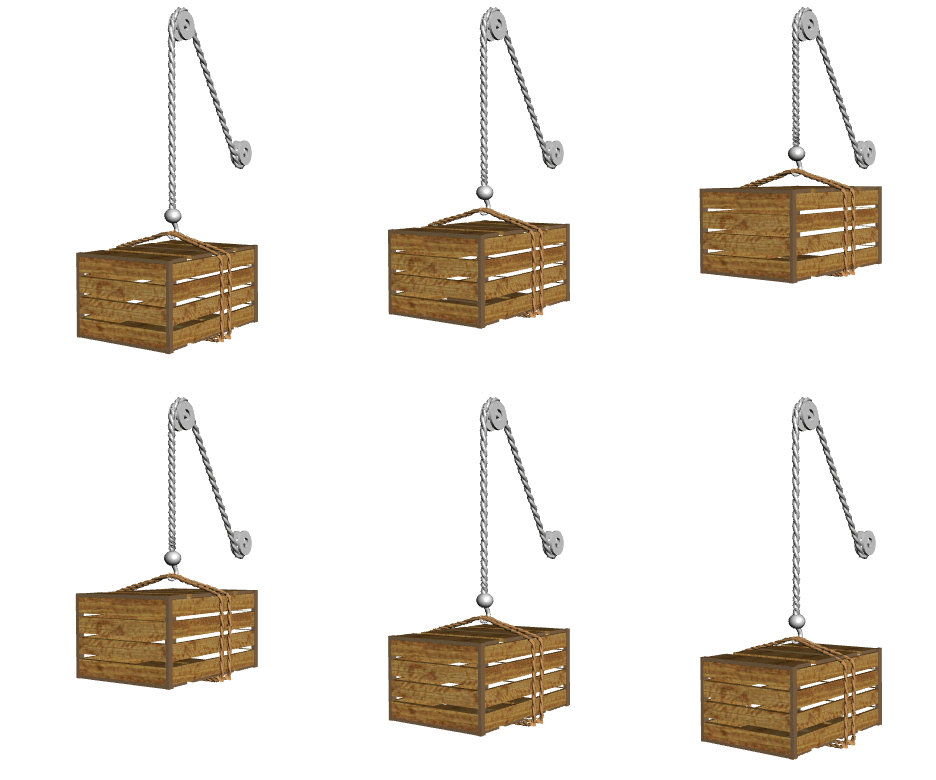
Ex 2
A girl weighing 500. newtons takes 50. seconds to climb a flight of stairs 18 meters high.
Her power output vertically is…

F = 500. N
t = 50. s
d = 18 m
P = ?
Ex 3
A 95-kg student climbs 4.0 m up a rope in 3.0 seconds.
What is the power output of the student?

m = 95 kg
d = 4.0 m
t = 3.0 s
P = ?
Check Your Understanding
5 quick questions — pick an answer to see if you’re right.
1. Power is defined as
2. Which unit is equivalent to a watt?
3. A 40 N force moves a crate at a constant speed of 5 m/s. What power is used?
4. A girl weighing 500. N climbs stairs 18 m high in 50. s. What is her vertical power output?
5. Two girls race up the same flight of stairs and tie. Which girl developed more power?
The Stair-Climb Power Lab
Students measured their power output by running up a flight of stairs with a vertical height of 4.0 m. One 60.-kg student took 5.0 s to reach the top.
What was the student’s average power output?
▶ Want a challenge? Open 6 more Regents-style questions (harder · mixed formats)
Challenge score: 0 / 6
C1. A second time, the same student walks up the stairs in 10. s. How do the work and power compare with the run?
C2. Place a check mark in three boxes to indicate the quantities a student must measure to determine his or her power output when running up the stairs.
C3. A second student with a mass of 75 kg runs up the same 4.0-m flight of stairs in 6.0 s. Substitute numerical values into a mathematical representation that can be used to determine this student’s average power output. Then calculate the power.
C4. A student makes the following claim.
Place a check mark in either the Support or Refute box. Justify your response using a mathematical relationship.
C5. An elevator motor delivers 10,000 W of power while lifting a 1000-kg elevator at constant speed. What is the elevator’s speed?
C6. The class measured times with phone stopwatches and estimated the height by counting steps. Identify one source of uncertainty in the power measurement and describe one change to the procedure that would reduce it.
