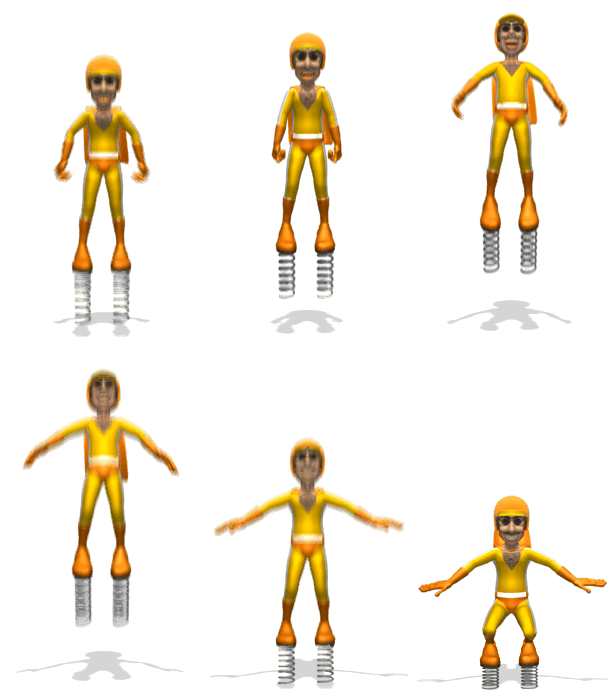
Kinetic Energy
The energy an object possesses due to its motion

Kinetic Energy - the energy an object possesses due to its motion
Why Does It Shrink?
Temperature and Volume for a Gas
Why does the balloon shrink when it enters the liquid nitrogen?
This Happens When You Don't Properly Vent a Storage Tank
"This happens when you don't properly vent a sealed storage tank before emptying it. Hot gas/air in the sealed container is left to cool. The air pressure difference inside is so great that the structure is compromised."

B) Kinetic Energy
the energy an object possesses due to its motion


Newton mistakenly believed that the kinetic energy of a moving body was directly related to its velocity.
Émilie du Châtelet

Translates and creates a commentary on Newton's Principia
Helps to develop Conservation of Energy (KE)
Émilie du Châtelet - She Showed Them The Physics

Relationships
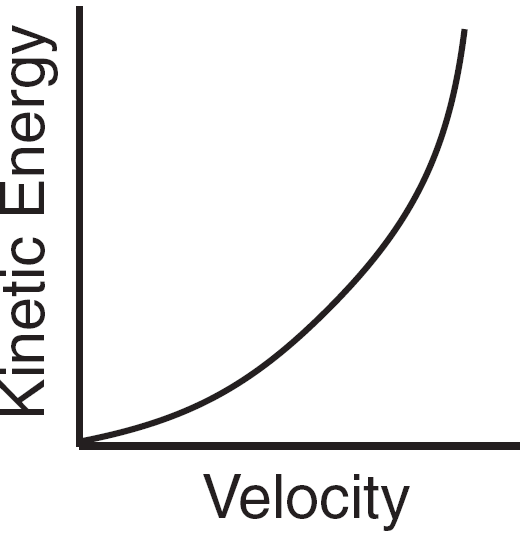
Ex 1
A 60.0-kg runner has 1920 joules of kinetic energy.
Find: her speed (V = ?)
Summary — W, KE, PE
K.E. - equivalent to work needed to get an object to a certain speed or to stop it.
P.E. - Equivalent to work needed to get an object to where it is or into its present condition. (spring)

W = 40 J

Check Your Understanding
5 quick questions — pick an answer to see if you’re right.
1. Kinetic energy is the energy an object has because of its
2. A 60.0 kg runner has 1920 J of kinetic energy. What is her speed?
3. Newton thought kinetic energy was directly proportional to velocity. If an object's speed triples, its KE actually becomes
4. What is the kinetic energy of a 2.0 kg cart moving at 3.0 m/s?
5. A student does 40 J of work lifting a box straight up at constant speed. How much does the box's gravitational PE increase?
Balls Dropped Into Clay
In the 1720s, Willem ’s Gravesande dropped identical brass balls into soft clay and measured how deep they sank. Émilie du Châtelet used results like these to argue that the energy of motion depends on v². Table 1 shows data from a modern version of the experiment.
Table 1: Clay Impact Data
| Impact Speed (m/s) | 1.0 | 2.0 | 3.0 |
|---|---|---|---|
| Depth of Dent (mm) | 2.0 | 8.0 | 18 |
Which conclusion is best supported by the data?
▶ Want a challenge? Open 6 more Regents-style questions (harder · mixed formats)
Challenge score: 0 / 6
C1. A student makes the following claim.
Place a check mark in either the Support or Refute box. Justify your response using a mathematical relationship.
C2. If a ball with twice the mass hits the clay at the same speed, how does its kinetic energy compare?
C3. One of the brass balls has a mass of 0.20 kg. Substitute numerical values into a mathematical representation that can be used to determine the kinetic energy of this ball when it strikes the clay at 3.0 m/s. Then calculate the kinetic energy.
C4. Using the pattern in Table 1, determine the impact speed that would produce a dent 50. mm deep.
C5. A car’s braking distance depends on its kinetic energy. If a car’s speed doubles, about how does its braking distance change (same braking force)?
C6. A student repeats the clay experiment to test whether dent depth depends on speed. Identify two variables that must be kept constant, and explain why each must be controlled.