Conservation of Energy
Total mechanical energy stays constant when no work is done on or by the system
Name the energy changes in this video.
School blocks YouTube? BlobLaunch.mov
Try This at Home!
School blocks YouTube? Onsite
St. Mary's U. Astronomy and Physics Dept.
Video Instruction
D) Law of Conservation of Energy
Unless work is done on or by a system, its total mechanical energy does not change.
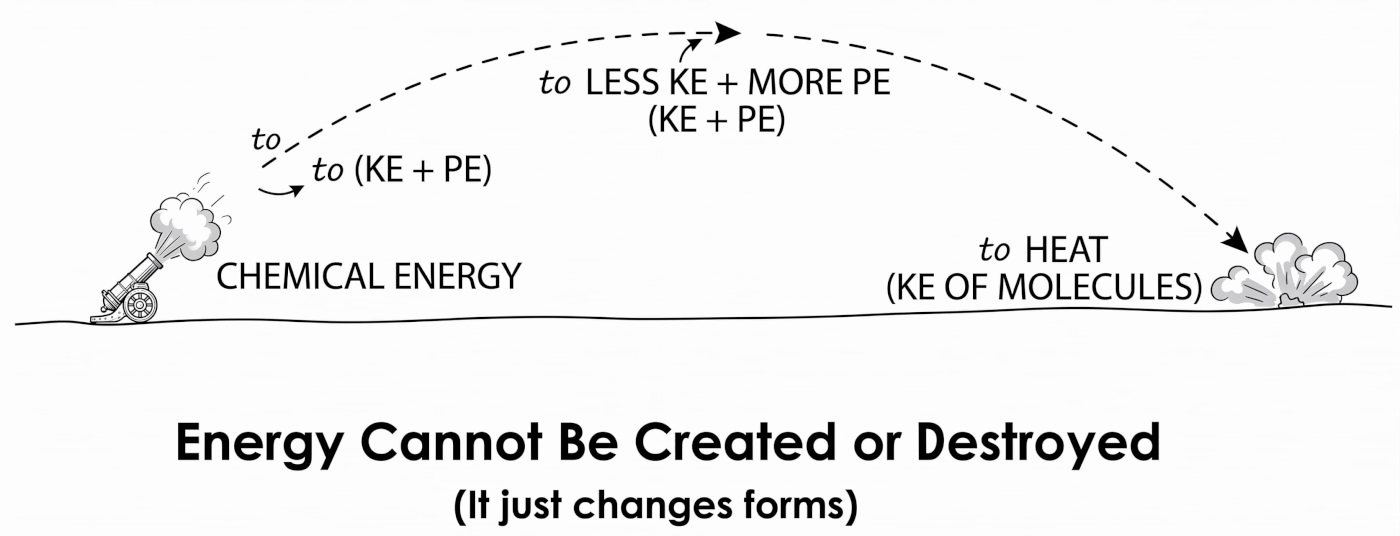
Was energy created in this video?
Girl goes flying after the biggest piggy-back blob jump
School blocks YouTube? BlobLaunch.mov
The massive PE of the men on the platform completely turned into KE at the bottom of their jump.
The boy on the blob has more KE but less PE than the men.
1. Total Mechanical Energy
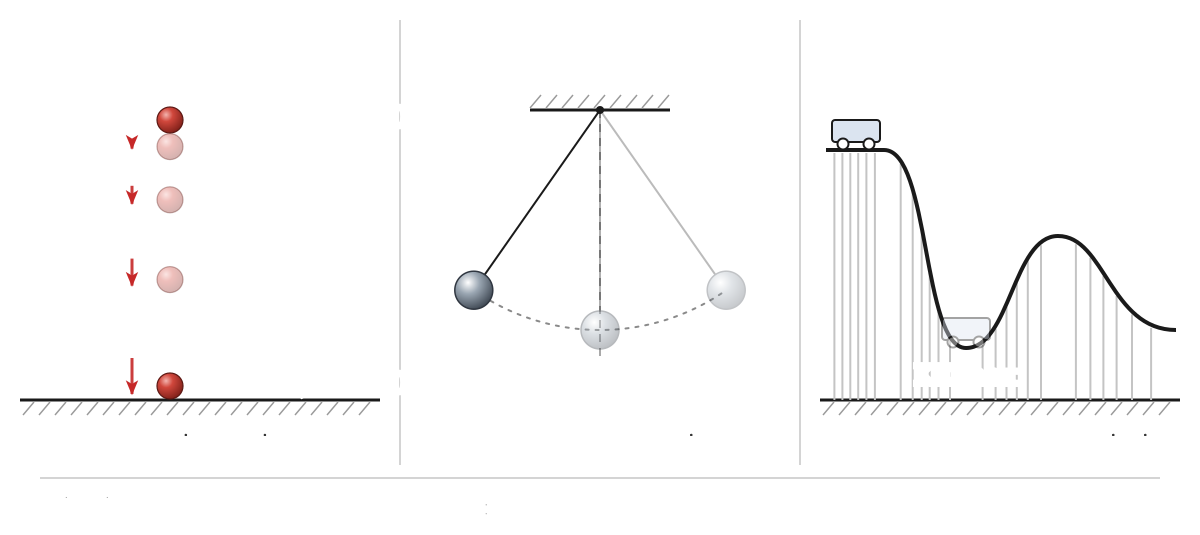
Ex 1) Falling object (no friction)

Answer

Predict how far up the incline each ball will go.
(assume no friction)
Why does each ball rise to the same height from which it began?
PE depends only on height.
Ball stops when all KE turns into PE.
Energy changes in a roller coaster
— Teachers Domain

Ex 2) Roller coaster track

If KE at A = 0 → PE = ?
PE = mgh (use g = 10 m/s2)
PE = 3 kg × (10 m/s2) × 3 m
| PE | KE | |
|---|---|---|
| A | 90 J | 0 |
Point B
m = 3 kg, h = 1 m
| PE | KE | |
|---|---|---|
| B | 30 J | 60 J |
Point C
m = 3 kg, h = 0
| PE | KE | |
|---|---|---|
| C | 0 J (h = 0) | 90 J |
Point D
m = 3 kg, h = 1 m
| PE | KE | |
|---|---|---|
| D | 30 J | 60 J |
Point E
m = 3 kg, h = 0
| PE | KE | |
|---|---|---|
| E | 0 J (h = 0) | 90 J |
Point F
m = 3 kg, h = 1 m
| PE | KE | |
|---|---|---|
| F | 30 J | 60 J |
Point G
m = 3 kg, h = 3 m
| PE | KE | |
|---|---|---|
| G | 90 J | 0 J |
Point H?
Physics of Designing Rollercoasters
At what minimum height should you place the ball so it makes it all the way around the loop?
UC Irvine
School blocks YouTube? LoopTheLoop.mov | LoopTheLoop.mpg
The ball has to be placed at a height above the top of the loop so it has the KE to continue.
Show Me The Bungee Game
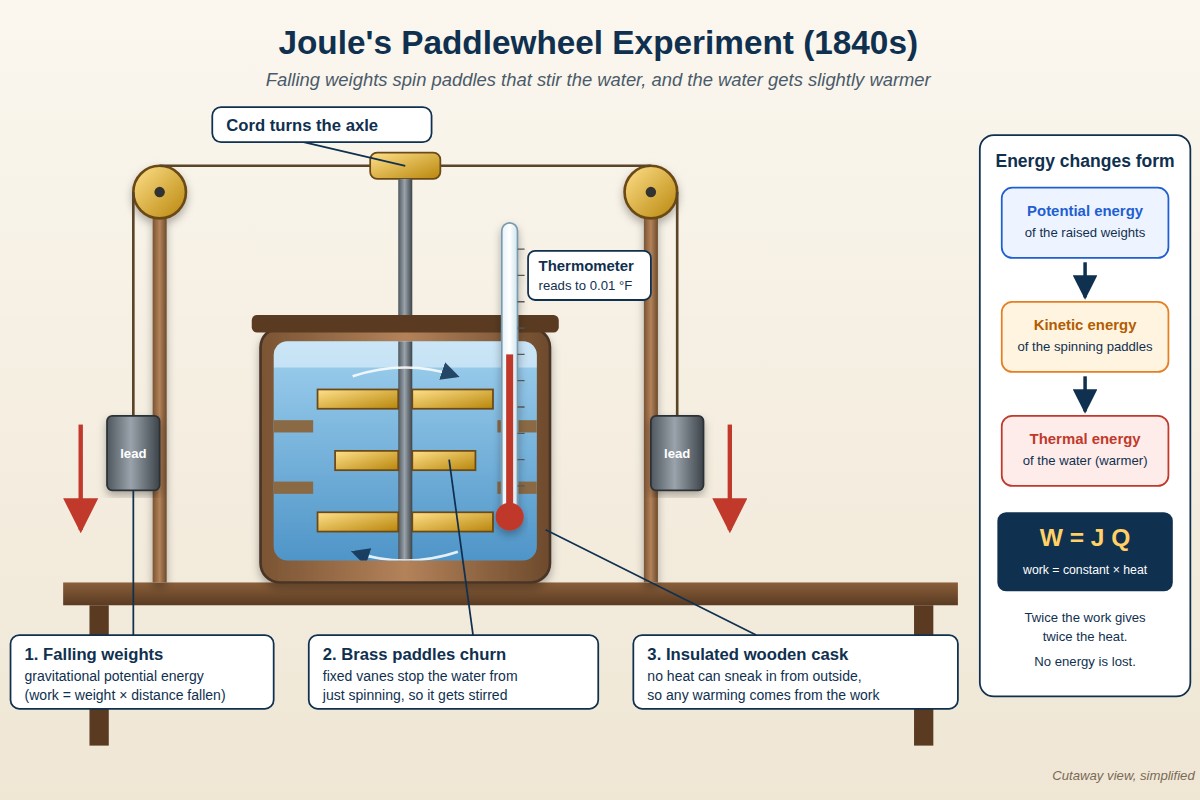

NYSSLS Reading Passage · Energy
The Weight of Heat: A Honeymoon, a Waterfall, and the Law That Changed Physics
Open Reading Passage → Regents Practice Version →Check Your Understanding
5 quick questions — pick an answer to see if you’re right.
1. According to the law of conservation of energy, a system's total mechanical energy stays constant when
2. A 3 kg cart starts from rest 3 m high on a frictionless track. What is its KE when it is 1 m high? (g = 10 m/s²)
3. As an object falls with no air resistance, which statement is true?
4. A ball released from rest rolls down one frictionless ramp and up another. How high does it rise?
5. A frictionless roller coaster starts from rest at the top of a 3 m hill. Can it get over a later hill that is 4 m high?
Roller Coaster Design
Engineers are designing a roller coaster. A 500.-kg car starts from rest at the top of a 40. m hill and rolls down the track. For the first design model, friction and air resistance are neglected.
What is the speed of the car at the bottom of the first hill (height = 0)?
▶ Want a challenge? Open 6 more Regents-style questions (harder · mixed formats)
Challenge score: 0 / 6
C1. Construct an energy bar graph for the car–Earth system when the car is 30. m above the bottom of the first hill on its way down. The zero level for gravitational potential energy is the bottom of the hill, and friction and air resistance are negligible.
Click a box to set each bar’s height; click it again to clear the bar to 0. The ET bar is drawn for you.
C2. The design team proposes a second hill 45 m tall. Which evaluation is correct for the frictionless model?
C3. Substitute numerical values into a mathematical representation that can be used to determine the speed of the car when it is 10. m above the bottom, after it has descended 30. m from the top. Then calculate the speed.
C4. A member of the design team makes the following claim.
Place a check mark in either the Support or Refute box. Justify your response using a mathematical relationship.
C5. When the real coaster is tested, the car’s speed at the bottom is less than 28 m/s. Which explanation is correct?
C6. The designers are considering making the first hill taller than 40. m. Identify one benefit and one drawback of this design change.