Elastic PE and the Spring Constant
Hooke's Law, the Spring Constant k, and Elastic Potential Energy

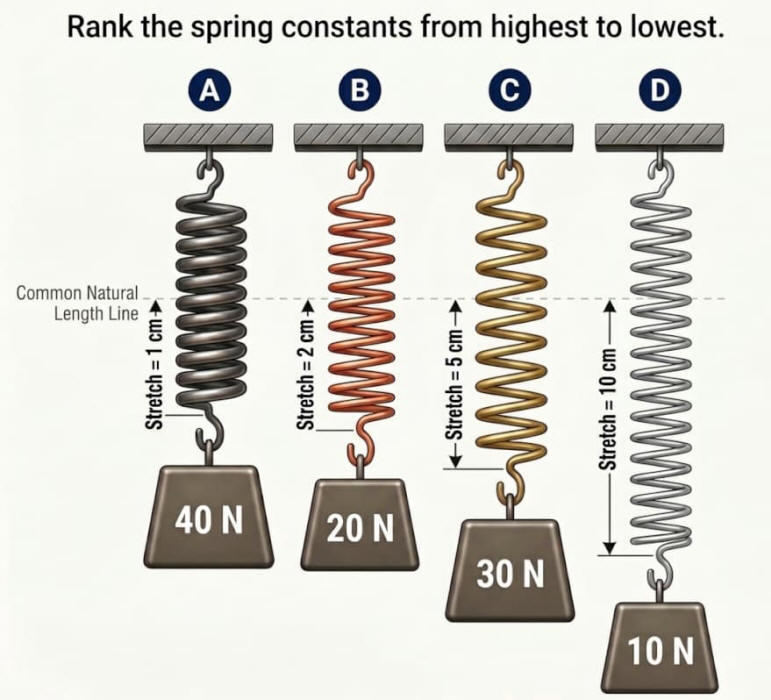
Spring Constant (k) - a measure of a spring's stiffness; how much force is needed to stretch or compress it a given distance
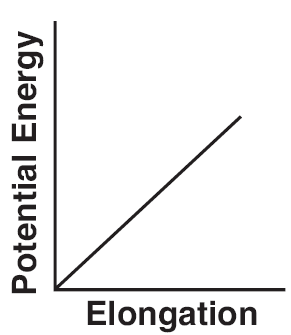
What is the shape of a plot that shows a direct square relationship?
Review - Spring Constant
PE and k
e) PEs in terms of k — Ideal Spring
1. PEs = Fx
Average Force: F = F/2
2. PE = (F/2)x
substitute F = kx (on reference)
3. PEs = (1/2)(kx)x
Ex 1
A force of 12. N stretches a spring and makes it .15 m longer.
Find: a) the spring constant (k) of this spring.
Ex 1 (cont.)
b) What is the PE of this spring?

Ex 2
If 15. joules of energy are stored in the stretched spring below, what is the value of the spring constant?
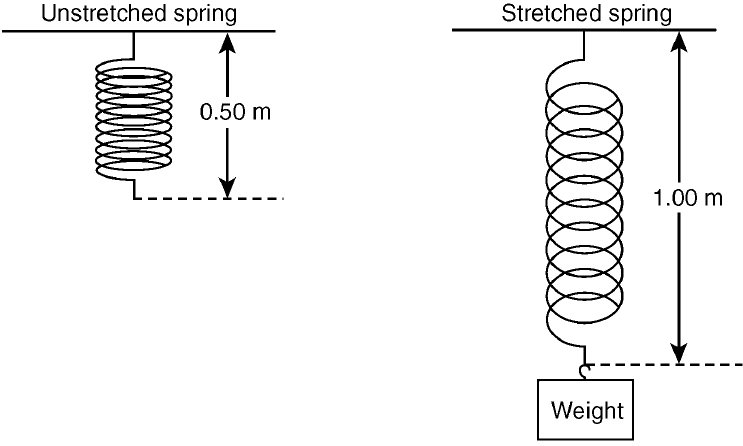
What's Wrong With This Picture?
PEs = (1/2)kx2 (x = elongation)
Try This at Home!
Egg trick — learn how now
Check Your Understanding
5 quick questions — pick an answer to see if you’re right.
1. A force of 12 N stretches a spring 0.15 m. What is the spring constant?
2. A spring with k = 80. N/m is stretched 0.15 m. How much elastic PE does it store?
3. A spring stretched 0.50 m stores 15 J of energy. What is its spring constant?
4. If the stretch of an ideal spring is doubled, its elastic potential energy becomes
5. What is the shape of a graph of elastic PE (y-axis) versus stretch x (x-axis) for an ideal spring?