Force Questions
Practice Problems
Do Now
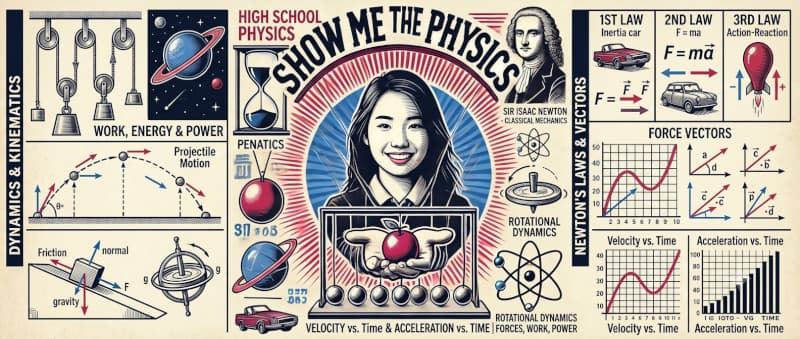

What would happen if this bottle were dropped?
Newton's Masterpiece!
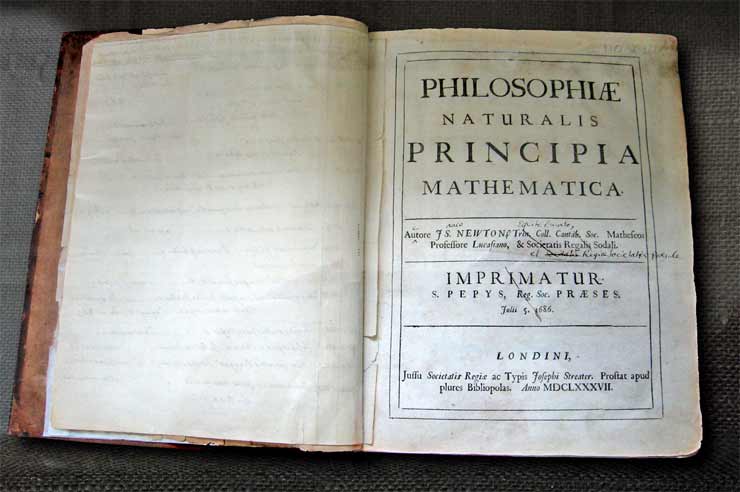
Sir Isaac Newton's own first edition copy of his Philosophiae Naturalis Principia Mathematica with his handwritten corrections for the second edition.
The first edition was published under the imprint of Samuel Pepys who was president of the Royal Society. By the time of the second edition, Newton himself had become president of the Royal Society, as noted in his corrections.
The book can be seen in the Wren Library of Trinity College, Cambridge.
Photograph © Andrew Dunn, 5 November 2004. www.andrewdunnphoto.com/
4. Standard Equation
Newton — force needed to give a 1 kg of mass an acceleration of 1 m/s2
Derived unit — A unit that comes from the combination of other units
Fundamental unit (opposite) — m, s, Kg
Force Questions
What is the net force necessary to give a 3.0 kg mass, initially at rest, an acceleration of 5.0 m/s2?

A net force of 30. nt accelerates an object by 15. m/s2. Find the object's mass.
An unbalanced force of 100. nt acts on a 50. kg mass for 5.0 seconds. Find the acceleration of the mass.
A 10. kg cart moving with a velocity of 2.0 m/s is brought to a stop in 2.0 sec. Find the magnitude of the average force used to stop the cart.
The object below has a mass of 5 kg. Find its acceleration.

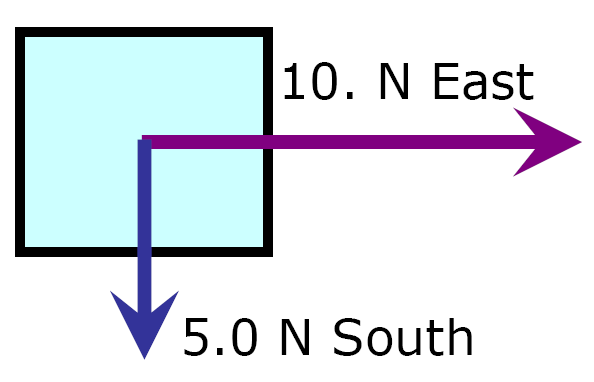
The block above has an acceleration of 22. m/s2. What is the mass of the block?

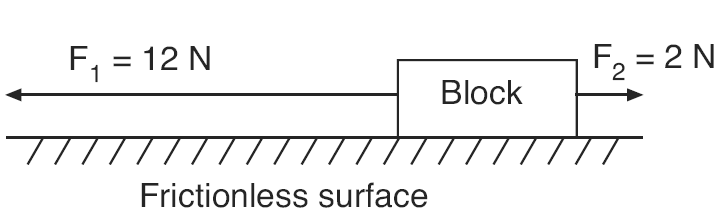
If the magnitude of the block's acceleration is 2.0 m/s2, what is the mass of the block?
Balloon in the Car

What will the balloon do when the cart is pushed to the left?
(Click on image)
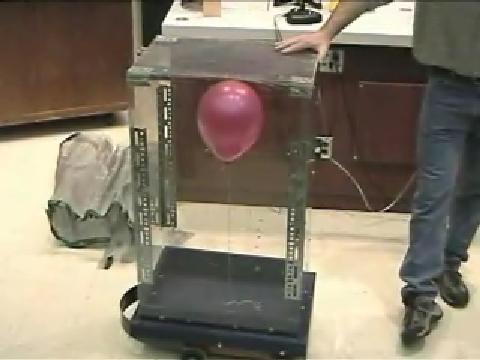
The air in the container tends to remain at rest. When the cart is pushed to the left, air pressure builds up on the right side of the container.
Try this at home!
Ranking Task

From least to greatest.
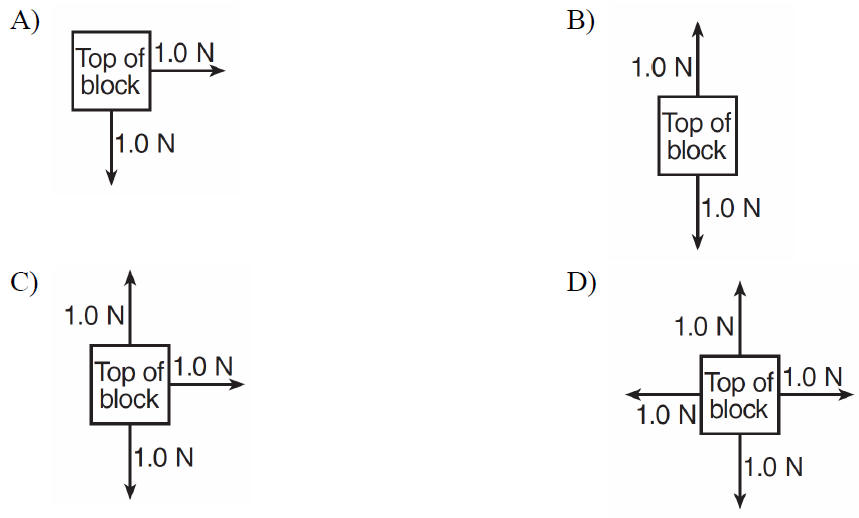
From least to greatest.


Check Your Understanding
5 quick questions — pick an answer to see if you’re right.
1. What is one newton?
2. What net force is needed to give a 3.0 kg mass, initially at rest, an acceleration of 5.0 m/s²?
3. A 10. kg cart moving at 2.0 m/s is brought to a stop in 2.0 s. What is the magnitude of the average stopping force?
4. The newton is a derived unit. It is equivalent to…
5. A 5 kg object has a 60 N force pushing it east and a 20 N force pushing it west. What is its acceleration?