Mass & Acceleration
2nd Law of Motion
Do Now
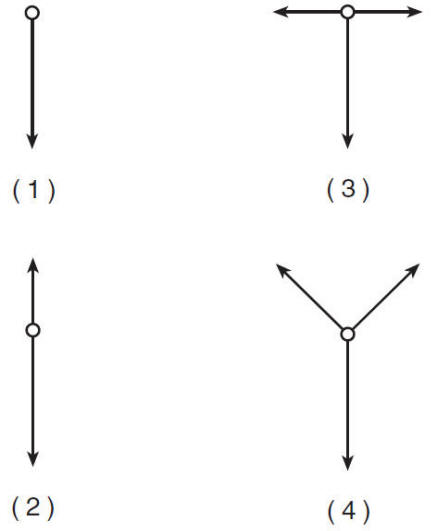
Ranking Task

Rank the Net Force on each object
from greatest to least.
June 2015
Simulating Zero g
What's a Vomit Comet? — NASA
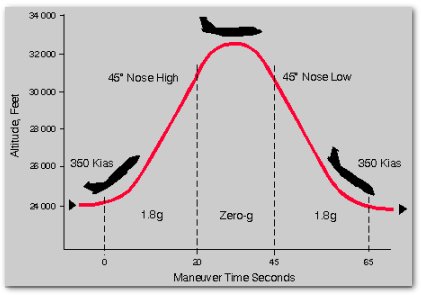
NASA and B.Y.U.
School blocks YouTube? Download files below.
The Formula
Mass & Acceleration Are Inversely Proportional
The acceleration a given force will produce on an object is inversely proportional to the mass of the object
[ Flash ]
Object A
F = 10 nt
m = 2 kg
a = 5 m/s2
Object B
F = 10 nt
m = 4 kg
a = ?
Object A
a = 5 m/s2
Object B
a = 2.5 m/s2
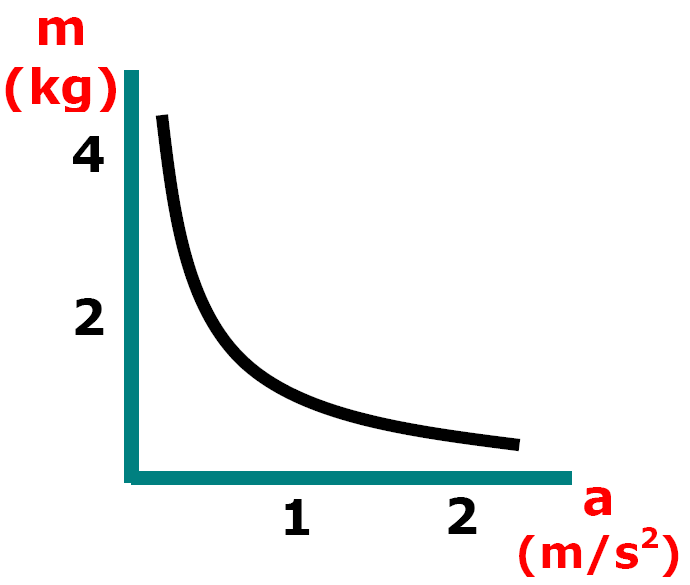
| a | m |
|---|---|
| ×2 | ×1/2 |
| ×1/2 | ×2 |
| ×1/3 | ×3 |
| ×3 | ×1/3 |
| ×1/4 | ×4 |
| ×3/2 | ×2/3 |

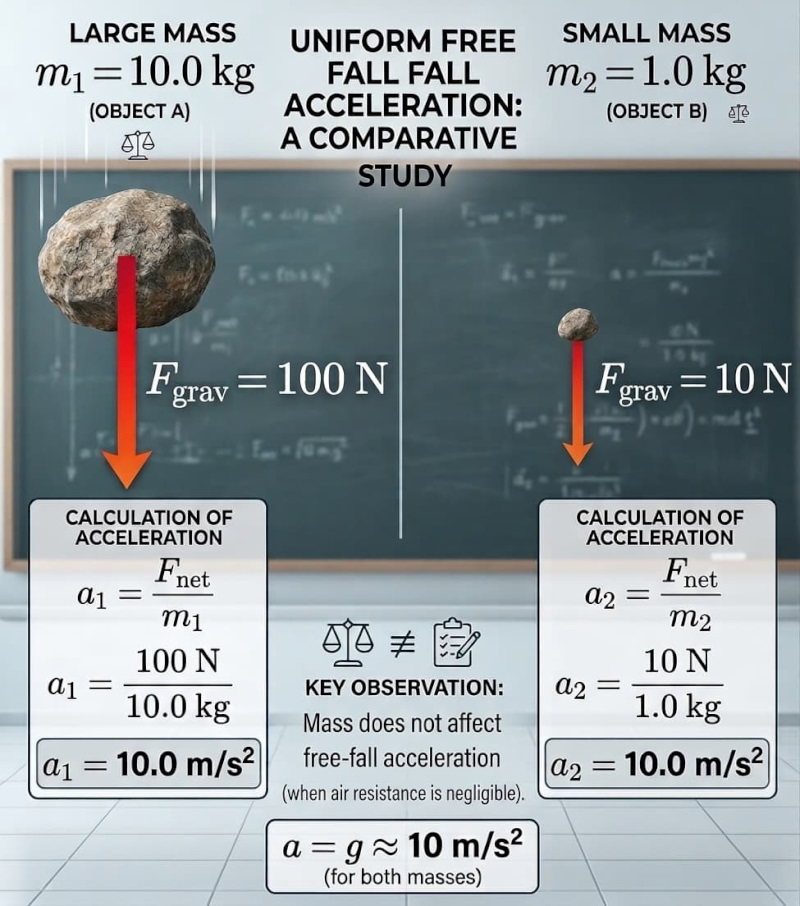
“Why do all bodies accelerate at a rate of 10 m/s2 (9.8 m/s2)”
(neglecting friction)
Inertial Mass
Solve for m — finding mass using motion and force
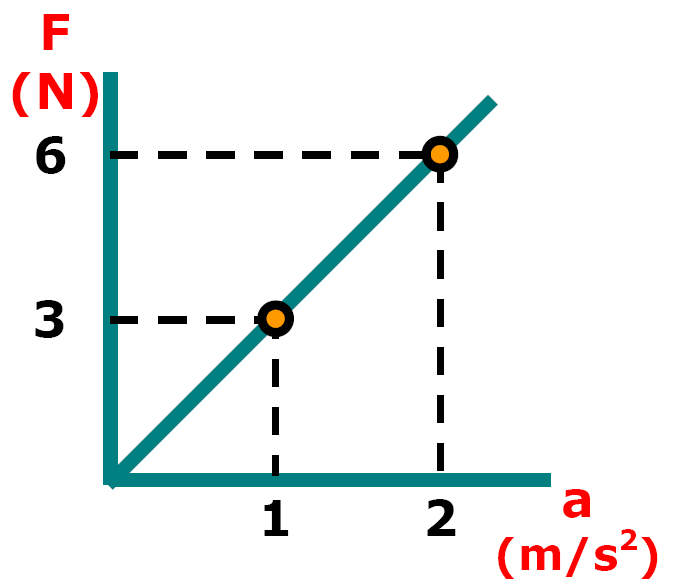
What is the mass of the body
that produced the plot above?
Enrichment

Check Your Understanding
5 quick questions — pick an answer to see if you’re right.
1. The same net force acts on two carts. Cart B has twice the mass of cart A. Compared with cart A, cart B's acceleration is…
2. A 10 N net force acts on a 4.0 kg object. What is its acceleration?
3. A net force of 6 N gives an object an acceleration of 2 m/s². What is its mass?
4. For a constant net force, how are mass and acceleration related?
5. Without air resistance, a heavy rock and a light rock fall with the same acceleration. Why?