Specific Heat
Q = mcΔT and why water heats up so slowly
Do Now: On a sunny day at the beach, the sand burns your feet but the ocean water feels cool. They both got the same sunlight. Why?
Water has a much higher specific heat than sand. It takes far more energy to raise water’s temperature, so the same sunlight warms the sand much more.
A. Specific Heat
| Substance | Specific Heat, c (J/g•°C) |
|---|---|
| Water (liquid) | 4.18 |
| Aluminum | 0.90 |
| Iron | 0.45 |
| Copper | 0.39 |
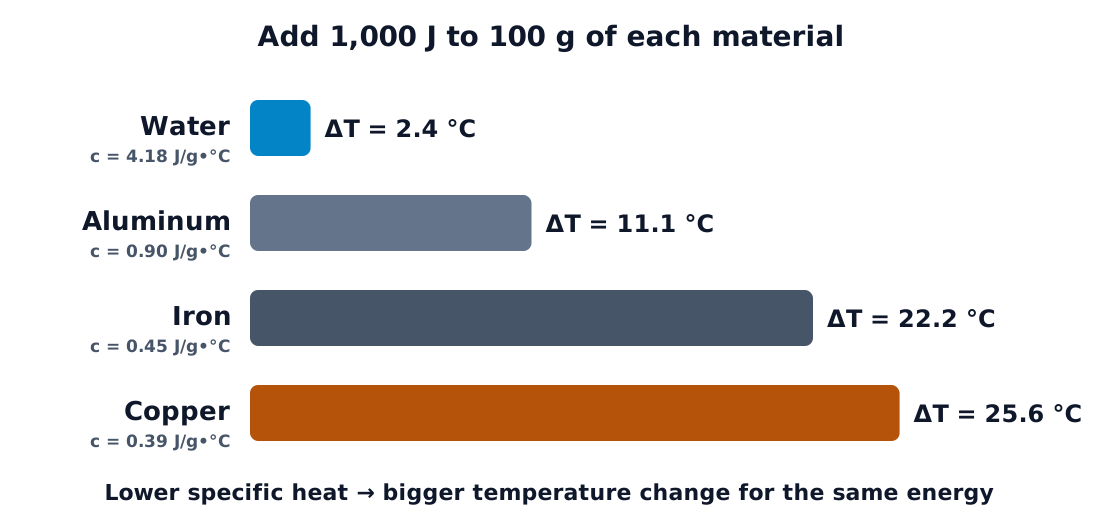
High specific heat → temperature changes slowly (water). Low specific heat → temperature changes quickly (metals).
B. The Heat Equation
Heat Equation
Q = heat added or removed (J)
m = mass (g)
c = specific heat (J/g•°C)
ΔT = change in temperature = Tfinal − Tinitial (°C)
If Q comes out negative, the object lost energy (it cooled down).
C. Worked Examples
How much heat is needed to warm 250 g of water from 20. °C to 80. °C?
Given: m = 250 g, c = 4.18 J/g•°C, ΔT = 80. − 20. = 60. °C
Q = mcΔT = (250 g)(4.18 J/g•°C)(60. °C)
Q = 62,700 J (about 63 kJ)
A 500-g iron pan absorbs 9,000 J of heat. How much does its temperature rise?
Given: m = 500 g, c = 0.45 J/g•°C, Q = 9,000 J
ΔT = Qmc = 9,000 J(500 g)(0.45 J/g•°C)
ΔT = 40. °C
A 200-g sample of an unknown metal absorbs 1,800 J and its temperature rises 10. °C. What is the metal?
Given: m = 200 g, Q = 1,800 J, ΔT = 10. °C
c = QmΔT = 1,800 J(200 g)(10. °C) = 0.90 J/g•°C
From the table, the metal is aluminum.
D. Practice
How much heat does 100. g of water give off as it cools from 90. °C to 30. °C?
Q = (100.)(4.18)(−60.) = −25,080 J — about 25 kJ released.
A 50.-g piece of copper gains 975 J. How much does its temperature rise?
ΔT = 975 / (50. × 0.39) = 50. °C
How much energy does it take to heat 2.0 kg (2,000 g) of water from 15 °C to 100. °C for pasta?
Q = (2,000)(4.18)(85) = 710,600 J ≈ 711 kJ
A 300.-g metal block absorbs 2,700 J while warming by 20. °C. Identify the metal.
c = 2,700 / (300. × 20.) = 0.45 J/g•°C → iron
E. Specific Heat in the Real World
Coastal climates: oceans warm and cool slowly, so cities near the coast have milder temperatures.
Car radiators: water carries away lots of engine heat with only a small temperature rise.
Cookware: metal pots have low specific heat, so they heat up quickly.
Your body: mostly water, which helps keep your temperature steady.
Check Your Understanding
5 quick questions — pick an answer to see if you’re right.
1. The same amount of heat is added to 100 g of water and 100 g of iron. Which has the larger temperature increase?
2. How much heat raises 10. g of water by 5.0 °C?
3. Why does the ocean stay cooler than the sand on a sunny day?
4. A 100.-g metal absorbs 390 J and warms by 10. °C. Its specific heat is
5. If Q is negative in Q = mcΔT, the object