Mixing Problems
Heat lost = heat gained, and finding the final temperature

Do Now: You mix 1 cup of 80 °C water with 1 cup of 20 °C water. What is the final temperature? What if it were 1 cup of hot water and 3 cups of cold?
Equal amounts: 50 °C, exactly halfway. 1 hot + 3 cold: 35 °C — the final temperature ends up closer to the larger amount of water.
A. Energy Is Conserved
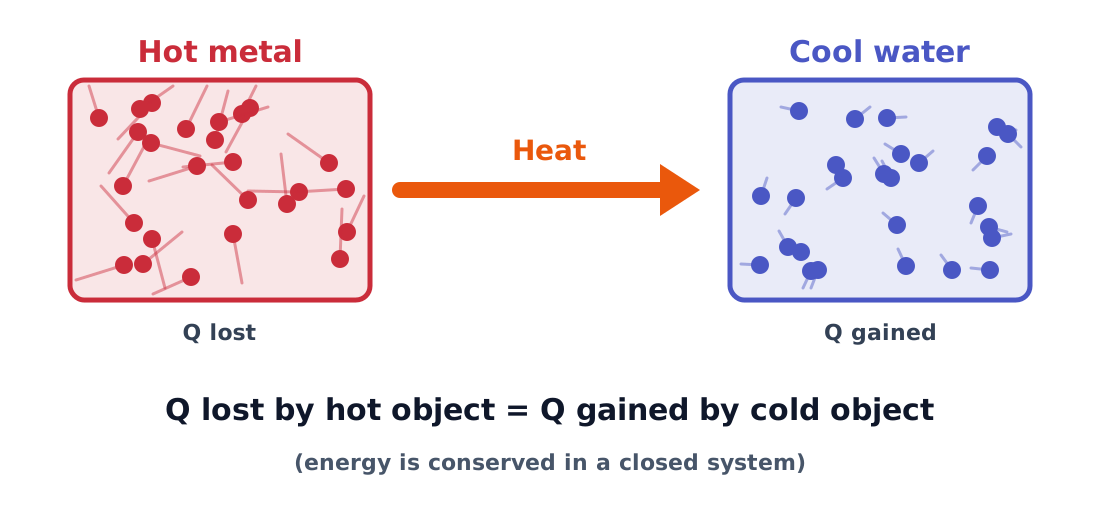
Write each side so it comes out positive
Solving for the final temperature gives a weighted average:
B. Worked Examples
100. g of water at 90. °C is mixed with 300. g of water at 10. °C. Find the final temperature.
Both are water, so c is the same on both sides and cancels.
(100.)(90. − Tf) = (300.)(Tf − 10.)
9,000 − 100Tf = 300Tf − 3,000
12,000 = 400Tf → Tf = 30. °C
A 300.-g aluminum block at 95 °C is dropped into 200. g of water at 15 °C. Find the final temperature and the heat transferred.
Aluminum: mc = (300.)(0.90) = 270 J/°C
Water: mc = (200.)(4.18) = 836 J/°C
Tf = (270)(95) + (836)(15)270 + 836 = 38,1901,106 = 34.5 °C
Q = (836)(34.5 − 15) ≈ 16,300 J gained by the water (and lost by the aluminum)
Notice: the aluminum dropped 60.5 °C, but the water rose only 19.5 °C — water’s high specific heat at work.
Lab: A 150.-g metal sample is heated to 100. °C and placed in 200. g of water at 20.0 °C. The final temperature is 26.0 °C. Identify the metal.
Water gained: Q = (200.)(4.18)(26.0 − 20.0) = 5,016 J
Metal lost the same 5,016 J: c = 5,016 J(150. g)(100. − 26.0 °C) = 0.45 J/g•°C
The metal is iron.
Explore: Thermal Tales
Drop a hot block into water. Predict the final temperature with the equation first, then check it. Try the Challenge Module!
C. Practice
50. g of water at 100. °C is mixed with 150. g of water at 20. °C. Find the final temperature.
Tf = (50.×100. + 150.×20.) / 200. = 40. °C
A 400.-g copper block at 100. °C is placed in 500. g of water at 20. °C. Find the final temperature.
mc: copper 156 J/°C, water 2,090 J/°C → Tf = (15,600 + 41,800) / 2,246 = 25.6 °C
You have 250. g of water at 60. °C. How much 10. °C water must you add to end at 30. °C?
(250.)(60. − 30.) = m(30. − 10.) → m = 375 g
Lab: A 100.-g metal at 90.0 °C is placed in 100. g of water at 20.0 °C. The final temperature is 32.4 °C. Find c and identify the metal.
Water gained (100.)(4.18)(12.4) = 5,183 J. c = 5,183 / (100. × 57.6) = 0.90 J/g•°C → aluminum
D. Design the Investigation
Plan an experiment to show that the energy lost by a hot metal equals the energy gained by cool water. What equipment do you need? What do you measure? How do you keep the system closed?
Equipment: balance, thermometers, an insulated cup (calorimeter) with a lid, hot water bath, metal sample.
Measure: masses of the metal and water, starting temperatures of both, and the final temperature once it stops changing.
Closed system: use an insulated cup with a lid and transfer the metal quickly so little energy escapes to the room.
Analyze: calculate Q for the water and for the metal and compare. Small differences come from energy lost to the cup and the air.
Check Your Understanding
5 quick questions — pick an answer to see if you’re right.
1. Equal masses of water at 70. °C and 30. °C are mixed. The final temperature is
2. A hot iron block is placed in cool water in an insulated cup. Compared with the heat gained by the water, the heat lost by the iron is
3. Hot copper is dropped into an equal mass of cool water. Which has the larger temperature change?
4. 200. g of water at 80. °C is mixed with 600. g of water at 20. °C. The final temperature is
5. In a mixing lab, the water gained slightly less energy than the metal lost. The most likely reason is