Heat Review
Everything in one place, plus mixed practice

The Big Ideas
Temperature = average kinetic energy of particles. K = °C + 273
Thermal energy = total energy of all the particles (depends on mass too).
Heat (Q) = energy transferred from hot to cold, in joules.
Thermal equilibrium = same temperature, no net heat flow.
Second law: heat flows on its own only from hot to cold; energy spreads out.
Closed system: Qlost = Qgained
| Substance | Specific Heat, c (J/g•°C) |
|---|---|
| Water (liquid) | 4.18 |
| Aluminum | 0.90 |
| Iron | 0.45 |
| Copper | 0.39 |
Explore
Pick the materials, masses, and starting temperatures, then press “Touch them!”
Mixed Practice
Convert −23 °C to kelvins.
−23 + 273 = 250 K
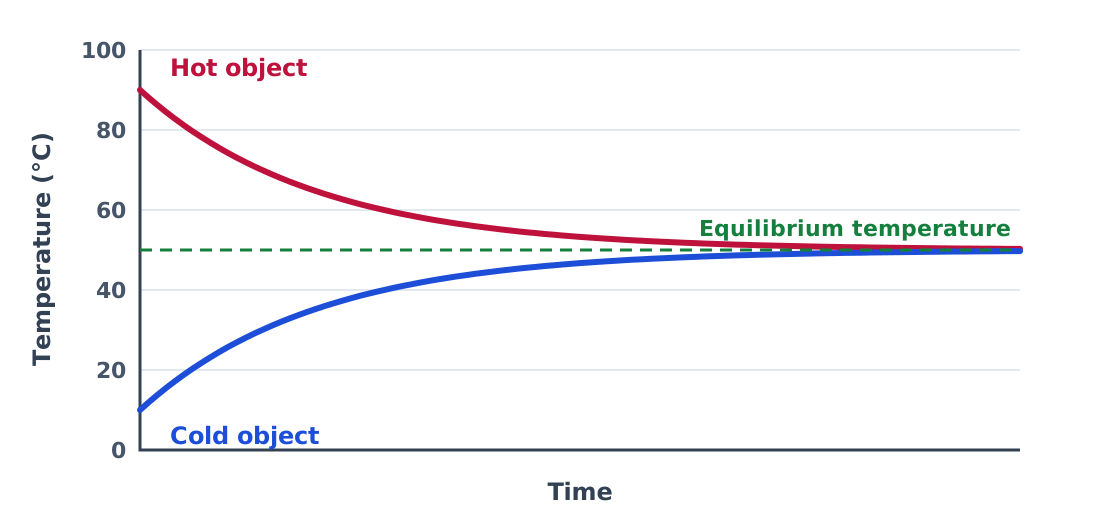
Read the graph: which object started hotter, what is the equilibrium temperature, and which object gained energy?
The hot object (red) started at 90 °C. Equilibrium is 50 °C. The cold object (blue) gained energy.
How much heat is needed to raise 400. g of aluminum from 25 °C to 75 °C?
Q = (400.)(0.90)(50.) = 18,000 J
A 200.-g iron bolt at 120. °C is dropped into 150. g of water at 20. °C. Find the final temperature.
mc: iron 90. J/°C, water 627 J/°C → Tf = (10,800 + 12,540) / 717 = 32.6 °C
Explain, using particles, why a cold spoon placed in hot cocoa warms up.
Fast-moving particles in the cocoa collide with the slower particles of the spoon and transfer kinetic energy. The spoon’s particles speed up (its temperature rises) while the cocoa’s slow down, until both reach the same temperature.
A student says, “The ice cube gave its cold to the drink.” Correct the statement.
Cold does not transfer. Heat (energy) flowed from the warmer drink into the ice, so the drink lost energy and cooled down.
Check Your Understanding
6 quick questions — pick an answer to see if you’re right.
1. Which quantity is measured in joules?
2. Heat will flow between two objects in contact only if they have different
3. How much heat raises 20. g of water by 10. °C?
4. Equal masses of aluminum and water absorb the same heat. Which warms more?
5. A hot block cools from 90 °C as it warms 20 °C water. The final temperature must be
6. Which best describes the second law of thermodynamics?