The Mirror & Lens Equation
Calculating where an image forms and how big it is
Do Now: Ray diagrams tell you roughly where an image is. How could you find its exact location and size?
Use the mirror & lens equation. One equation works for all curved mirrors and thin lenses.
A. The Equations
Mirror & Lens Equation
Magnification
f = focal length
M = magnification (how many times bigger)
do = object distance (object to mirror/lens)
ho = object height (size)
di = image distance (image to mirror/lens)
hi = image height (size)
Use the same units for every distance (all cm or all m). M has no units.
B. Sign Rules
| Quantity | Positive (+) | Negative (−) |
|---|---|---|
| f | Concave mirror Converging lens | Convex mirror Diverging lens |
| di | Real image | Virtual image |
| M and hi | Upright image | Inverted image |
If the size of M is greater than 1, the image is larger. Less than 1 means smaller. Exactly 1 means same size.
C. Worked Examples
A 4.0-cm-tall object is 30. cm in front of a concave mirror with a focal length of 10. cm. Find the image distance, magnification, and image height.
Given: f = +10. cm, do = 30. cm, ho = 4.0 cm
Find: di, M, hi
1di = 1f − 1do = 110. − 130. = 230.
di = +15 cm (positive → real image, in front of the mirror)
M = −1530. = −0.50 (negative → inverted, half size)
hi = M × ho = (−0.50)(4.0 cm) = −2.0 cm
Check: the object is beyond C (20 cm), so the image should be real, inverted, smaller, between C and F. ✓
A magnifying glass has a focal length of 12 cm. A stamp is held 8.0 cm from the lens. Where is the image, and how many times larger is it?
Given: f = +12 cm (converging), do = 8.0 cm
Find: di, M
1di = 112 − 18.0 = −124
di = −24 cm (negative → virtual, on the same side as the stamp)
M = −−248.0 = +3.0 (upright, 3 times larger)
Check: the stamp is inside F, so the image should be virtual, upright, and larger. ✓
An object is 30. cm from a diverging lens with a focal length of magnitude 15 cm. Locate and describe the image.
Given: f = −15 cm (diverging), do = 30. cm
1di = 1−15 − 130. = −330.
di = −10. cm (virtual)
M = −−10.30. = +0.33 (upright, one-third the size)
Check: a diverging lens always gives a virtual, upright, smaller image. ✓
A candle 40. cm from a converging lens makes a sharp image on a screen 40. cm on the other side of the lens. What is the focal length?
Given: do = 40. cm, di = +40. cm (real — it is on a screen)
1f = 140. + 140. = 240.
f = 20. cm
Check: do = di = 2f, so the candle is at 2F and the image is the same size. ✓
Check It With the Simulation
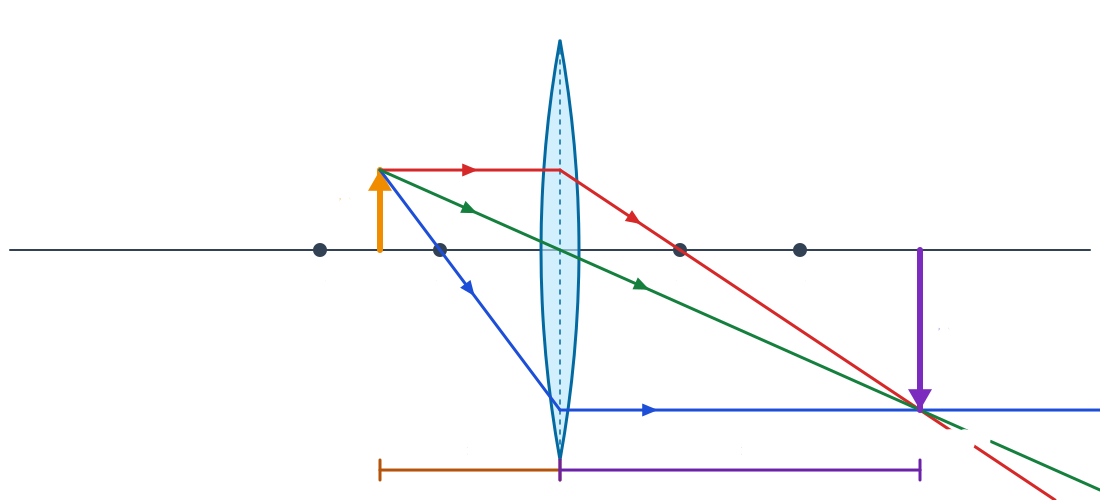
This converging lens has f = 12.0 cm and the object at 18.0 cm. Use the equation to predict di and M, then compare with the numbers under the diagram.
Drag the orange object. Turn rays on and off with the check boxes.
1di = 112 − 118 = 136 → di = 36 cm, M = −3618 = −2.0 (real, inverted, twice as large)
D. Practice
An object is 60. cm from a concave mirror with f = 20. cm. Find di and M.
di = +30. cm (real), M = −0.50 (inverted, half size)
An object is 20. cm from a convex mirror with a focal length of magnitude 20. cm. Find di and M.
f = −20. cm → di = −10. cm (virtual, behind the mirror), M = +0.50 (upright, half size)
A 3.0-cm-tall object is 7.5 cm from a converging lens with f = 5.0 cm. Find di and hi.
di = +15 cm (real), M = −2.0, hi = −6.0 cm (inverted, 6.0 cm tall)
Your face is 10. cm from a makeup mirror (concave, f = 15 cm). Where is the image, and how much larger is it?
di = −30. cm (virtual, behind the mirror), M = +3.0 (upright, 3 times larger)
A candle 30. cm from a lens makes a sharp image on a screen 60. cm behind the lens. Find the focal length and the magnification.
f = 20. cm (converging), M = −2.0 (inverted, twice as large)
A camera lens has f = 50. mm. How far behind the lens must the sensor be to focus on a person 2.0 m (2000 mm) away?
di = 51 mm — just beyond F, because the person is very far away compared to f.
Check Your Understanding
5 quick questions — pick an answer to see if you’re right.
1. An object is 15 cm from a concave mirror with f = 10 cm. The image distance is
2. An object 20. cm from a lens forms an image 60. cm from the lens. The size of the magnification is
3. A calculation gives a negative image distance. The image is
4. An object is 20. cm from a converging lens with f = 10. cm. The image is
5. An object is 10. cm from a diverging lens with f = −10. cm. The image distance is