Converging Lenses
Cameras, projectors, and magnifying glasses
Do Now: A magnifying glass can make a bug look huge, or focus sunlight into a tiny bright dot. How can one lens do both?
It depends on where the object is compared to the focal point. Sunlight arrives as parallel rays and meets at F. A bug inside F gives a larger, upright, virtual image.
A. The Three Principal Rays
A lens has a focal point on each side. Light enters from the left and leaves on the right.
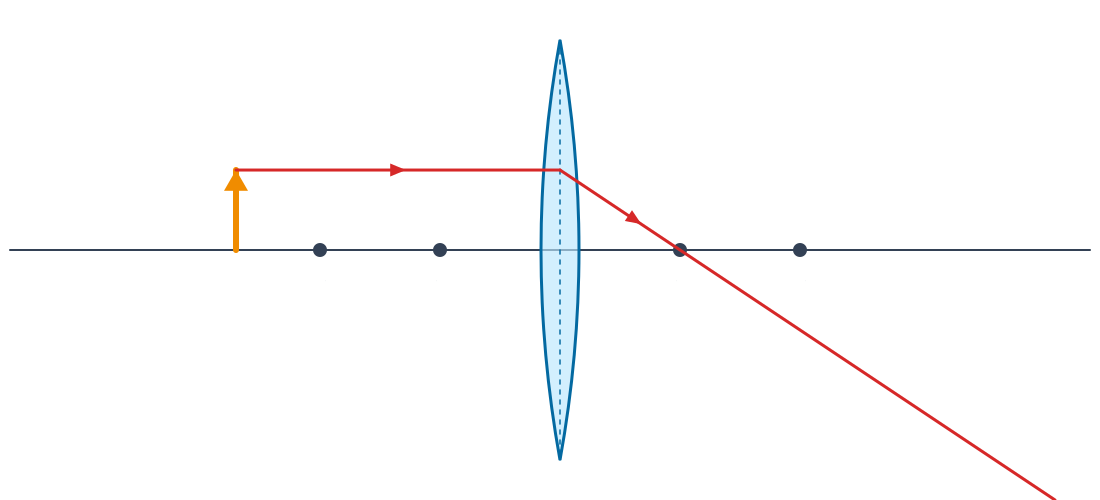
Ray 1 — Parallel Ray
Travels parallel to the principal axis, then refracts through F on the far side.
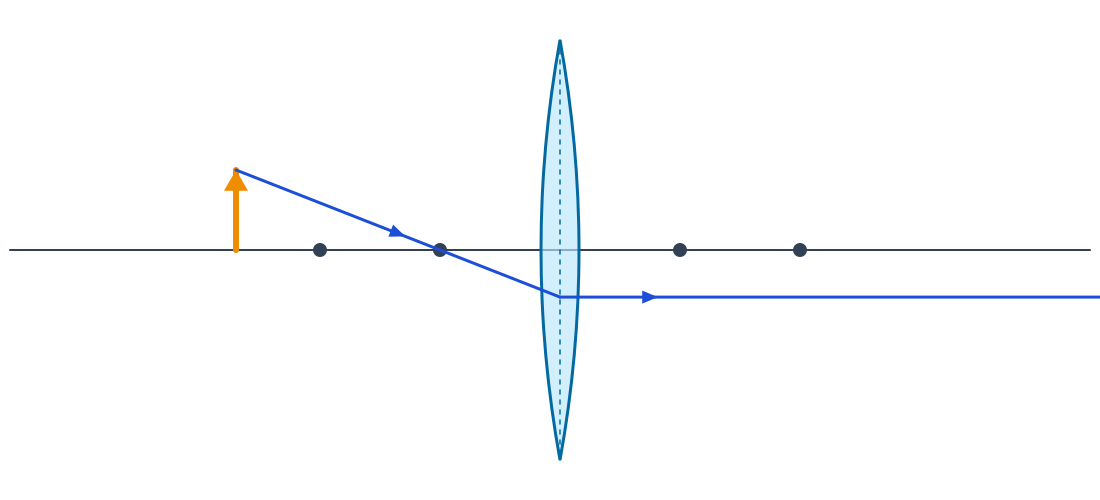
Ray 2 — Focal Ray
Travels through F on the near side, then leaves the lens parallel.
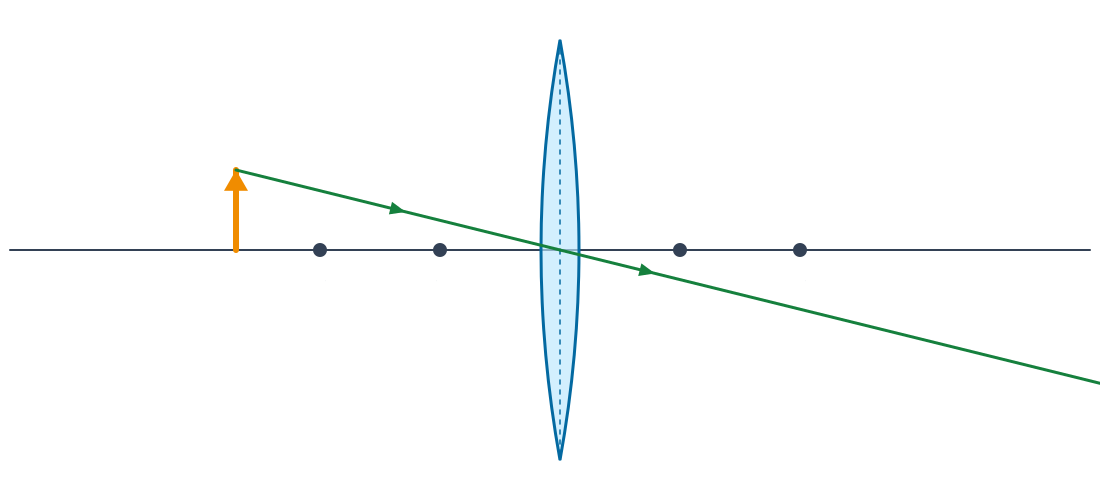
Ray 3 — Center Ray
Goes through the center of the lens without bending.
B. Five Object Positions
The pattern matches the concave mirror, with 2F in place of C — but real images form on the other side of the lens.
Case 1: Object beyond 2F
Click Next to draw the ray diagram step by step.
Describe the image using L-O-S-T.
L: Between F and 2F (other side) O: Inverted S: Smaller T: Real
Case 2: Object at 2F
Click Next to draw the ray diagram step by step.
Describe the image using L-O-S-T.
L: At 2F (other side) O: Inverted S: Same size T: Real
Case 3: Object between 2F and F
Click Next to draw the ray diagram step by step.
Describe the image using L-O-S-T.
L: Beyond 2F (other side) O: Inverted S: Larger T: Real
Case 4: Object at F
Click Next to draw the ray diagram step by step.
Describe the image using L-O-S-T.
The refracted rays come out parallel and never meet, so no image forms.
Case 5: Object between F and the lens
Click Next to draw the ray diagram step by step.
Describe the image using L-O-S-T.
L: Same side as the object O: Upright S: Larger T: Virtual
Summary: Converging Lens
| Object Location | Image Location | Orientation | Size | Type |
|---|---|---|---|---|
| Beyond 2F | Between F and 2F (other side) | Inverted | Smaller | Real |
| At 2F | At 2F (other side) | Inverted | Same size | Real |
| Between 2F and F | Beyond 2F (other side) | Inverted | Larger | Real |
| At F | No image forms | — | — | — |
| Between F and the lens | Same side as the object | Upright | Larger | Virtual |
Explore: Converging Lens
Drag the orange object. Turn rays on and off with the check boxes.
C. Converging Lenses at Work
Camera & your eye (Case 1): a faraway scene makes a small, inverted, real image on the sensor or retina.
Photocopier (Case 2): a same-size copy.
Projector (Case 3): a small slide or chip just outside F makes a large image on the screen. That’s why projector slides go in upside down!
Magnifying glass (Case 5): the object is inside F, giving a larger, upright, virtual image.
Glasses for farsightedness: converging lenses help the eye focus on nearby objects.
Check Your Understanding
5 quick questions — pick an answer to see if you’re right.
1. A ray passes through the near-side focal point of a converging lens. After the lens it
2. A camera photographs a building far away. The image on the sensor is
3. To use a converging lens as a magnifying glass, the object must be
4. A movie projector makes a huge image on a screen. Where is the film compared to the lens?
5. A ray of light passes through the exact center of a thin lens. It