Phase, Wavelength & Speed
Describing position, spacing, and motion in periodic waves
|
Video Instruction showmethephysics.com
Review - Flashlight without Batteries?? Can you figure this out?
Trig. Review
Made using a spreadsheet created by Dan Hosey - Pittsford Sutherland HS At which positions do you find the following degrees?
Transverse wave - medium move in 2 directions
Remove your mouse from the animation to stop it. Show Me The Physics Website
D. Phase
"In Phase" (0° difference) – points on a single periodic wave that have the same displacement (from equilibrium position) and moving in the same direction
Whole number of wavelengths apart? A & ____ A & ____ B & ___ B & ___
A & E, A & I, A & M
B & _, B & _, B & _
B & F, B & J, B & N
"Out of Phase"– (1800 difference)
- same displacement from equilibrium position but going in a different direction
½, 1½, 2½ etc wavelengths apart
A & C, B & D, F & H
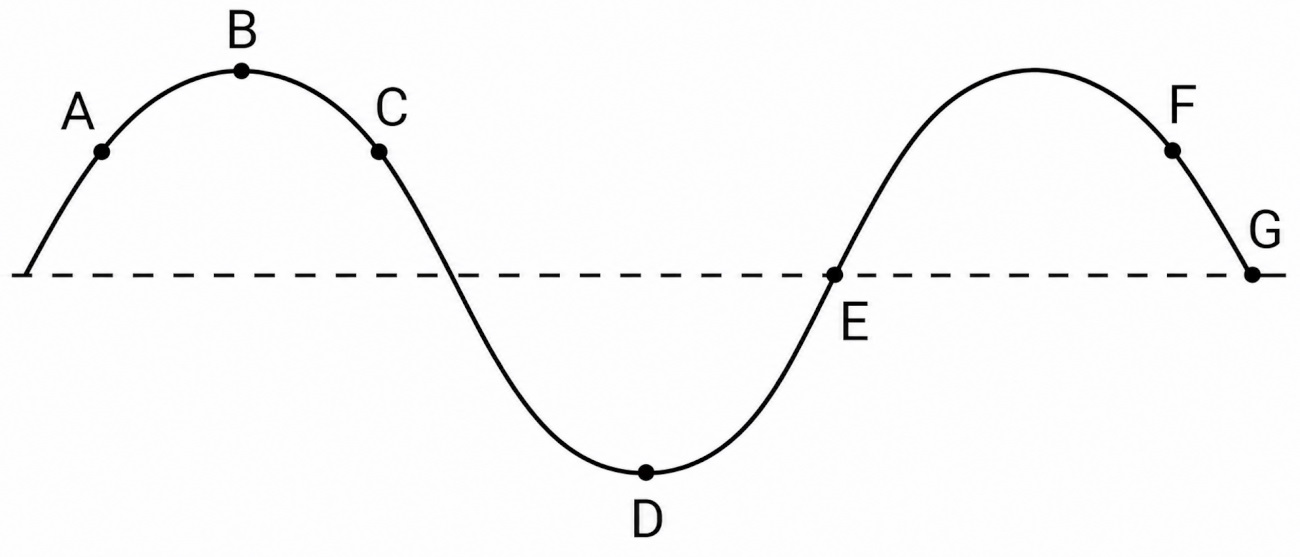
Which 2 points are in phase?
C and F
2 points that are 180°
B and D E and G
E. Wavelength – distance between two consecutive points in phase
[ HTML5 ]
- length of one cycle #m/cycle
Wavelength?
Made using a spreadsheet created by Download /
4 meters
Ex) Wavelength?
June 2000 Regents
λ = 5.0 m/2.5 cycles
λ = 2.0 m
Ex) Amplitude? Wavelength?
Amplitude = .10 m Wavelength = .60 m
Ex) Amplitude A?, B?, C?
Jan 2004
|
|||||||||||




Check Your Understanding
5 quick questions — pick an answer to see if you’re right.
1. Two points on a wave are "in phase" when they have
2. Two points on a periodic wave are 2½ wavelengths apart. Their phase difference is
3. Wavelength (λ) is the distance between
4. A wave train 5.0 m long contains 2.5 cycles. What is the wavelength?
5. On a wave, the point at 0 m is at 0° and the point at 3 m is at 90°. What is the wavelength?
Points on a Vibrating String
A periodic wave with a wavelength of 0.80 m and a frequency of 25 Hz travels along a long string. Points A, B, C, and D are marked on the string at distances of 0, 0.40 m, 0.80 m, and 1.0 m from the source.
Which two points are vibrating in phase?
▶ Want a challenge? Open 6 more Regents-style questions (harder · mixed formats)
Challenge score: 0 / 6
C1. A student makes the following claim.
Place a check mark in either the Support or Refute box. Justify your response using a mathematical relationship.
C2. What is the phase difference between points A and B?
C3. Substitute numerical values into a mathematical representation that can be used to determine the speed of the wave along the string. Then calculate the speed.
C4. More points are marked on the string at the distances listed from the source. Place a check mark in two boxes to indicate the points that vibrate in phase with point B (0.40 m).
C5. What is the phase difference between A and D (1.0 m apart)?
C6. Explain why the time it takes the wave to travel from point A to point C is exactly equal to the period of the wave.