Period & Amplitude
Timing repeating waves and measuring the size of a disturbance

|
Video Instruction showmethephysics.com
Sound through
This movie is part of the collection: Prelinger
Archives Creative Commons license: Public Domain School blocks YouTube?
B. Period (T) – time for an entire wave cycle to pass a given point in a medium
- determined by source of vibration not medium
T = Total Time/# of waves 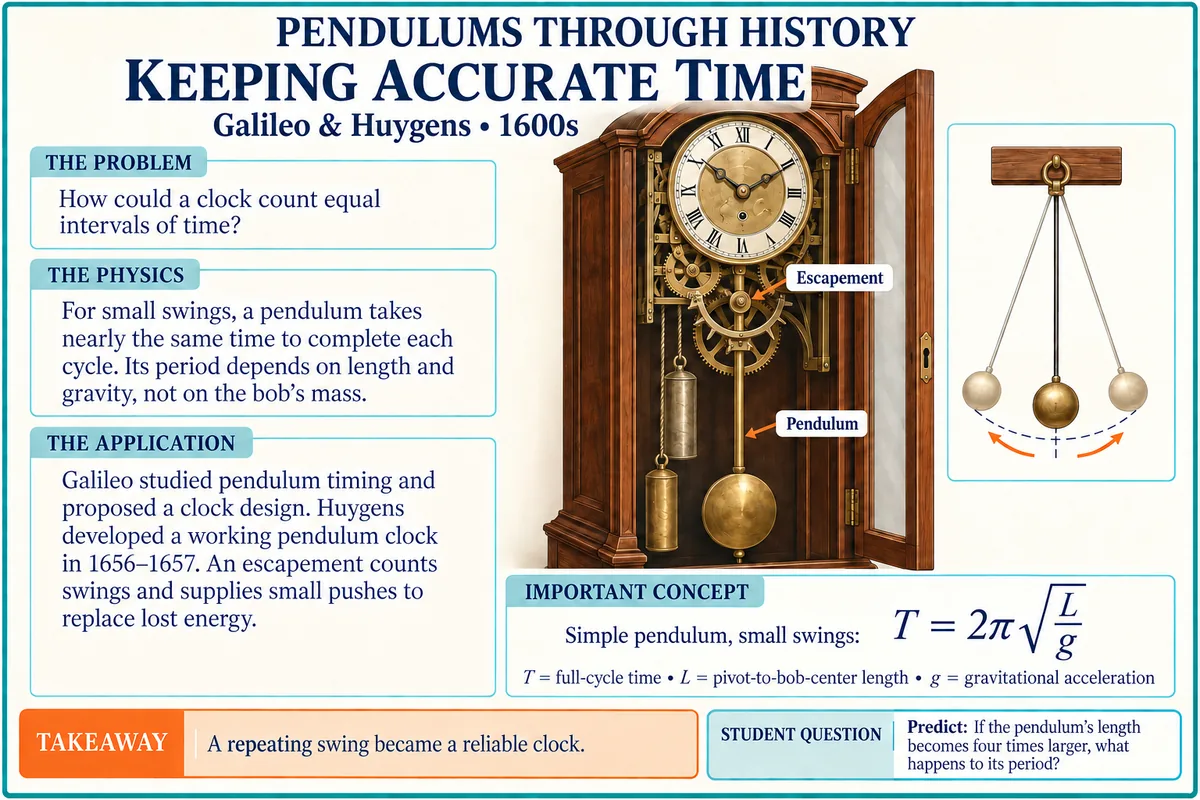
A pendulum's period stays nearly constant for small swings, no matter how the swing shrinks over time — the property Galileo studied and Huygens used in 1656–1657 to build the first working pendulum clock. Click the image for a larger view.
Ex) Use the controls to give this wave an amplitude of 5 and a period of 10
Ex) It takes 20 seconds for 5 waves to pass by a point. What is the period?
The period is 4 seconds
T
(sec) (Period)
=
1
f
T = 1/f
= 1/(5.0 x 1014 hertz)
a) 2.0 x 10⁻¹⁵ s
Which has the largest period?
Jan 2004
B
C. Amplitude – maximum change in position of a particle from its rest position during a single vibration
[ HTML5 ]
- determined by source of vibration, not medium
Ex) Compare waves A & B
Same Frequency, Period
1. Amplitude of a wave shows the amount of energy in the wave
a. Amplitude is a measure of loudness for sound and brightness for color -
Set your volume low before playing this video
Sound Waves/Oscilloscopes | Onsite |
Amplitude?
Made using a spreadsheet created by Dan Hosey - Pittsford Sutherland HS
3.0 meters
Review Which interval is closest to one wavelength?
Longitudinal or Transverse?
Enrichment
How the Ear Works
Producer: Bosse (Karl Kurt) Creative Commons license: Public Domain
|
||





Check Your Understanding
5 quick questions — pick an answer to see if you’re right.
1. The period of a wave is
2. It takes 20 seconds for 5 waves to pass a point. What is the period?
3. A light wave has a frequency of 5.0 × 10¹⁴ Hz. What is its period?
4. The amplitude of a wave is a measure of the
5. You turn up the volume on a speaker playing one steady note. Which property of the sound wave changes?
Ocean Buoy Data
A data buoy floating in the ocean records its height as waves pass. It rises and falls 12 times per minute. The vertical distance from the highest point to the lowest point of its motion is 3.0 m.
What are the frequency and period of the ocean waves?
▶ Want a challenge? Open 6 more Regents-style questions (harder · mixed formats)
Challenge score: 0 / 6
C1. The crests are 40. m apart. What is the speed of the waves?
C2. Determine the amplitude of the ocean waves recorded by the buoy.
C3. A student makes the following claim.
Place a check mark in either the Support or Refute box. Justify your response using a mathematical relationship.
C4. After the storm passes, a new set of waves arrives with crests 60. m apart, traveling at 15 m/s. Substitute numerical values into a mathematical representation that can be used to determine the period of these waves. Then calculate the period.
C5. Which graph best represents the relationship between period and frequency?
C6. Engineers plan to install wave-energy generators that use the up-and-down motion of buoys to produce electricity. Identify one benefit and one drawback of placing the generators where waves have very large amplitudes.