Nuclear Review
Everything in one place, plus mixed practice

Summary
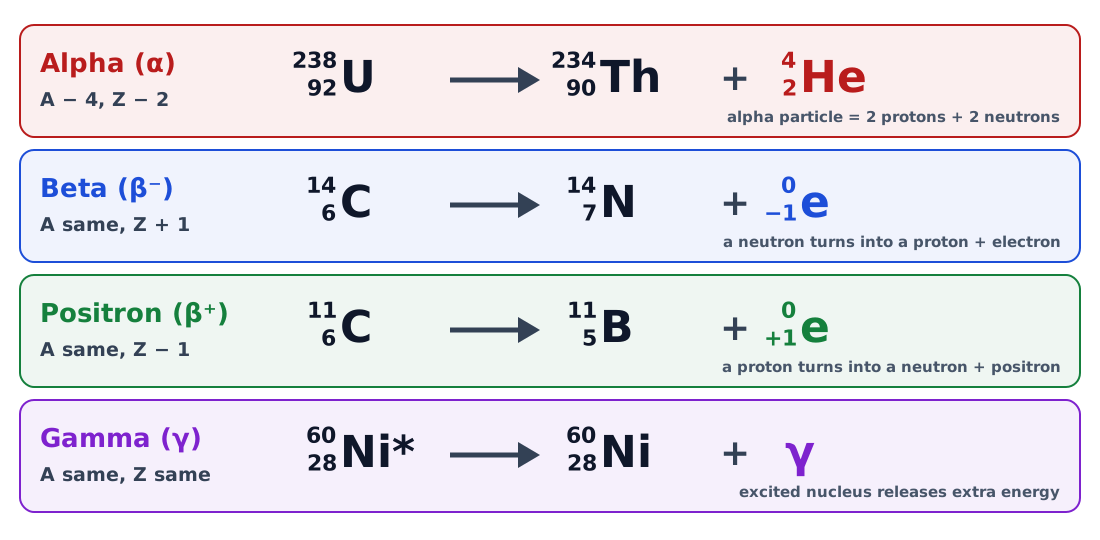
Balance equations: top numbers (A) and bottom numbers (Z) must match on both sides.
Penetration: alpha < beta < gamma.
Fission splits heavy nuclei; fusion joins light nuclei. Both turn a little mass into a lot of energy.
Nuclear vs. chemical: millions of times more energy per atom.
Explore
Pick a starting nucleus, then press a decay button. Watch the protons, neutrons, and notation change.
Mixed Practice
Complete: 23490Th → ? + 0−1e
23491Pa (protactinium-234)
Complete: 23892U → 23490Th + ?
42He — an alpha particle
Complete: 116C → 115B + ?
0+1e — a positron
A fossil has 25% of its original carbon-14 left (half-life 5,730 years). How old is it?
100% → 50% → 25% = 2 half-lives = 11,460 years
A worker needs to shield a source of gamma rays. Would a sheet of aluminum be enough? Explain.
No. Gamma rays have no charge and no mass, so they pass through aluminum. Thick lead or concrete is needed.
Draw a model of what happens to the nucleus in beta decay.
Inside the nucleus, one neutron changes into a proton, and an electron is shot out. The mass number stays the same and the atomic number goes up by 1, so the element changes to the next one on the periodic table.
Check Your Understanding
6 quick questions — pick an answer to see if you’re right.
1. Which particle is the same as a helium-4 nucleus?
2. 146C → 147N + ? The missing particle is
3. Which type of radiation is the most penetrating?
4. Fusion and fission both release energy because
5. Which statement compares nuclear and chemical energy correctly?
6. After 3 half-lives, what fraction of a radioactive sample is left?