The Bohr Model of the Atom
Quantized energy levels and the structure of the hydrogen atom
|
showmethephysics.com
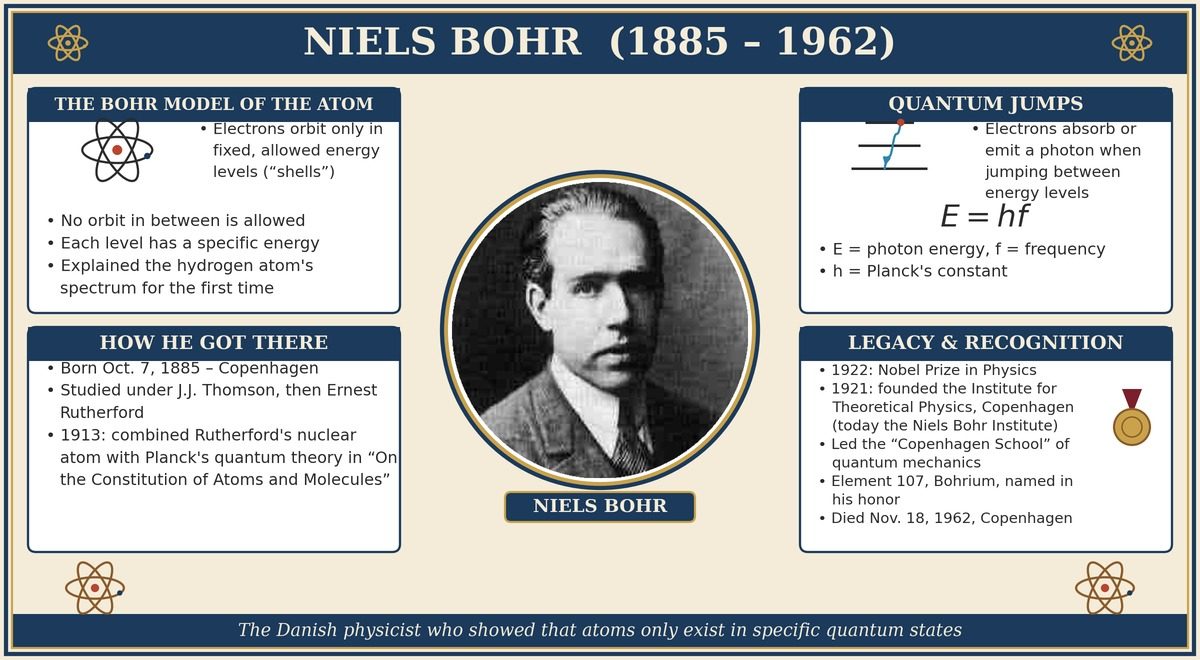
Early 1900's - Danish scientist Neils Bohr
This image is in the public domain because its copyright has expired. B) Bohr Model of Atom
1:15 Bohr Model School Blocks YouTube?
showmethephysics.com
Hypothetical Element X
When electron falls back to ground state, what energies
Answer
8 eV, 3 eV, 11 eV
(the difference between
1 eV = 1.6 x 10⁻¹⁹
J
|
|||||||||||


Check Your Understanding
5 quick questions — pick an answer to see if you’re right.
1. What did Bohr's model say about the energies of electrons in atoms?
2. Element X has energy levels of 1 eV (ground), 4 eV and 12 eV. Which photon energy could it emit?
3. How many photons are produced by a single energy-level transition?
4. Convert 2.0 eV to joules. (1 eV = 1.6 × 10⁻¹⁹ J)
5. Fireworks of different elements burn with different colors. According to Bohr, why?
The Red Glow of Hydrogen
A hydrogen gas discharge tube glows with a red line at 656 nm. Table 1 shows the energy levels of hydrogen. (1 eV = 1.60 × 10⁻¹⁹ J; h = 6.63 × 10⁻³⁴ J·s)
Table 1: Hydrogen Energy Levels
| Level (n) | Energy (eV) |
|---|---|
| ∞ | 0.00 |
| 6 | −0.38 |
| 5 | −0.54 |
| 4 | −0.85 |
| 3 | −1.51 |
| 2 | −3.40 |
| 1 (ground) | −13.60 |
The red line is produced when an electron drops from n = 3 to n = 2. What is the energy of the emitted photon?
▶ Want a challenge? Open 6 more Regents-style questions (harder · mixed formats)
Challenge score: 0 / 6
C1. Substitute numerical values into a mathematical representation that can be used to determine the wavelength of the 1.89-eV photon emitted in the n = 3 → n = 2 transition. Then calculate the wavelength. (c = 3.00 × 10⁸ m/s)
C2. Which transition emits a photon with more energy than the red line?
C3. A student makes the following claim.
Place a check mark in either the Support or Refute box. Justify your response using a mathematical relationship.
C4. Hydrogen also emits a violet line when electrons drop from n = 5 to n = 2. Using Table 1, determine the energy of this photon.
C5. An electron in hydrogen absorbs a photon and jumps from n = 2 to n = 3. What must be true of the photon?
C6. Visible photons have energies between about 1.8 eV and 3.1 eV. Using Table 1, explain why every visible line in hydrogen’s spectrum comes from an electron dropping to the n = 2 level.