More Motion Terms
Displacement

Displacement - distance & direction from start to finish
Fill In The Blanks NotesDisplacement
When studying motion, physicists find it more useful to measure the displacement of an object rather than the distance. Displacement refers to the object's change in position from its starting point to its finishing point, taking both distance and direction into account.
How can you travel a distance of 10 meters but have a zero displacement?
Science Requires Careful Observations
Why does this boat float?
Ship floating on nothing! :: Physikshow Uni Bonn
School blocks YouTube? Use the file below | Onsite
Sulfur hexafluoride is more dense than the surrounding air
When physicists study motion they study displacement, not distance.
Video Instruction
showmethephysics.com
Enduring Understanding
1. Displacement is an object's distance and direction traveled from start to finish. (What happens in between doesn't matter.)
2. + is up, right, east and forward.
1) Examples
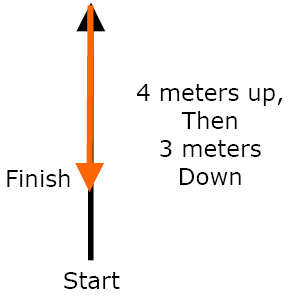
Displacement? 1 m up
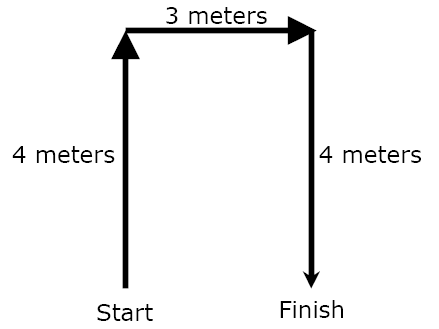
Displacement? 3 m Right
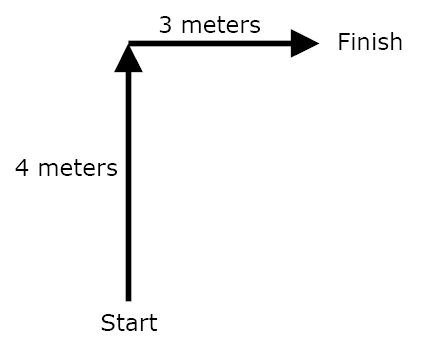
2) Displacement Always Has ...
Magnitude

(a number)
...and Direction
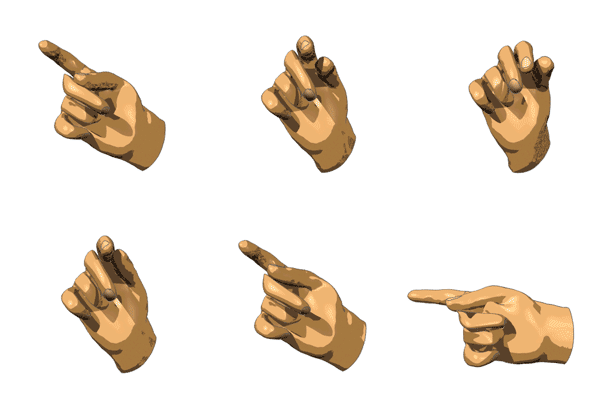
a) Examples: 5 m East • 7 m upward • +17 m
b) Positive and negative signs also show direction.
+ — usually up, right, north, east, forward
− — usually down, left, south, west, backwards
c) Symbol for displacement: d
Summary Review
[ Flash ]
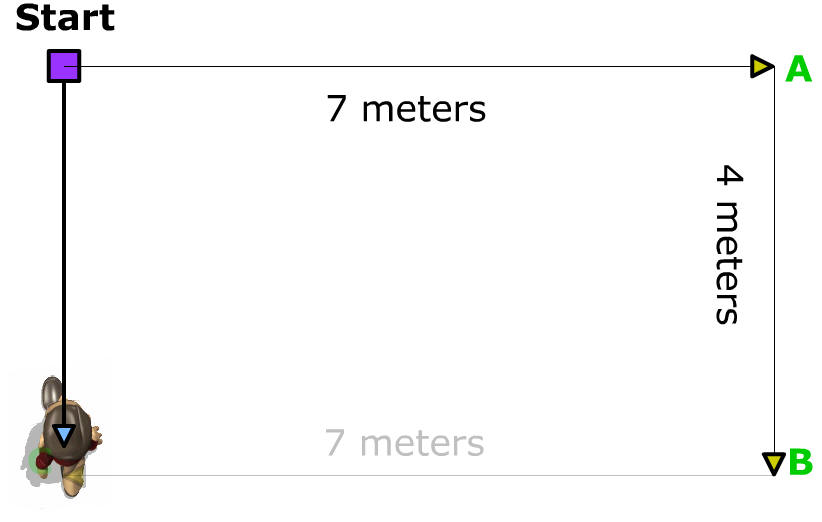
At what point is the displacement: 1) greatest? 2) zero? 3) equal to distance? 4) What is the displacement at C?

Check Your Understanding
5 quick questions — pick an answer to see if you’re right.
1. What is displacement?
2. A student walks 5 m east and then 5 m back west. What are the distance and displacement?
3. A hiker walks 4 m north and then 3 m east. What is the magnitude of the hiker's displacement?
4. Using the usual sign convention, a displacement of −8 m most likely means...
5. Which of these is a complete displacement?