Range of Possible Resultants
Finding the Maximum and Minimum Resultant of Two Forces

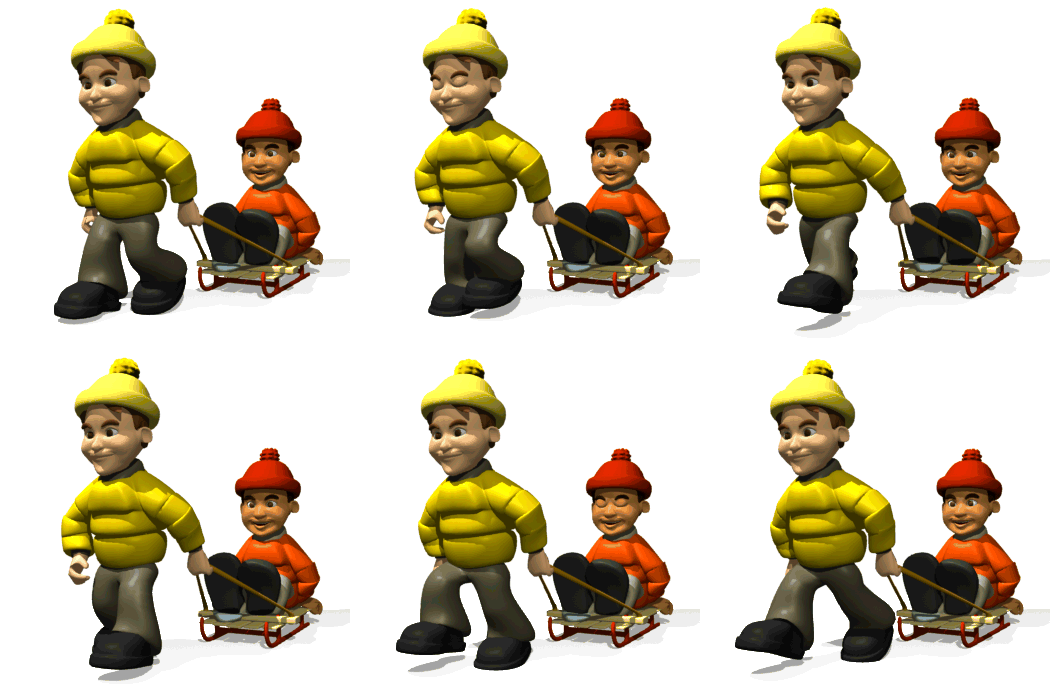
A boy and his sister exert a 5 N force eastward on a dresser. If their mother wants to prevent them from moving the dresser, how large must her force be?
C. Combining Forces
Range of Possible Resultants
Case III
θ ≠ 0° ≠ 180°
Forces of 100. N and 30. N act on a body.
Find: Largest Possible Resultant.
Find: Smallest Possible Resultant.
Subtract the two forces to find the Smallest Resultant
Add the two forces to find the Largest Resultant
Concurrent Forces
All forces pass through a common point
Example 1


Example 2

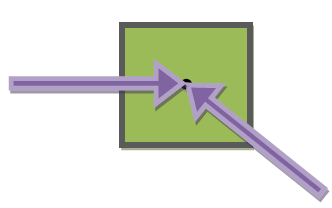

Not Concurrent

Which pair of concurrent forces may have a resultant of 20 nt?
a) 5 nt + 10 nt
b) 20 nt + 20 nt
c) 20 nt + 50 nt
d) 30 nt + 5 nt
Hint: Find the range of possible resultants for each choice
| Choice | Max | Min |
|---|---|---|
| a) 5 nt + 10 nt | 15 nt | 5 nt |
| b) 20 nt + 20 nt | 40 nt | 0 nt |
| c) 20 nt + 50 nt | 70 nt | 30 nt |
| d) 30 nt + 5 nt | 35 nt | 25 nt |
Check Your Understanding
5 quick questions — pick an answer to see if you’re right.
1. Forces of 100. N and 30. N act on a body. What is the largest possible resultant?
2. Forces of 100. N and 30. N act on a body. What is the smallest possible resultant?
3. Which pair of concurrent forces could have a resultant of 20 N?
4. What are concurrent forces?
5. A boy and his sister each push a dresser 5 N east. What force must their mother apply to keep it from moving?