Energy Problems
When work is done on or by a system
Approximately how much kinetic energy does the green box acquire?
http://www.ignitelearning.com/
Video Instruction
Energy Problems
When work is done on or by a system
Ex 1
An object slides across a horizontal table which changes its kinetic energy from 20 J to 18 J in 2 sec.
What work does the object do against friction?
**Work against friction** increases an object's Internal Energy** (makes it hotter)
Friction is a nonconservative force (doesn't store energy)
(can't get back)
Joule Paddle — Conservation of Energy
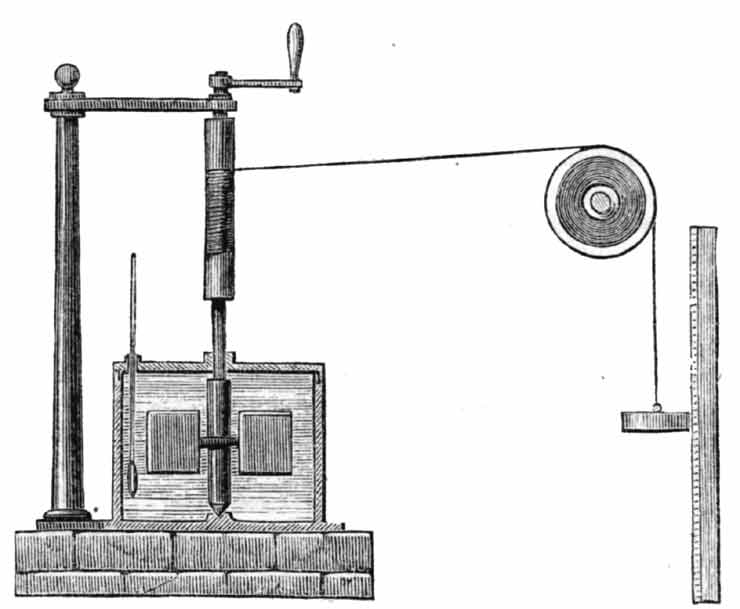
Joule Paddle — Penn State Schuylkill
Work–Energy Relationship
The work done on or by a system

If ΔPE of the yellow box = 30 J, how much work did the green box do on it?
Work done by the ball on the floor changes the ball's mechanical energy
When the WORK equation doesn't WORK,
use an ENERGY equation.
When an ENERGY equation doesn't WORK,
use the WORK equation.
Enrichment

Superfluids
The strange behavior of liquid helium — BBC
Check Your Understanding
5 quick questions — pick an answer to see if you’re right.
1. An object sliding across a table slows, and its KE drops from 20 J to 18 J. How much work did it do against friction?
2. Work done against friction mostly increases an object's
3. In Joule's paddle-wheel experiment, falling weights churned water in an insulated container. Where did the weights' energy end up?
4. 100 J of work is done on a system. Its PE increases by 60 J and 10 J is done against friction. What is its change in KE?
5. A lever lifts a box, increasing its gravitational PE by 30 J. Neglecting friction, how much work was done on the box?
Joule’s Paddle-Wheel Experiment
In the 1840s, James Joule let a falling weight turn a paddle wheel in an insulated container of water. In a modern version, a 10.-kg mass falls slowly at constant speed through 2.0 m, and this is repeated 20 times. The paddle stirs 1000. g of water (specific heat 4.2 J/g·°C).
How much gravitational potential energy is transferred to the water in the 20 drops?
▶ Want a challenge? Open 6 more Regents-style questions (harder · mixed formats)
Challenge score: 0 / 6
C1. Why does the weight fall at a slow, constant speed rather than speeding up?
C2. The 20 drops transfer 3920 J of energy to the water. Substitute numerical values into a mathematical representation that can be used to determine the temperature rise of the water. Then calculate the temperature rise.
C3. Construct an energy bar graph for the weight–Earth–water system when the weight is halfway through the first 2.0-m drop. The zero level for gravitational potential energy is the bottom of the drop, the weight’s kinetic energy is negligible, and the container is perfectly insulated.
Click a box to set each bar’s height; click it again to clear the bar to 0. The ET bar is drawn for you.
C4. A student makes the following claim.
Place a check mark in either the Support or Refute box. Justify your response using a mathematical relationship.
C5. What did Joule’s experiment show?
C6. In a classroom version of the experiment, the measured temperature rise was less than the predicted 0.93 °C. Identify one likely source of the difference, and describe one change to the apparatus that would reduce it.