Recoil
Conservation of Momentum
Recoil Problem — when interacting objects start from rest

Review – Explain this using one of Newton's Laws
A lead brick has a lot of mass and therefore a lot of inertia.
The greater the mass, the greater the tendency for an object to remain at rest, the smaller the acceleration that is produced by a given force.
Conservation of Momentum
Newton Collider
B) Recoil Problem
When interacting objects start from rest

"What is the total momentum before cannon is fired?"
"Total momentum after clown is fired?"
"Total momentum before = 0. (at rest)"
"Total momentum after = 0. (momenta are equal but opposite.)"

"In real life, it would be foolish to shoot a rifle like this. Why?"
"The recoil on that rifle would throw the shooter's shoulder out!"
Ex 1) Rifle Recoil
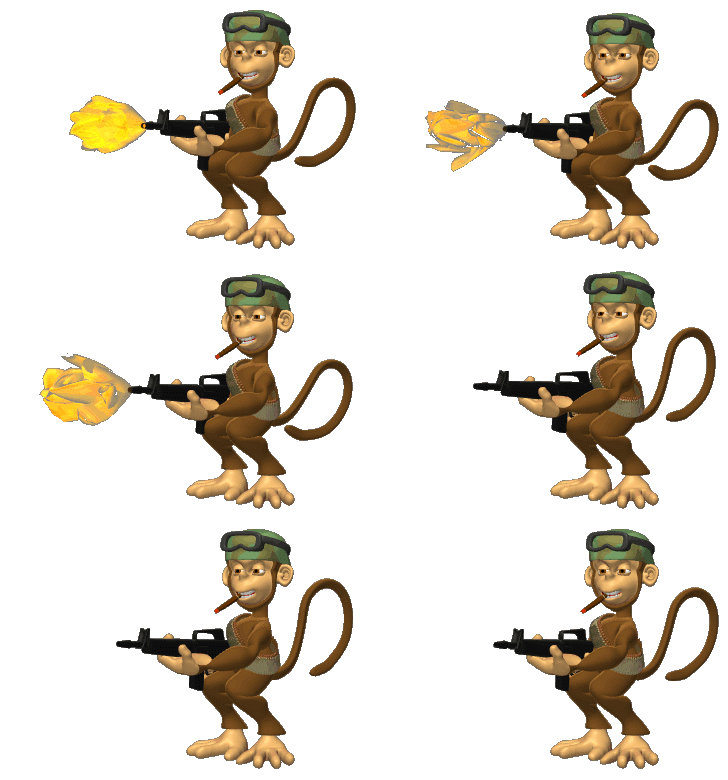
After rifle is fired
| Rifle | Bullet |
|---|---|
| mR = 4.0 kg | mB = 5.0 × 10⁻³ kg |
| VR = ? | VB = 500. m/s |
Total Momentum Before = Total Momenta After Interaction
0 = m1V1 + m2V2
Subtract m2V2 from both sides:
m1v1 = −m2V2
In problem solving, remove the negative sign and use:
(4.0 kg)V = (5.0 × 10⁻³ kg)(500. m/s)
(4.0 kg)V = 2.5 kg·m/s
Equal vs. Unequal Mass Explosions
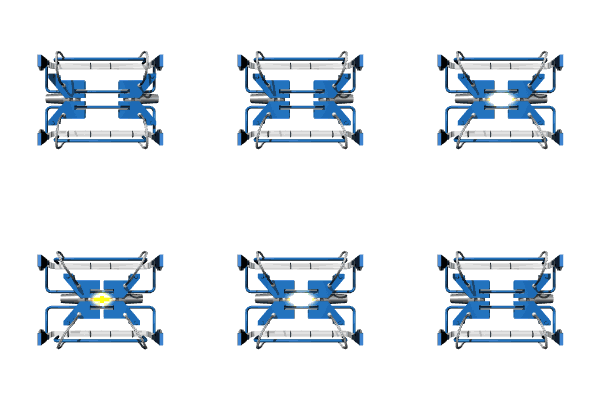
Yes, the slower cart has a greater mass.
Ex 2) Magnet Momentum

When the string holding them together is cut, they move apart under a magnetic force of repulsion.
a) What is the total momentum of the magnets before the string is cut?
Total momentum before = 0
(Both objects begin at rest)
b) What is the total momentum of the magnets after the string is cut?
Total momentum after = 0
(Total mom. before = Total mom. after)
c) What is the velocity of the 1.0 kg mass when the velocity of the 2.0 kg magnet is 30. m/s?
| Magnet 1 | Magnet 2 |
|---|---|
| m1 = 2.0 kg | m2 = 1.0 kg |
| V1 = 30. m/s | V2 = ? |
2.0 kg(30. m/s) = 1.0 kg(V)
One More
What is the velocity of the cannon below?
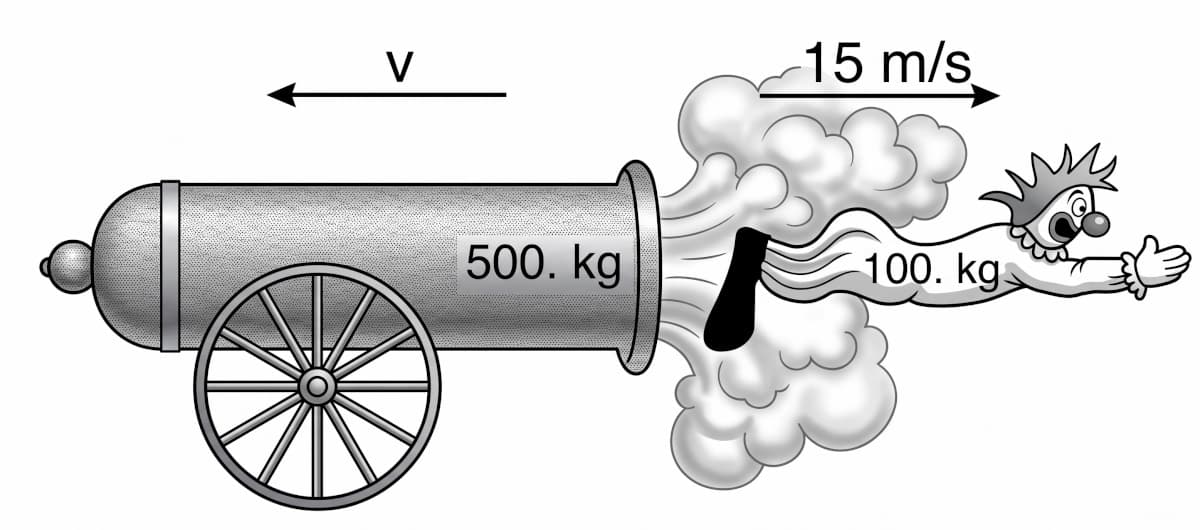
500 kg(V1) = 100 kg(15 m/s)
Related

Enrichment

Rifle Recoil
Dr. Dave's Hall of Fame
Check Your Understanding
5 quick questions — pick an answer to see if you’re right.
1. A cannon at rest fires a ball. What is the total momentum of the cannon and ball just after firing?
2. A 4.0 kg rifle fires a 5.0 × 10⁻³ kg bullet at 500. m/s. What is the rifle's recoil speed?
3. Two magnets at rest push apart. The 2.0 kg magnet moves at 30. m/s. How fast does the 1.0 kg magnet move?
4. A 500 kg cannon fires a 100 kg ball at 15 m/s. What is the cannon's recoil speed?
5. Two carts at rest are pushed apart by a spring. One cart moves away more slowly. What does that tell you?