Conservation of Momentum
Momentum
In a closed system, the total momentum of a group of objects before an interaction equals the total momentum after the interaction. Conserv. of Momentum – Fill in the Blanks Notes
Do Now
Warm-Up


A teacher pushed ice cubes of different masses with different amounts of force. Which diagram shows the cube that will show the biggest velocity change when pushed with the force represented by the arrow?
A) A B) B C) C D) D
E) To find the velocity change, you need the force's contact time.
Try This at Home
Review – 3 Laws of Motion
The Power of the New York Times
Show Me The Physics YouTube Channel
Physics in History: The Ballistic Pendulum
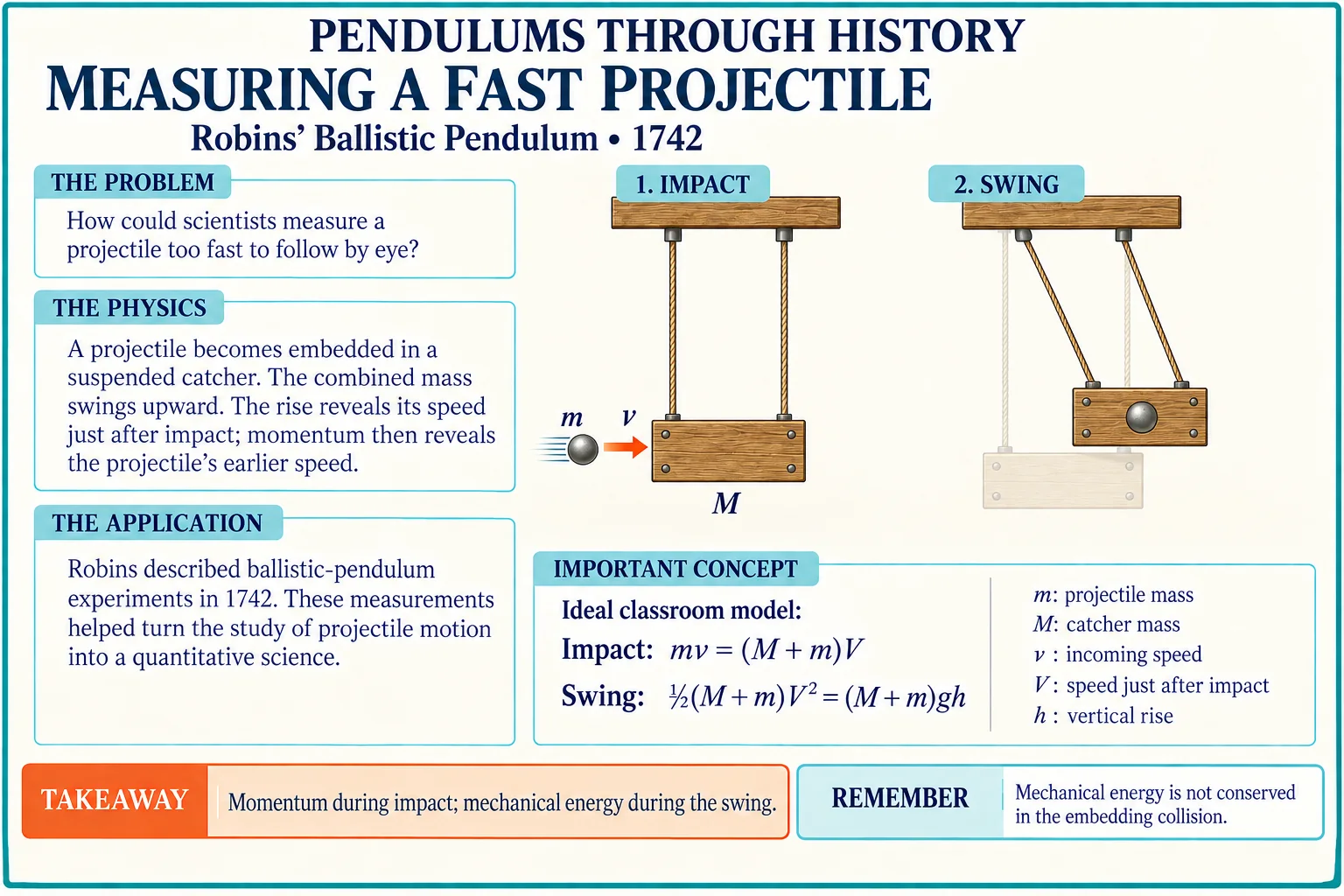 Measuring a Fast Projectile
Click to enlarge: the ballistic pendulum
Totally Elastic Collision?
Show Me The Physics YouTube Channel
What is the momentum of the big fish after it swallows the little fish?
A) Collision Problems
A 3.0 kg object traveling 6.0 m/s East has a perfectly elastic collision with a 4.0 kg object traveling 8.0 m/s West. After the collision, the 3.0 kg object will travel 10. m/s West.
a) What was the total momentum before the collision?
| Before | After |
| m1 = 3.0 kg | |
| v1 = 6.0 m/s (East) | |
| m2 = 4.0 kg | |
| v2 = -8.0 m/s (West) |
Total momentum before:
= m1v1 + m2v2
= 3.0 kg(6.0 m/s) + 4.0 kg(-8.0 m/s)
= 18. kg·m/s + -32. kg·m/s
Total Momentum Before Interaction = Total Momentum After Interaction
b) What is the total momentum of these objects after this collision?
c) What velocity will the 4.0 kg object have after the collision?
| Before | After |
| m1 = 3.0 kg | |
| v1′ = -10. m/s | |
| m2 = 4.0 kg | |
| v2′ = ? |
Total Momenta Before Interaction = Total Momenta After Interaction
-14. kg·m/s = m1v1′ + m2v2′
-14. kg·m/s = 3.0 kg(-10. m/s) + 4.0 kg(v2′)
-14. kg·m/s = (-30. kg·m/s) + 4.0 kg(v2′)
16. kg·m/s = 4.0 kg(v2′)
What is the momentum of the attached carts?
| p = 15 kg·m/s | p = -30 kg·m/s |
A 10. kg Block A moves with a velocity of 2.0 m/s to the right and collides with a 10. kg Block B which is at rest. After the collision Block A stops moving and Block B moves to the right.
a) Find the total momentum after the collision.
| Before | After |
| mA = 10. kg | mA = 10. kg |
| vA = 2.0 m/s (East) | vA′ = 0 m/s |
| mB = 10. kg | mB = 10. kg |
| vB = 0 m/s | vB′ = ? |
Total mom. before = Total mom. after:
= mAvA + mBvB
= 10. kg(2.0 m/s) + 10. kg(0 m/s)
Find the velocity of Block B after the collision.
20. kg·m/s = mAVA + mBVB
20. kg·m/s = 10. kg(0 m/s) + 10. kg·VB
A 10. kg cart moving with a velocity of 10. m/s East collides and attaches itself to a 10. kg cart moving at a velocity of 50. m/s West.
a) Find the total momentum before the collision.
| Before | After |
| mA = 10. kg | |
| vA = 10. m/s (East) | |
| mB = 10. kg | |
| vB = -50. m/s |
Total momentum = m1v1 + m2v2
Total momentum = 100. kg·m/s + -500. kg·m/s
Impulse
Hi-speed video of a golf ball compressed by driver.
Recorded at 10,000 fps with the Photron ultima APX slow motion video camera, the golf ball can be seen to compress as the golf club comes into contact with it at high speed. Recorded with the APX at 10K fps, with a 10 microsecond shutter and 512 (H) x 256 (V) at 10-bit pixel depth.
b) Find the total momentum after the collision.
Total mom. before = Total mom. after:
c) What is the velocity of the attached carts after the collision?
| m = 20. kg (masses combine) |
| v = ? |
Total mom. before = Total mom. after:
-400. kg·m/s = (20. kg)V
What is the magnitude of the total momentum of these carts?

Total momentum = m1v1 + m2v2
Total mom. = (4.0 kg)(3 m/s) + 6.0 kg(-3.0 m/s)
= 12. kg·m/s + -18. kg·m/s
"Left train momentum = 30 kg·m/s. What is the momentum of the right train?"
What's the total momentum before the collision? After the collision?

Check Your Understanding
5 quick questions — pick an answer to see if you’re right.
1. What does the law of conservation of momentum state?
2. A 3.0 kg object moves 6.0 m/s east and a 4.0 kg object moves 8.0 m/s west. What is their total momentum?
3. A 10. kg block moving 2.0 m/s hits an identical 10. kg block at rest. The first block stops. How fast does the second block move?
4. A 10. kg cart moving 10. m/s east collides and sticks to a 10. kg cart moving 50. m/s west. What is their velocity afterward?
5. Two carts collide and stick together in a closed system. Compared with the total momentum before, the total momentum after is…
Coupling Railroad Cars
In a rail yard, a 20,000-kg boxcar rolling at 3.0 m/s east collides with a stationary 10,000-kg boxcar. The cars couple together and move off as one unit. Friction is negligible.
Table 1: Before the Collision
| Boxcar | Mass (kg) | Velocity (m/s) |
|---|---|---|
| A | 20,000 | 3.0 east |
| B | 10,000 | 0 |
What is the velocity of the coupled cars just after the collision?
▶ Want a challenge? Open 6 more Regents-style questions (harder · mixed formats)
Challenge score: 0 / 6
C1. A student makes the following claim about the coupling.
Place a check mark in either the Support or Refute box. Justify your response using evidence from the momentum changes of the two cars.
C2. Kinetic energy before the collision is 9.0 × 10⁴ J and after is 6.0 × 10⁴ J. Which explanation is correct?
C3. The coupling takes 0.50 s. Substitute numerical values into a mathematical representation that can be used to determine the magnitude of the average force on boxcar B during the coupling. Then calculate the force.
C4. East is to the right. Choose the direction of the momentum of boxcar A just after the collision, and determine its magnitude.
●
C5. A 0.010-kg bullet moving at 300. m/s embeds in a 2.0-kg wooden block hanging at rest (a ballistic pendulum). What is the speed of the block and bullet just after impact?
C6. Rail engineers install spring-and-hydraulic buffers on the couplers between cars. Using the concepts of impulse and momentum, explain how the buffers reduce the force on each car during coupling, and identify one drawback of this design.