What the Universe Is Made Of
Hydrogen, helium, and what starlight tells us
Do Now: No one has ever visited a star. So how do scientists know what stars billions of light-years away are made of?
By studying their light. Each element leaves its own pattern of lines in a spectrum, so starlight tells us which elements are present and how much of each.
A. Reading Starlight
Light from a star or a glowing gas cloud is spread into a spectrum.
The positions of the lines tell us which elements are present. How dark the lines are helps tell us how much of each.
Helium was actually discovered in the Sun’s spectrum in 1868 — before it was ever found on Earth!
B. The Big Bang’s Prediction
In the first few minutes, the whole universe was hot enough for nuclear fusion, like the inside of a star.
Protons and neutrons fused into helium nuclei. But the universe expanded and cooled so quickly that fusion stopped before heavier elements could form.
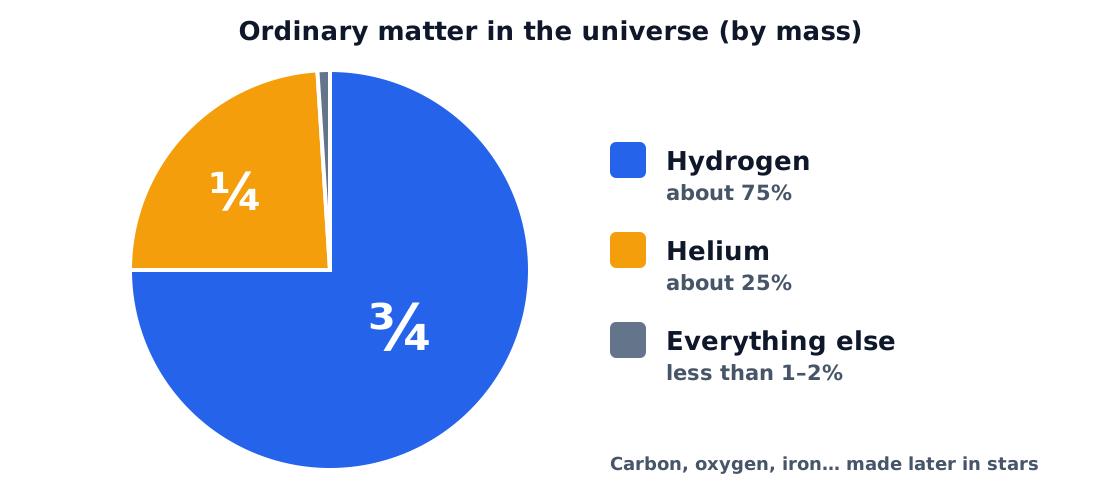
The theory predicts the result: about ¾ hydrogen and ¼ helium by mass, with only a trace of lithium.
C. What We Observe
D. Where Everything Else Came From
Stars fuse hydrogen and helium into heavier elements like carbon and oxygen.
Exploding stars (supernovae) and collisions of dead stars make even heavier elements and scatter them into space.
New stars, planets — and people — formed from that recycled material.
The carbon in your body and the oxygen you breathe were made inside stars!
Check Your Thinking
Old stars contain very few elements heavier than helium, while younger stars like our Sun contain more. Why?
Old stars formed from almost pure Big Bang material (hydrogen and helium). Younger stars formed later from gas that earlier generations of stars had already enriched with heavier elements.
Check Your Understanding
5 quick questions — pick an answer to see if you’re right.
1. Ordinary matter in the universe is mostly
2. How do astronomers find out what distant stars are made of?
3. Why did the Big Bang make almost no elements heavier than helium?
4. Most of the carbon and oxygen in the universe was made
5. Which observation supports the Big Bang theory?