Big Bang Review
Writing a claim-evidence-reasoning explanation

Three Pieces of Evidence
| Evidence | What We Observe | How It Supports the Big Bang |
|---|---|---|
| Redshift of galaxies | Spectral lines of distant galaxies shift toward red; farther galaxies shift more. | Galaxies are moving apart, so the universe is expanding. Run backward, it began hot and dense. |
| Cosmic microwave background | A faint 2.7 K microwave glow from every direction. | It is the stretched leftover light from the hot early universe. |
| Composition of matter | Spectra of stars and gas show about ¾ hydrogen, ¼ helium. | Matches what fusion in the first few minutes should produce. |
Write the Explanation
Write a scientific explanation for how the universe began. Include a claim, at least two pieces of evidence, and reasoning that connects the evidence to the claim.
Claim: one sentence answering the question.
Evidence: specific observations (redshift, CMB, composition).
Reasoning: explain why each observation supports the claim.
Model answer:
Claim: The universe began about 13.8 billion years ago in an extremely hot, dense state and has been expanding and cooling ever since.
Evidence 1: The spectral lines of distant galaxies are redshifted, and farther galaxies have larger redshifts. Reasoning: Redshift means the galaxies are moving away, and speed increasing with distance means space is expanding. If it is expanding now, it was once much smaller, denser, and hotter.
Evidence 2: A faint microwave glow at 2.7 K comes from every direction. Reasoning: This is the leftover light of the hot early universe, stretched to microwaves as space expanded. It was predicted by the Big Bang before it was found.
Evidence 3: Spectra show ordinary matter is about 3/4 hydrogen and 1/4 helium. Reasoning: This matches the amount of fusion the Big Bang predicts for the first few minutes.
Explore
Press Expand. Click any galaxy to make it the target and see its spectrum.
Mixed Practice
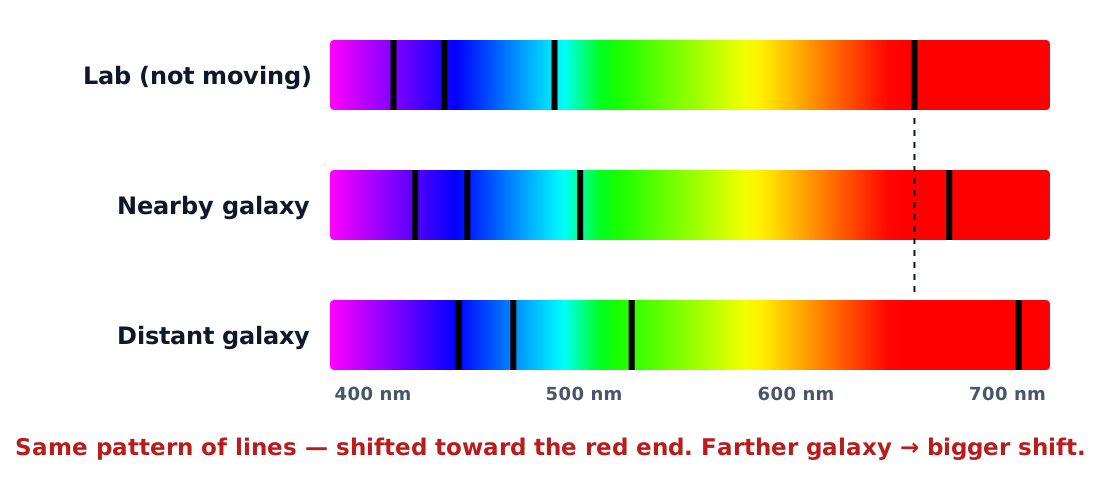
Which spectrum came from the galaxy moving away the fastest? How can you tell?
The distant galaxy — its lines are shifted farthest toward the red end.
A galaxy’s spectral lines are shifted toward the blue end. What does this tell you?
The galaxy is moving toward us (blueshift). Andromeda is an example.
Galaxy A is 100 million light-years away and moving away at 2,200 km/s. About how fast is galaxy B, which is 300 million light-years away?
Three times as far → three times as fast: about 6,600 km/s.
Why is the cosmic microwave background in the microwave part of the spectrum instead of visible or infrared light?
The expansion of space stretched its wavelength about 1,100 times since it was released.
A student says, “The Big Bang was an explosion that sent galaxies flying out from a center point.” Correct the student.
The Big Bang was the expansion of space itself, happening everywhere. There is no center — every galaxy sees the others moving away.
Why does the universe contain so little lithium, beryllium, and heavier elements from the Big Bang?
The universe expanded and cooled within minutes, so fusion stopped after making mostly helium. Heavier elements were made later in stars.
Check Your Understanding
6 quick questions — pick an answer to see if you’re right.
1. Which is NOT evidence for the Big Bang theory?
2. The redshift of galaxies shows that the universe is
3. The cosmic microwave background was released when the universe was about
4. About how old is the universe?
5. The observed ratio of about 3/4 hydrogen to 1/4 helium supports the Big Bang because
6. Every galaxy sees the other galaxies moving away from it. This means
Building a Scientific Argument
A student writes a claim: “The universe is expanding.” She must support it with evidence and reasoning.
Table 1: Galaxy Data (sample)
| Galaxy | Distance (Mly) | Recession Speed (km/s) |
|---|---|---|
| A | 100 | 2200 |
| B | 200 | 4400 |
| C | 400 | 8800 |
Which statement best uses the data in Table 1 as evidence for the claim?
▶ Want a challenge? Open 6 more Regents-style questions (harder · mixed formats)
Challenge score: 0 / 6
C1. Substitute numerical values from Table 1 into a mathematical representation that can be used to determine the ratio of recession speed to distance (the Hubble constant) for galaxy C. Then calculate the ratio.
C2. Predict the recession speed of a galaxy 300 Mly away.
C3. A student makes the following claim.
Place a check mark in either the Support or Refute box. Justify your response using a mathematical relationship.
C4. Galaxy C is 400 Mly away, so its light took 400 million years to reach us. Its recession speed is 8800 km/s (the speed of light is 300,000 km/s). Assuming it has always moved at this speed, determine how long ago, in billions of years, galaxy C and the Milky Way were together.
C5. If every galaxy is moving away from us, does that mean Earth is at the center of the universe?
C6. Identify one limitation of the student’s evidence in Table 1, and describe additional data she could collect to make her argument stronger.