Temperature & Heat
Particles in motion, thermal energy, and the Kelvin scale

Do Now: Which has more thermal energy: a cup of boiling water or a bathtub full of warm water?
The bathtub. The cup is at a higher temperature, but the bathtub has far more water particles, so its total thermal energy is much larger.
A. Everything Is Made of Moving Particles
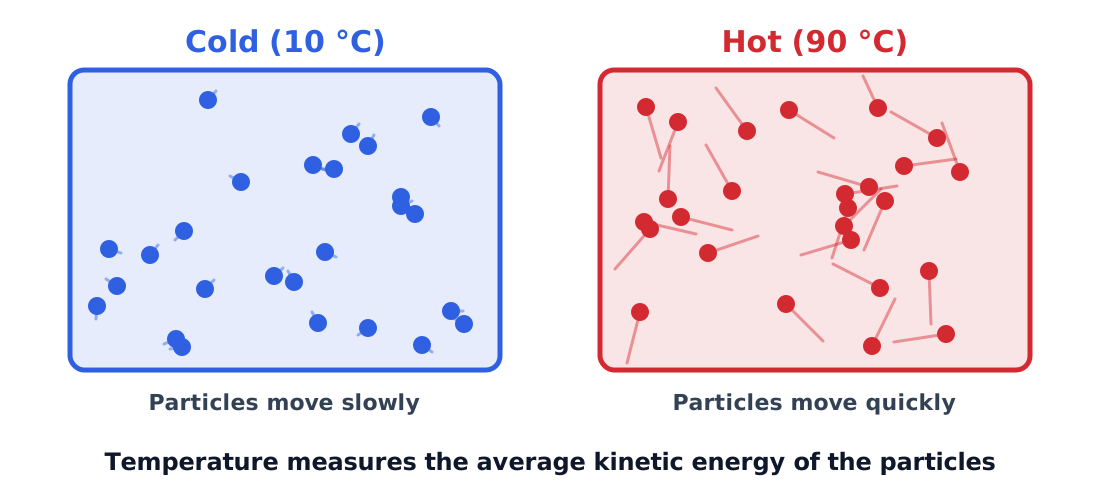
Temperature — a measure of the average kinetic energy of the particles in a substance. Faster particles → higher temperature.
Thermal (internal) energy — the total energy of all the particles in an object. It depends on temperature and on how much material there is.
Heat (Q) — thermal energy that is transferred from one object to another because of a temperature difference. Heat is measured in joules (J).
An object does not “contain heat.” It contains thermal energy. Heat is the name for energy while it is moving from hot to cold.
B. Temperature Scales
| Celsius (°C) | Kelvin (K) | |
|---|---|---|
| Water boils | 100 °C | 373 K |
| Room temperature | 20 °C | 293 K |
| Water freezes | 0 °C | 273 K |
| Absolute zero | −273 °C | 0 K |
Converting Celsius to Kelvin
Absolute zero (0 K) is the lowest possible temperature — particle motion is at a minimum.
A change of 1 °C is the same size as a change of 1 K, so ΔT is the same on both scales.
Convert 37 °C (body temperature) to kelvins.
37 + 273 = 310 K
C. How Heat Moves
Conduction — particles collide and pass energy to their neighbors. Example: a metal spoon in hot soup gets hot along its handle.
Convection — warm fluid (liquid or gas) rises and carries energy with it. Example: warm air rising from a radiator.
Radiation — energy travels as electromagnetic waves, even through empty space. Example: feeling the Sun’s warmth.
Check Your Understanding
5 quick questions — pick an answer to see if you’re right.
1. Temperature is a measure of the
2. Which has the most thermal energy?
3. Heat is best described as
4. Water at 50 °C is at what Kelvin temperature?
5. A metal spoon left in hot soup becomes hot along its handle mainly by