Introductory Video: Torque & Rotational Equilibrium
Under what conditions can a 24 kg box balance a 12 kg box?
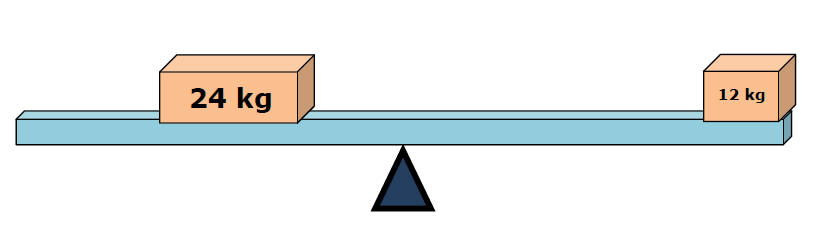 Diagram D: The Seesaw Equilibrium
I. Torque ($\tau$ - Tau)
Torque is a rotating force that causes angular acceleration.
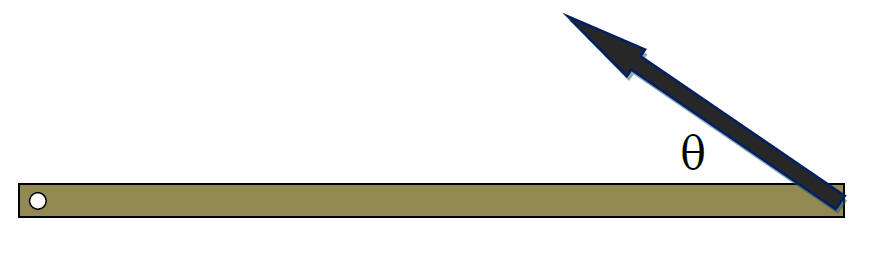
It depends on the applied force ($F$) and the displacement vector from the axis of rotation to the point of application.
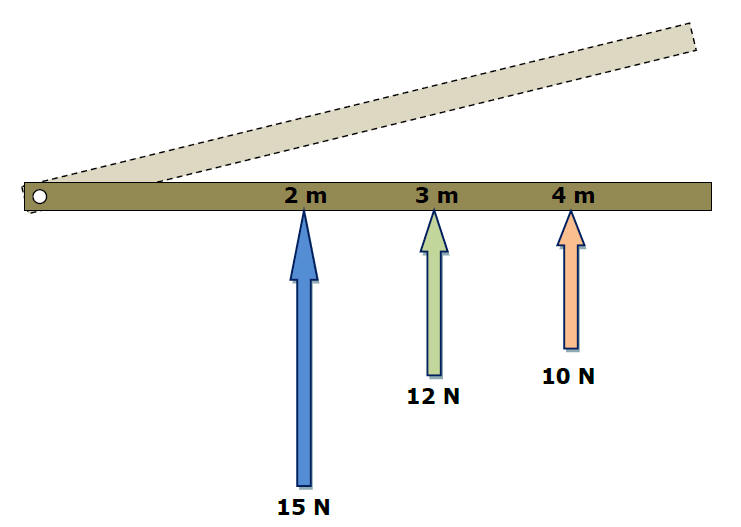 Diagram E: Angular Force Vector
The distance perpendicular to the line of action is called the moment arm or lever arm.
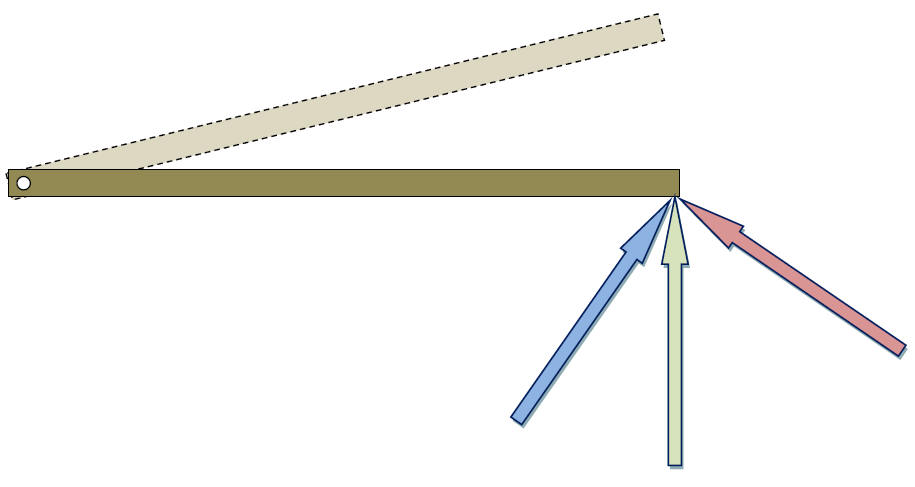
Torque is maximized when the force is applied at a 90-degree angle ($90^\circ$ or $\frac{\pi}{2}$ radians) to the lever arm.
Work vs. Torque Units
Although mathematically equivalent to Joules ($\text{N}\cdot\text{m}$), torque units are *always* written as **$\text{m}\cdot\text{N}$** (or $\text{N}\cdot\text{m}$). **Never use Joules for Torque!** Joules are reserved for scalar energy, while torque is a rotational vector.
Assigned Reading
Review rotational dynamics concepts in detail:
📖 Giancoli p. 220 | Questions 23, 25
Video Experiment: Applications of Torque in Real Life