Projectile Fired at an Angle - Problems II (AP)
AP-level worked problems: peak height, time of flight, and range at an angle

AP Problem Set - combining vertical and horizontal kinematics to solve angled-launch projectiles, including quadratic time-of-flight solutions
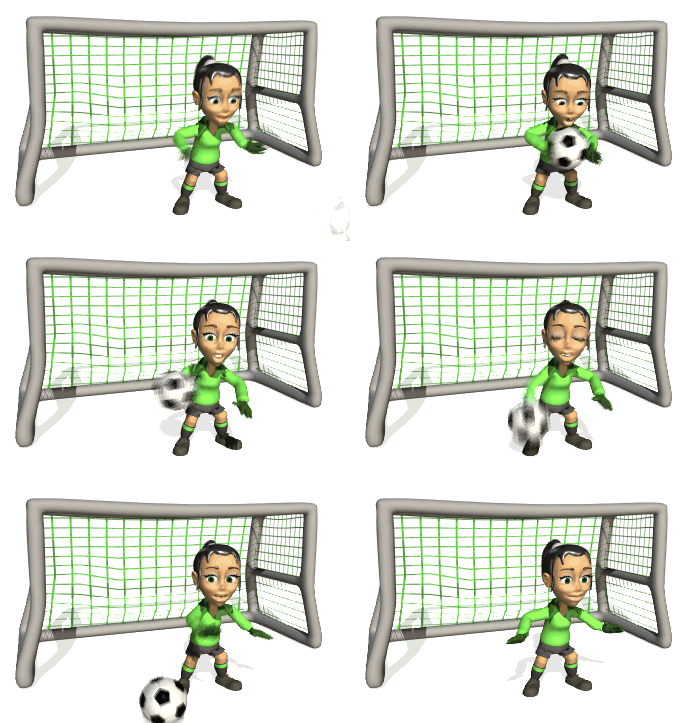
The football has 2 velocities. Which velocity is the football player matching?
Problem 1
A projectile leaves the ground at an angle of 60.° and a speed of 100. m/s (level ground).
Find: (a) the object's maximum height & (b) total time in the air.
(a) First find the initial vertical component of the object's velocity
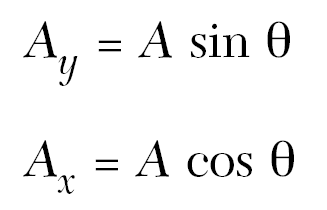
(a) Now find the maximum height
(b) Total time in the air
Problem 2
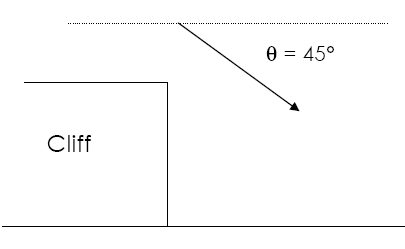
A rock is thrown from a cliff with an initial speed of 40. m/s at an angle of 45.° below the horizontal.
Find: (a) if the rock strikes the ground in 1.0 sec, the height of the cliff.
(a) What is the vertical component of the initial velocity?
(b) If the rock strikes the ground in 1.0 sec, what is the height of the cliff?
Problem 3
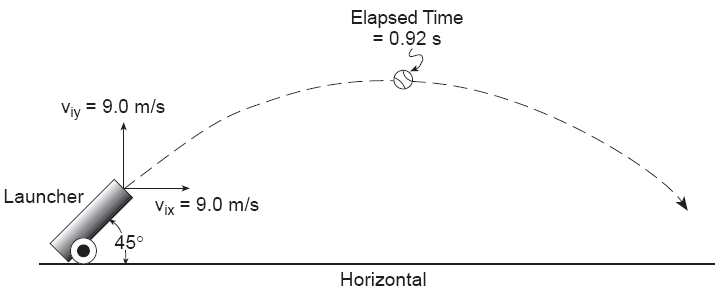
A ball is launched at 45.° with Vix = Viy = 9.0 m/s.
(a) At peak height, Vx = ?
(b) Total time in the air?
(c) What will the horizontal velocity be just before it hits the ground?
Problem 4
A wild bowler releases his bowling ball at a speed of 15 m/s and an angle of 34.0° above the horizontal, leaving his hand at a height of 2.20 m above the ground.
Find: the horizontal distance the bowling ball travels.
Problem 5
The ammunition fired from an M-16 rifle has a muzzle velocity of 1000 m/s. A sniper perched on a tower 50 m high aims at a target and fires. Neglect air resistance.
(A) The sniper aims her rifle 53.1° above the horizontal. How far away from the platform does the bullet hit the ground?
(B) With what speed would the bullet hit?
(C) If the target is 500 meters away on a platform 50 meters high, what angle would the sniper have to make with her gun to hit the target?
The Monkey and the Hunter
Monkey and Hunter — Don Ion
(offsite)
Flash Physics — Don Ion
St. Mary's U. Astronomy and Physics Dept.
| Onsite |
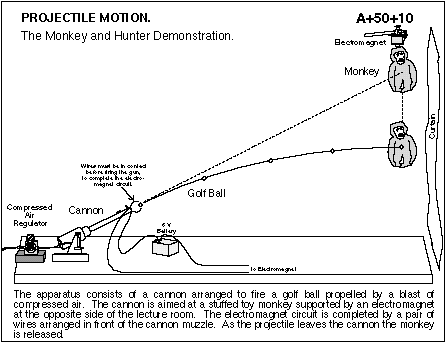
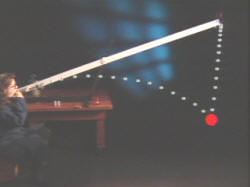
Monkey and Hunter (TeacherTube video)

Continuing your studies? Intro to Circular Motion
Check Your Understanding
5 quick questions — pick an answer to see if you’re right.
1. A projectile is launched at 100. m/s at 30.° above level ground. Using g = 10. m/s², what is its total time in the air?
2. For that same projectile (Viy = 50. m/s, g = 10. m/s²), what is its maximum height?
3. A rock is thrown from a cliff with Viy = 20. m/s downward and hits the ground 1.0 s later. Using g = 10. m/s², how high is the cliff?
4. A ball is launched at 45° with Vix = Viy = 9.0 m/s. What is its speed at the peak of its path?
5. Solving a launch-from-a-height problem with the quadratic formula gives t = 1.99 s and t = −0.225 s. What is the time of flight?
