Projectile Fired at an Angle
Breaking initial velocity into horizontal & vertical components

Launching a projectile at an angle splits its initial velocity into horizontal (Vix) and vertical (Viy) components — together they determine how far and how long it flies.

A soccer player kicks a soccer ball twice with the same force and contact time. One kick was at an angle of 20° and the other kick was at an angle of 40°. Which soccer ball went further? (greater dx)
How many things would you have to get right to make this work?
Show Me The Physics Website
Projectile Fired at an Angle
(not 0° or 90°)
Projectile Path is Parabolic
Baseball Throw
showmethephysics.com
Victoria Lollo - Class of 2007
Angle and Initial Velocities
Projectile fired at 5 m/s:
Projectile fired at 5 m/s.
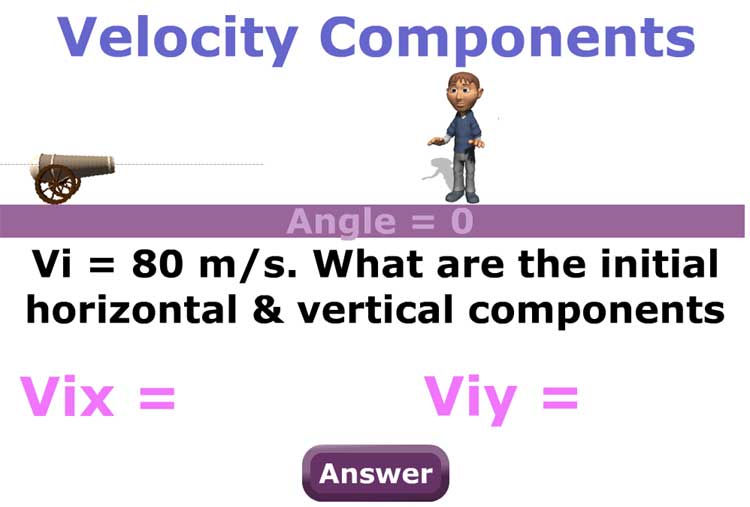
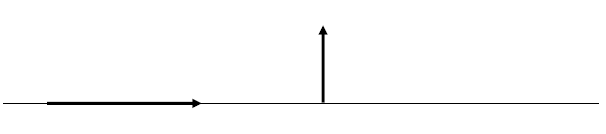
Find: Vix and Viy if θ = 0°.
Projectile fired at 5 m/s.
If θ = 90°, then…?
If angle is not 0° or 90°, the initial velocity is part vertical and part horizontal.
[ Flash ]
Show Me The Physics
Show Me The Physics Website
*** To understand this type of motion we must breakup the velocity into horizontal and vertical parts (components)
Finding Initial Horizontal & Vertical Components (parts)
V - velocity of projectile fired
Vix - initial V in x direction
Viy - initial V in y direction
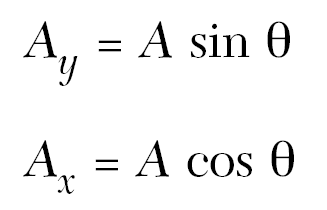
Use Trig. to Find Vix and Viy
Since…
cosθ = A/H = Vix/V
Cross multiply:
Since…
sinθ = Opp./Hyp. = Viy/V
Cross multiply:
During the time the ball is in the air, how many times is the vertical velocity zero?

MichaelMaggs Edit by Richard Bartz
Ex) A baseball is thrown upward at an angle of 30.° and a velocity of 6.0 m/s.
Find: the initial horizontal & vertical components of the baseball's velocity.
Vertical Component
Horizontal Component
Other Important Facts
dx = Vxt (memorize)
ay = -9.8 m/s² Ascending (down –)
ay = +9.8 m/s² Descending (down +)
Vy at Peak = 0
Quick Review: Mystery Planet
tpeak = ½ ttotal • V = at • dx = Vxt
Angles and Ranges
What angle produces the greatest range?

Don Ion
Name another angle that will give the same range (dx)
Minimum Range
Maximum Range
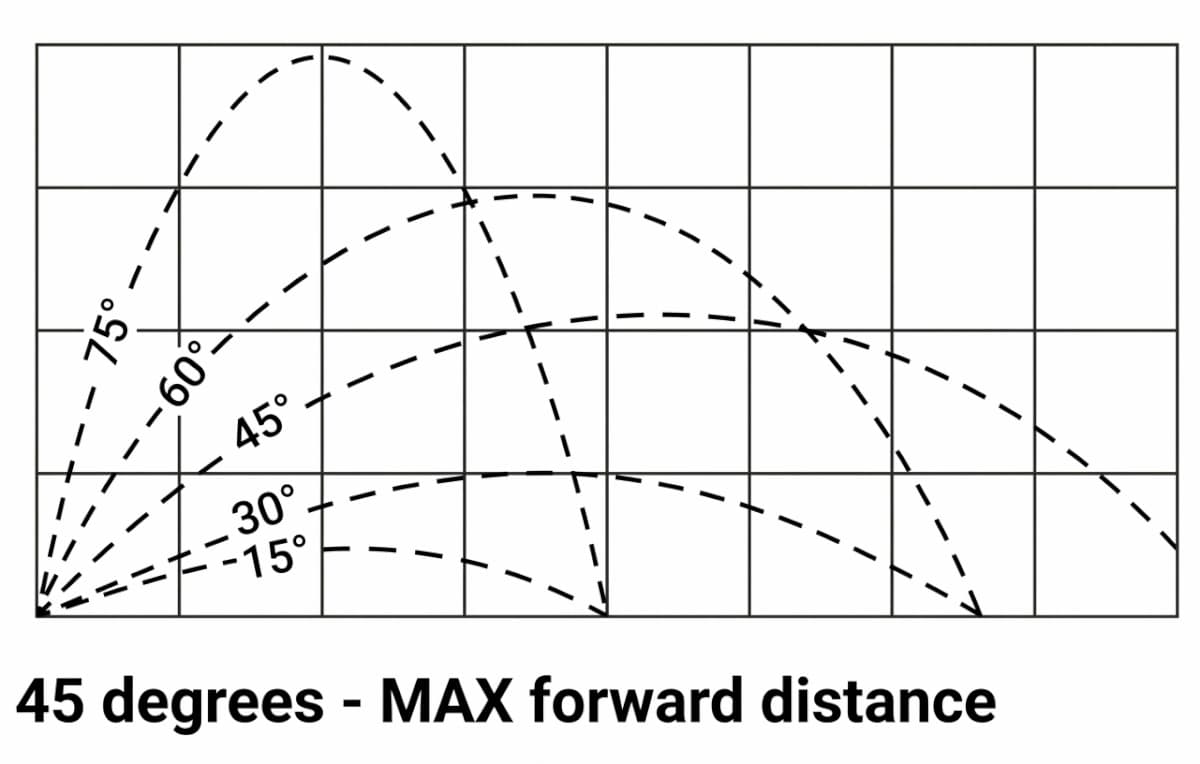
Angle with Longest
Time in Air?
[ HTML5 ]
Show Me The Physics Website
Ex) Which angle of projection causes a projectile to stay in the air longer?
50 or 70 degrees?
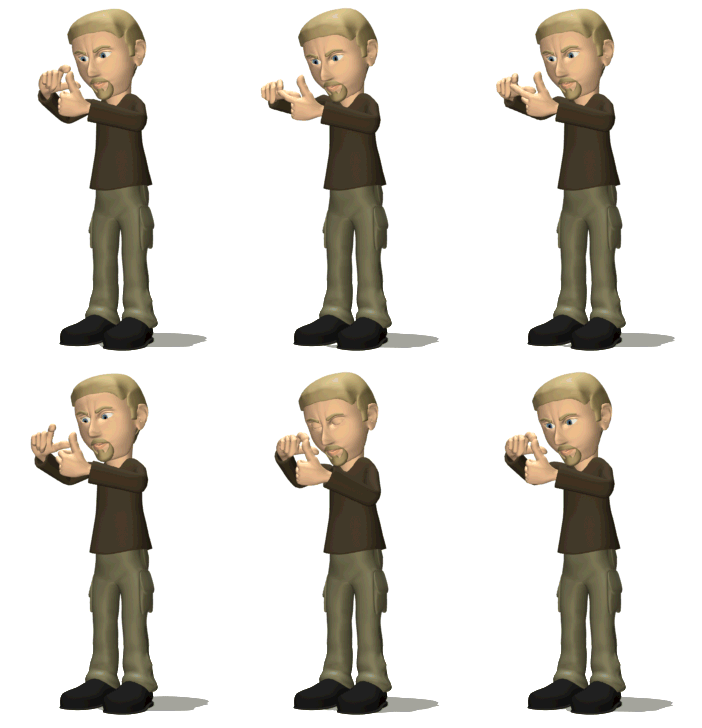
Ranking Task
1. A rock is thrown at various angles but with the same initial velocity.
2° 70° 20° 5° 60°
Find: rank the angles above from smallest horizontal displacement (dx) to the greatest.
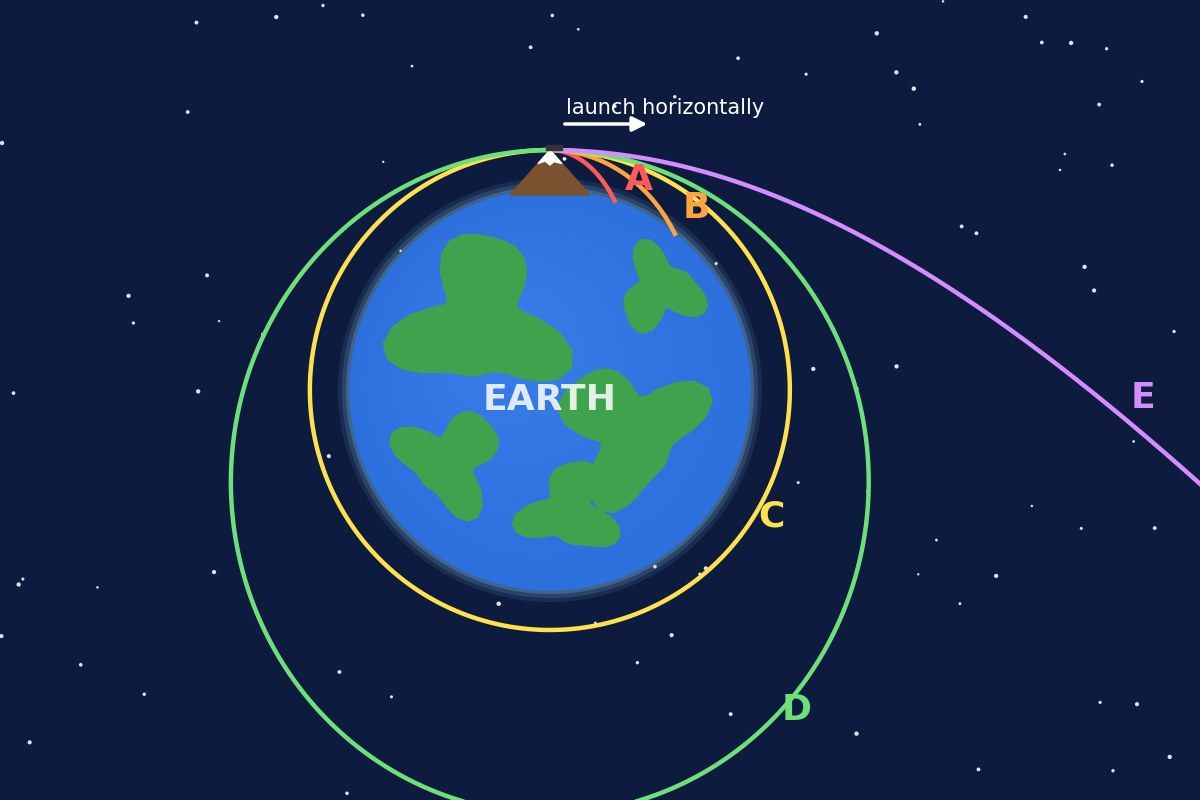

NYSSLS Reading Passage · 2D Motion
Newton's Cannonball: The Thought Experiment That Explained Orbits
Open Reading Passage →Check Your Understanding
5 quick questions — pick an answer to see if you’re right.
1. A baseball is thrown at 6.0 m/s at 30.° above horizontal. What is the initial vertical component of its velocity?
2. A projectile is launched at 10. m/s at 60.° above horizontal. What is its initial horizontal component?
3. Ignoring air resistance, what launch angle gives the greatest range over level ground?
4. A rock thrown at 30° lands a certain distance away. At the same speed, which other angle gives the same range?
5. At the very top of an angled projectile's path, which is true?