AP Physics 1
Module - Gravity

A. Defined - Gravity is the of between any two objects in the universe.
$G$ – Universal Gravitational constant $= 6.67 \times 10^{-11} \text{ N}\cdot\text{m}^2/\text{kg}^2$
$m_1$ and $m_2$ – masses of the two attracting objects
r - The distance measured between the of the two objects.
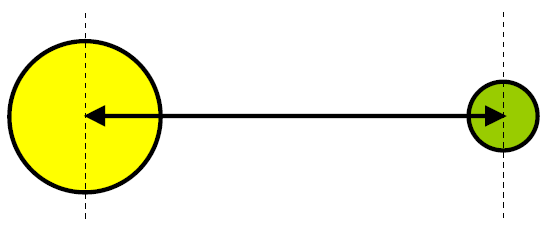
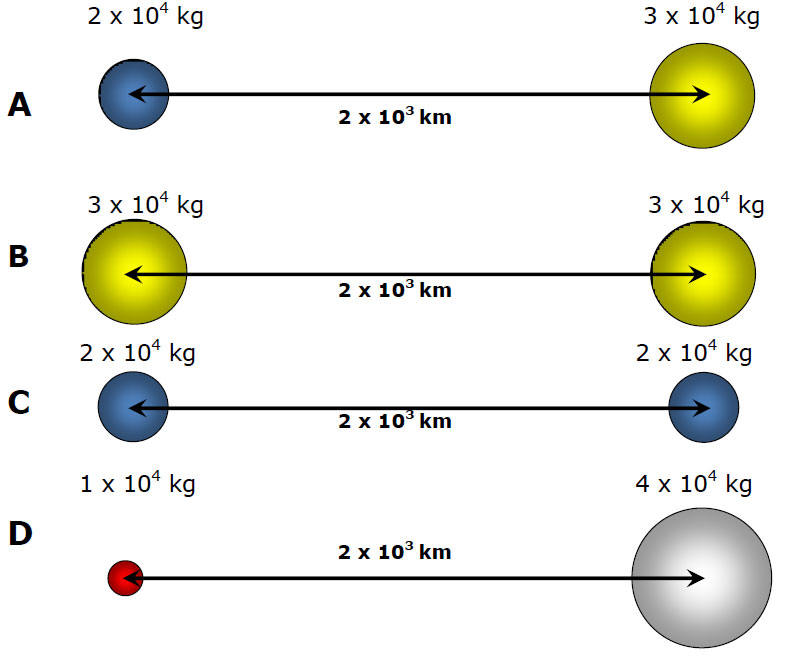
State the relationship between Gravitational Force (F) and distance (r): . What is the plot shape for this relationship?
If the distance between two objects is tripled, the gravitational force between them will change by a factor of
State the relationship between Gravitational Force (F) and mass (m): . What is the plot shape for this relationship?
Example 1: Two objects, with masses $m_1$ and $m_2$, are originally a distance r apart. The magnitude of the gravitational force between them is $F$. The masses are changed to $2m_1$ and $2m_2$, and the distance is changed to $4r$. What is the magnitude of the new gravitational force in terms of $F$?
3 questions on I. Defined & Relationships — pick an answer to check yourself.
1. If the distance between the centers of two objects is tripled, the gravitational force between them becomes…
2. Two 100 kg spheres have centers 2.0 m apart. What is the gravitational force between them? (G = 6.67 × 10⁻¹¹ N·m²/kg²)
3. Two masses feel gravitational force F. Both masses are doubled and the distance is made 4 times larger. What is the new force?
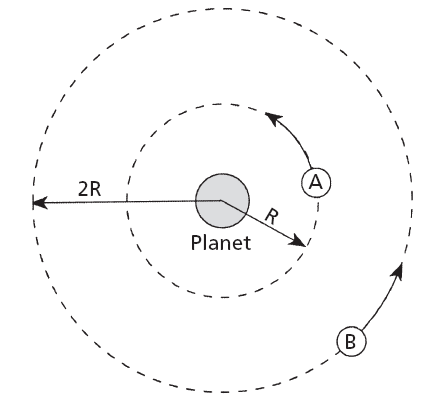
Example 2: Satellite A and Satellite B have the same mass and are orbiting the same planet. If the gravitational force on satellite A is 160,000 N and it is at a distance $R$ from the center, what is the gravitational force on satellite B if it is at a distance of $2R$?
Example 3: A rocket weighs 18,000 N at the Earth's surface. If the rocket rises to a height where its total distance from the center of the Earth is 3 Earth radii ($3R_e$), calculate its weight at that new location.
When an object is on the Earth, the net gravitational force on that object is defined as its weight ($F_g = mg$).
C. Weight – The net gravitational force exerted on an object by a celestial body.
3 questions on II. Satellite & Weight — pick an answer to check yourself.
1. The gravitational force on a satellite at distance R from a planet's center is 160,000 N. What is the force on an identical satellite at 2R?
2. A rocket weighs 18,000 N on Earth's surface. What does it weigh at a distance of 3 Earth radii from Earth's center?
3. An astronaut moves from Earth's surface to 2 Earth radii from Earth's center. What happens to her mass and weight?
Variations in Gravity Near the Earth's Surface:
New York - 9.803 m/s² / Denver - 9.796 m/s² / North Pole - 9.832 m/s²
Based on the formula for gravitational acceleration, what physical factor explains the differences in $g$ at these locations?
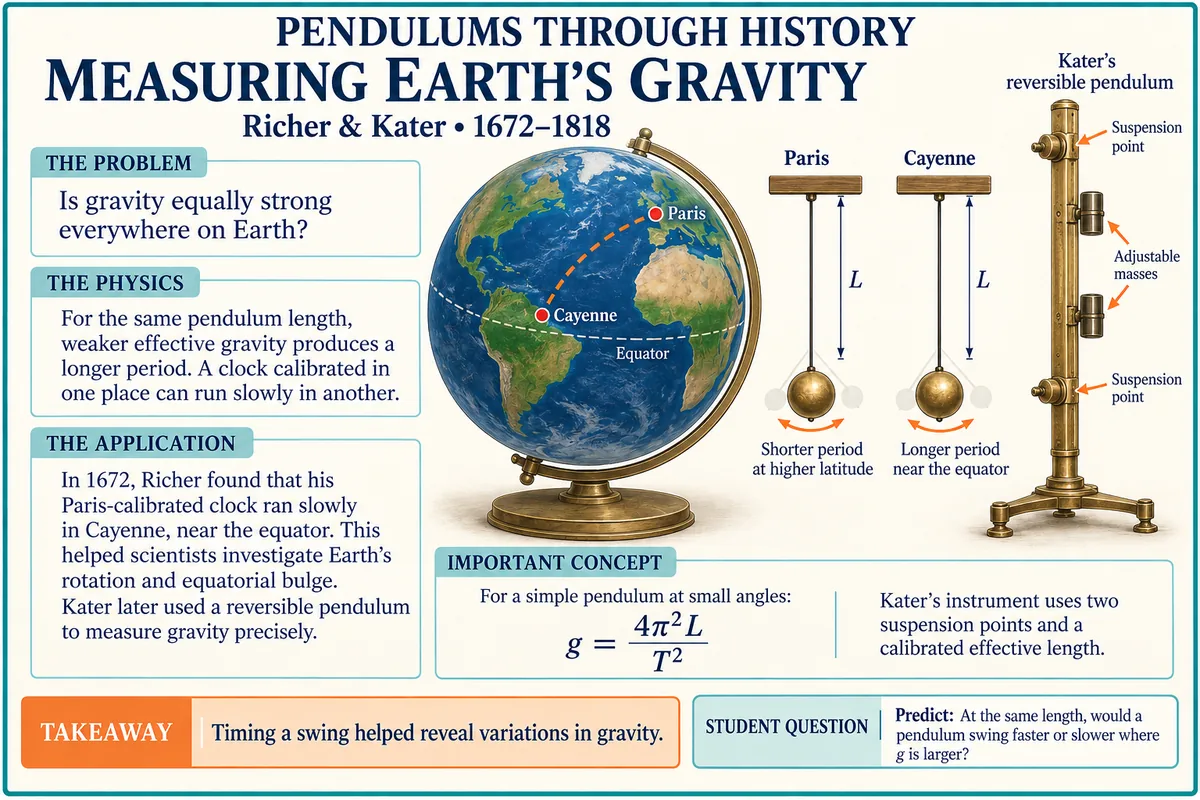
This is exactly how these tiny differences in $g$ were first discovered: in 1672, Jean Richer noticed his pendulum clock ran slow near the equator — the same idea Henry Kater later refined into a precision instrument. Click the image for a larger view.
Simplify the expression above to find the acceleration due to gravity $g$ on a planet's surface: $g = $
In this formula, $M_e$ represents the of the planet.
Example 4: Mars has a mass approximately 1/10 that of Earth and a diameter approximately 1/2 that of Earth. Based on this data, calculate the acceleration of a falling body near the surface of Mars in terms of $g$.
Giancoli p. 131 #28: A 2100-kg spacecraft is in a circular orbit at a distance of 2.0 Earth radii from the Earth's center. Calculate the magnitude of the force of gravity exerted on the spacecraft by the Earth.

Giancoli p. 131 #32: A hypothetical planet has a radius 1.5 times that of Earth, but has exactly the same mass as Earth. What is the value of the acceleration due to gravity on the surface of this hypothetical planet?

Compare surface g on Earth, the Moon, Mars, and Jupiter, then drag the test mass to see g = Gm/r² fall off with distance.
3 questions on III. Surface Gravity — pick an answer to check yourself.
1. A planet has the same mass as Earth but 1.5 times Earth's radius. What is g on its surface? (Earth's g = 9.8 m/s²)
2. Mars has about 1/10 of Earth's mass and 1/2 of Earth's diameter. Its surface gravity is about…
3. g is 9.803 m/s² in New York but only 9.796 m/s² in Denver. What best explains the difference?
Example 5: Use the principles of circular motion and universal gravitation to prove that the orbital velocity of a satellite is independent of its own mass.
a) From your derivation, identify which two physical quantities determine the orbital velocity $v$ and the orbital period $T$:
b) How does decreasing the orbital radius affect the orbital velocity $v$ and the orbital period $T$ ?
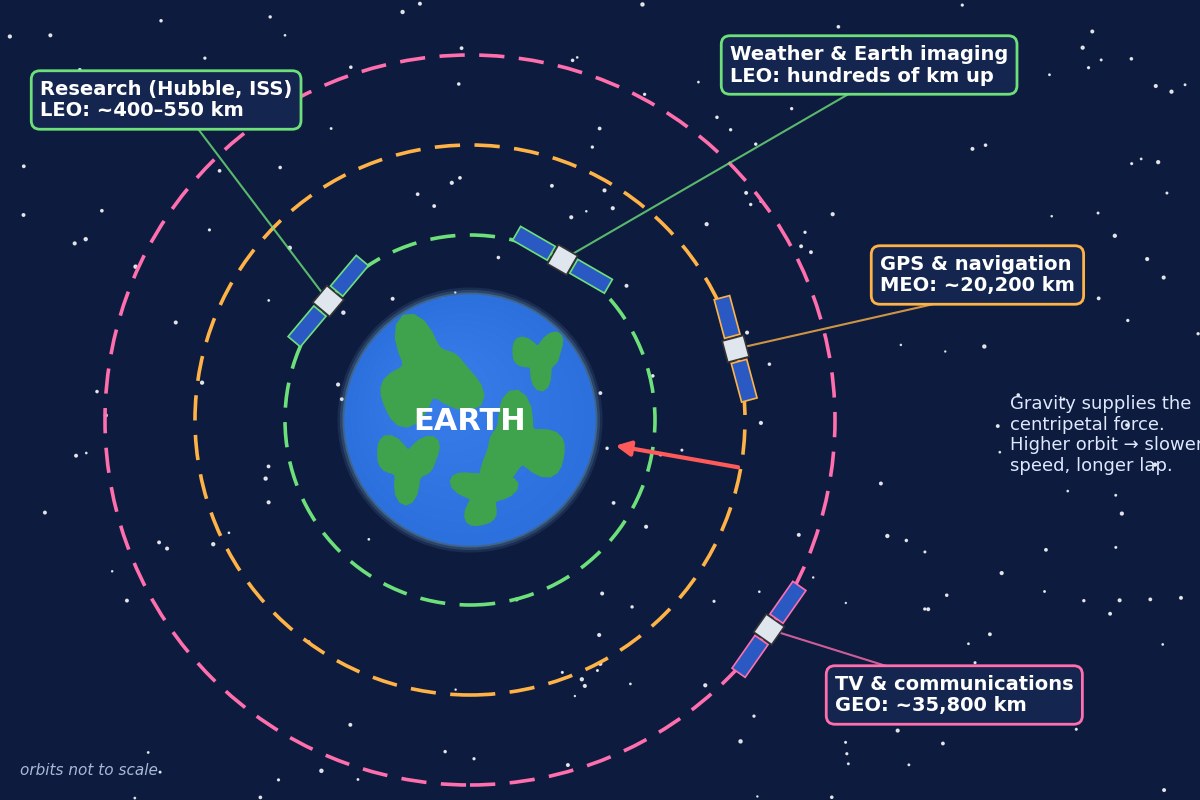

NYSSLS Reading Passage · Circular Motion
Eyes You'll Never See: The Many Uses of Artificial Satellites
Open Reading Passage →3 questions on IV. Orbital Proofs — pick an answer to check yourself.
1. A satellite orbits a planet with GM = 4.0 × 10¹⁴ m³/s² at r = 1.0 × 10⁸ m. What is its orbital speed?
2. Satellite B has twice the mass of satellite A, and both orbit Earth at the same radius. Compared with A, B's orbital speed is…
3. If a satellite moves to a smaller circular orbit, what happens to its orbital speed v and period T?
1. Lunar Eclipse Net Force: During a total lunar eclipse, the Moon, Earth, and Sun are aligned in a straight line, with the Earth positioned directly between the Moon and the Sun. Use the following data to solve:
Mass of the Moon ($m_m$) = $7.4 \times 10^{22} \text{ kg}$
Mass of the Earth ($M_e$) = $6.0 \times 10^{24} \text{ kg}$
Mass of the Sun ($M_s$) = $2.0 \times 10^{30} \text{ kg}$
Earth-Moon distance ($r_{em}$) = $3.8 \times 10^8 \text{ m}$
Earth-Sun distance ($r_{es}$) = $1.5 \times 10^{11} \text{ m}$
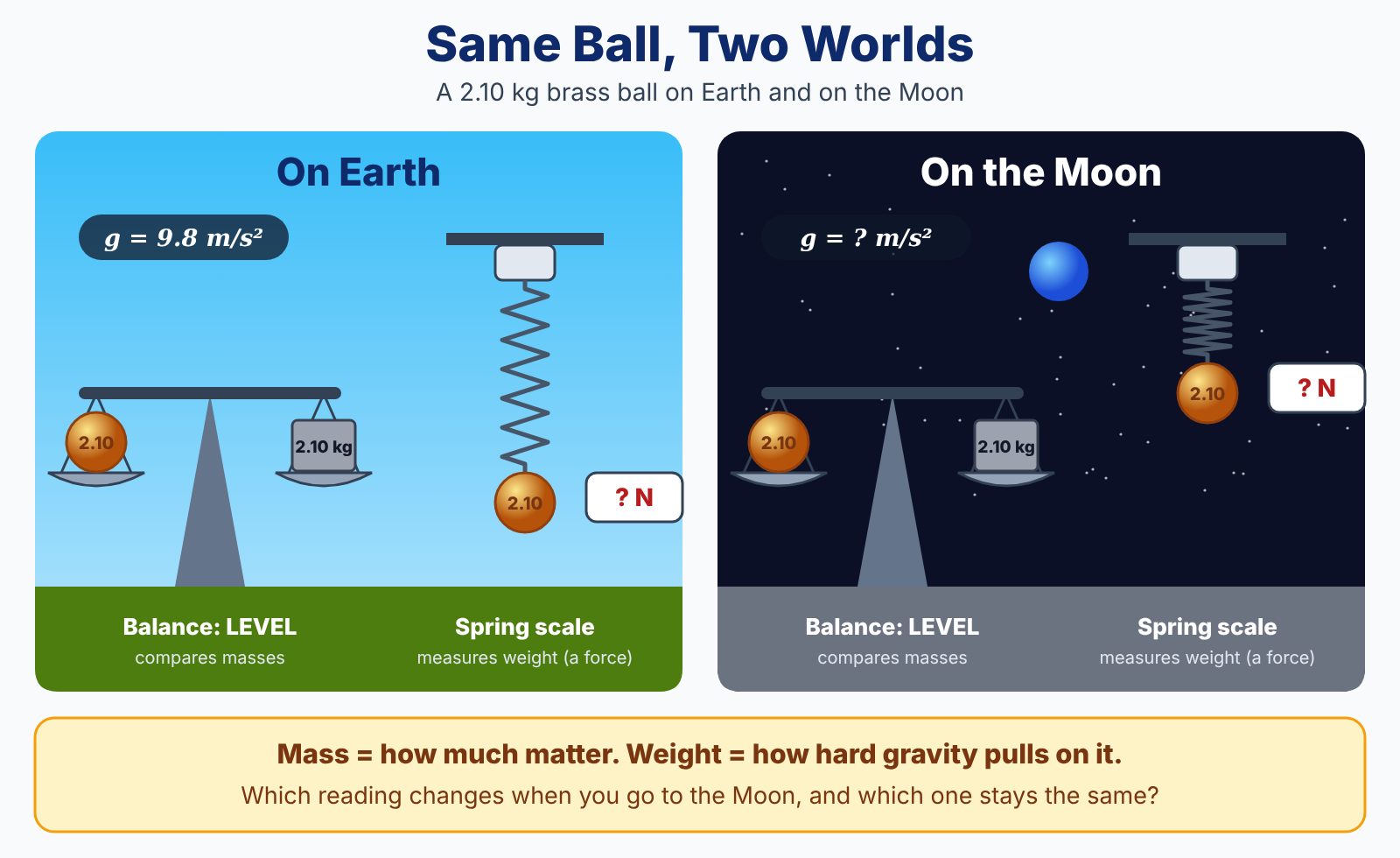
2. 2.10-kg brass ball transported to Moon: A solid brass ball is manufactured with a mass of 2.10 kilograms. It is transported to the surface of the Moon.
Radius of the Moon = $1.74 \times 10^6$ meters
Mass of the Moon = $7.35 \times 10^{22}$ kilograms
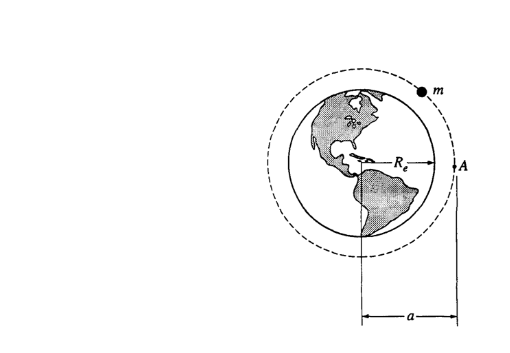
3. Earth Satellite Variable Derivation: A satellite of mass $m$ is placed in a stable circular orbit around the Earth. The Earth has a mass $M_e$ and a radius $R_e$. The satellite orbits at a distance $a$ measured from the center of the Earth. Express all algebraic answers strictly in terms of $a$, $m$, $M_e$, $R_e$, and $G$.
3 questions on VI. Extended Analysis — pick an answer to check yourself.
1. A satellite moves in a circular orbit. How much work does gravity do on it during one complete orbit?
2. A 2.10 kg brass ball is taken to the Moon, where g ≈ 1.6 m/s². What is its weight there?
3. A satellite orbits at distance a from Earth's center, where a is greater than Earth's radius Re. How does its acceleration compare with g at Earth's surface?
4. Jupiter Satellite: A research satellite is in a stable circular orbit around Jupiter at a radius $R$. Jupiter has a mass $M_J = 1.90 \times 10^{27} \text{ kg}$ and a mean radius $R_J = 7.14 \times 10^7 \text{ m}$.
5. Sojourner Rover Case Study: The Pathfinder spacecraft successfully landed on the Martian surface on July 4, 1997. It deployed a small rover named Sojourner to explore the landing site. Use the planetary and rover data provided below to complete the following analysis.
Mars Planetary Data: Radius = $0.53 R_e$, Mass = $0.11 M_e$.
Sojourner Rover Data:
Mass = $11.5 \text{ kg}$
Wheel diameter = $0.13 \text{ m}$
Stored Energy in Battery = $5.4 \times 10^5 \text{ J}$
Power consumption for driving = $10 \text{ W}$
Constant driving speed = $6.7 \times 10^{-3} \text{ m/s}$
NYSSLS Reading Passage · Dynamics
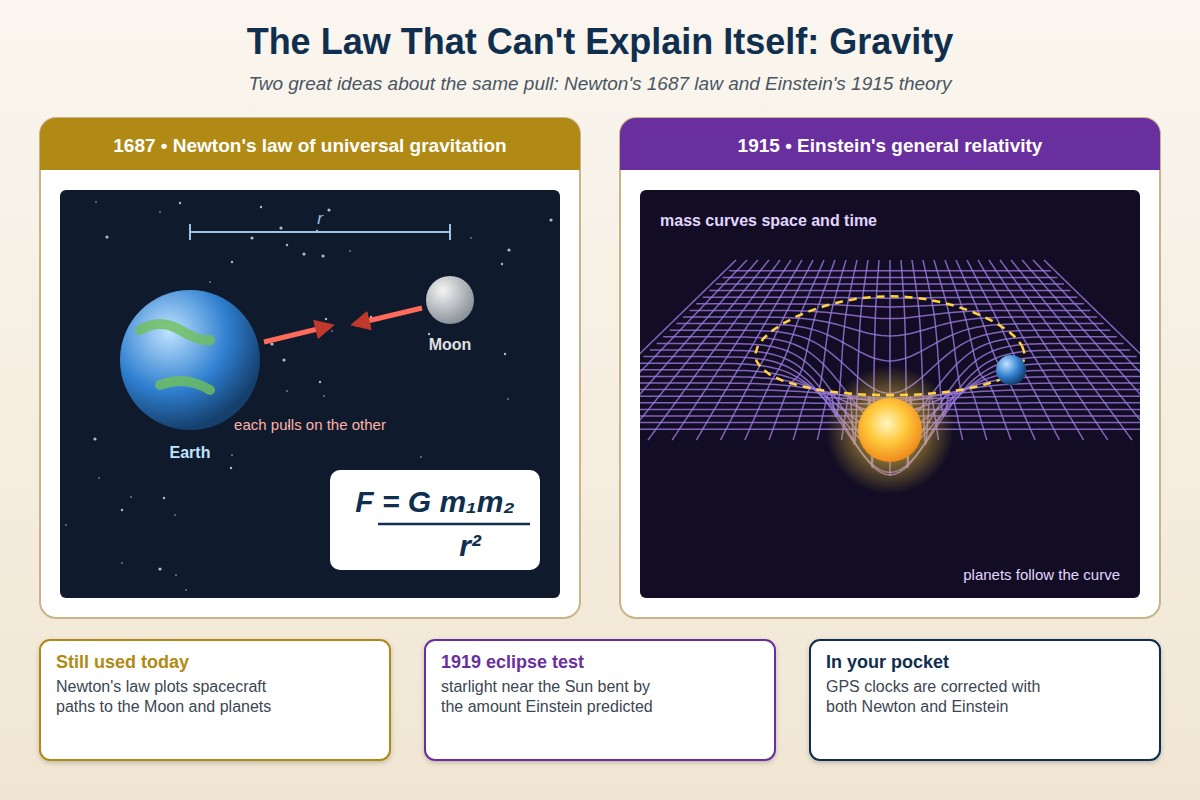
The Law That Can't Explain Itself: Gravity and the Biggest Myth in Science
Open Reading Passage →5 quick questions — pick an answer to see if you’re right.
1. Two masses m₁ and m₂ attract with force F at distance r. Both masses are doubled and the distance is changed to 4r. What is the new force?
2. A rocket weighs 18,000 N at Earth's surface. What is its weight at 3 Earth radii from Earth's center?
3. Mars has about 1/10 Earth's mass and 1/2 Earth's diameter. What is the gravitational acceleration at Mars's surface in terms of g?
4. For a satellite in a circular orbit, which quantities determine its orbital speed?
5. How much work does gravity do on a satellite during one complete circular orbit?
A satellite feels a gravitational force F when it is a distance r from Earth's center. A student predicts the force at 2r and 3r:
Student: "Gravity gets weaker as you move away, so at twice the distance the force is half, F/2. At three times the distance it's one-third, F/3."
What, if anything, is wrong? If something is wrong, explain the error and fix it. If nothing is wrong, explain why it is correct.
More Gravity Concept Challenges →