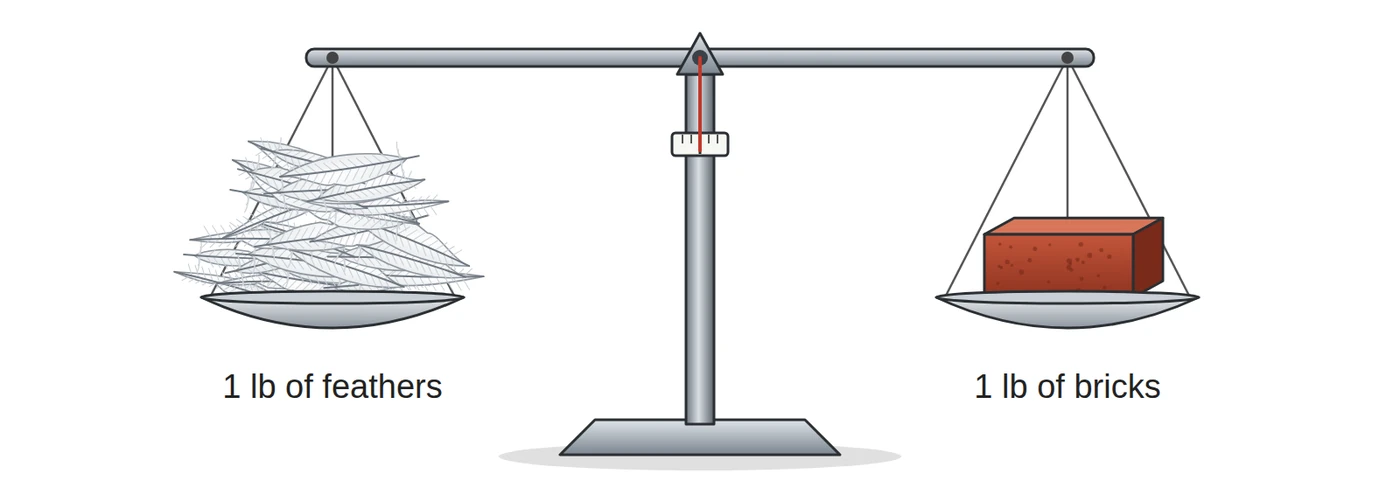
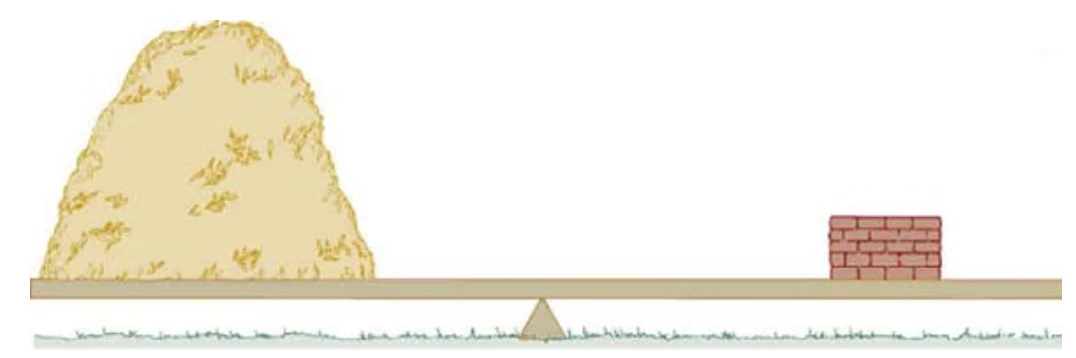
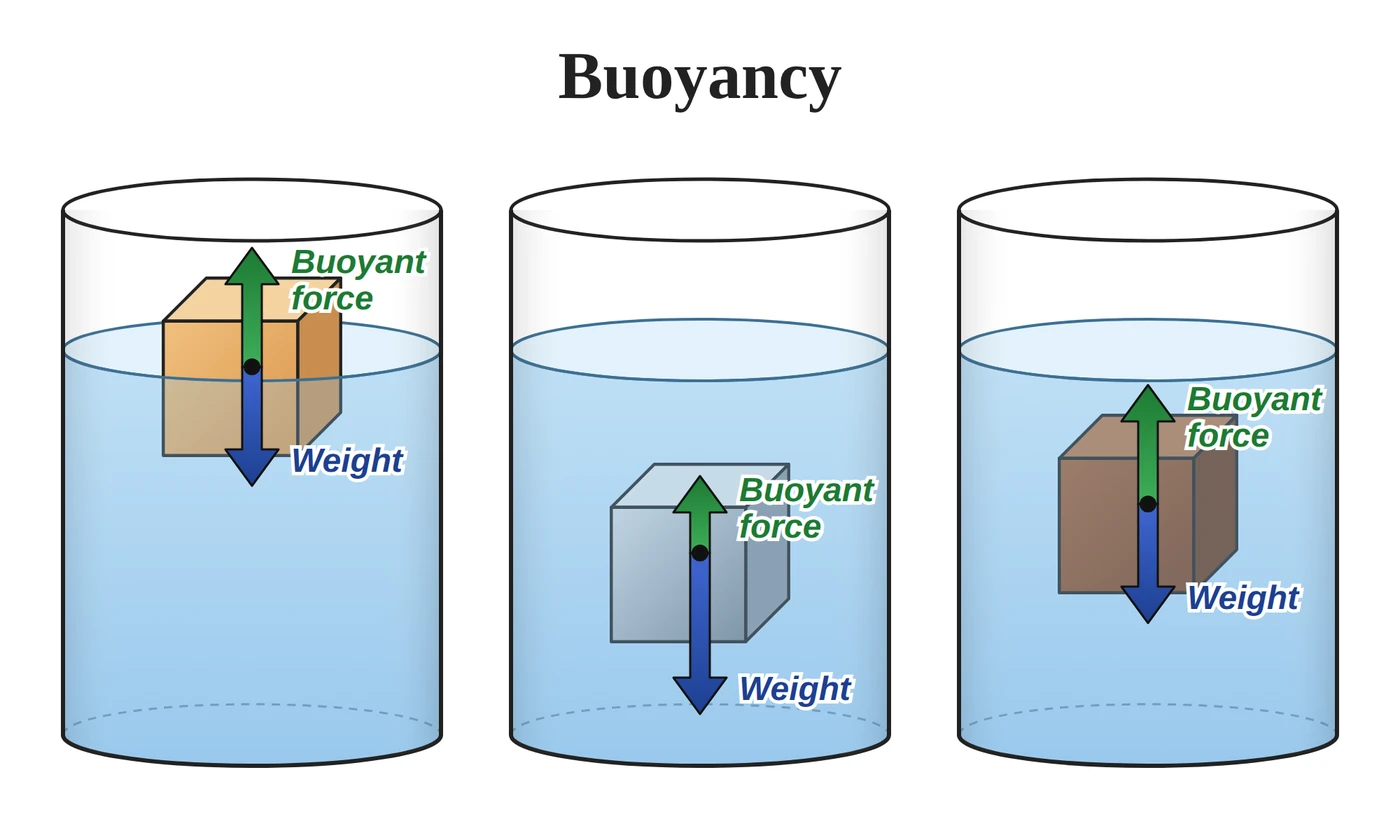
The same mass of feathers and bricks would have very different volumes. You would need a much larger pile of feathers to weigh the same as a pile of bricks.
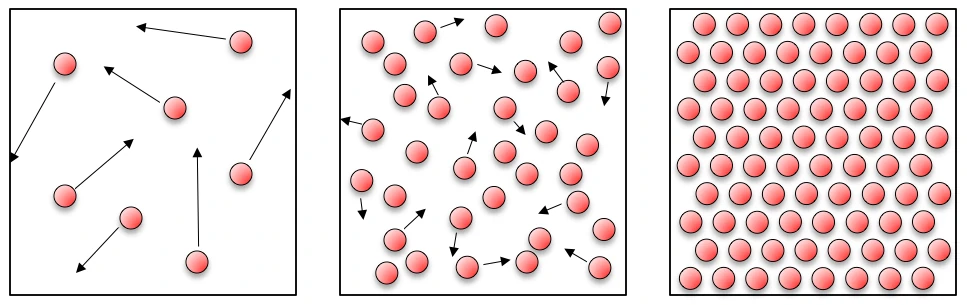
low density, large volume | high density, small volume
C. Weight of a Fluid
Weight of a fluid – the force gravity exerts on a fluid:
$$F_g = mg = \rho V g$$
D. Specific Gravity
Specific Gravity – the density of a fluid compared to the density of .
Example 3: Ice has a density of $934 \text{ kg/m}^3$.
(a) What percent of an ice cube is submerged and what percent is above water level in freshwater?
(b) Is it the same for salt water? ($\rho = 1030 \text{ kg/m}^3$)
(c) A ship floats in both freshwater and saltwater. Compared to the freshwater, the volume of water displaced in the salt water is:
ClaimB) Less.
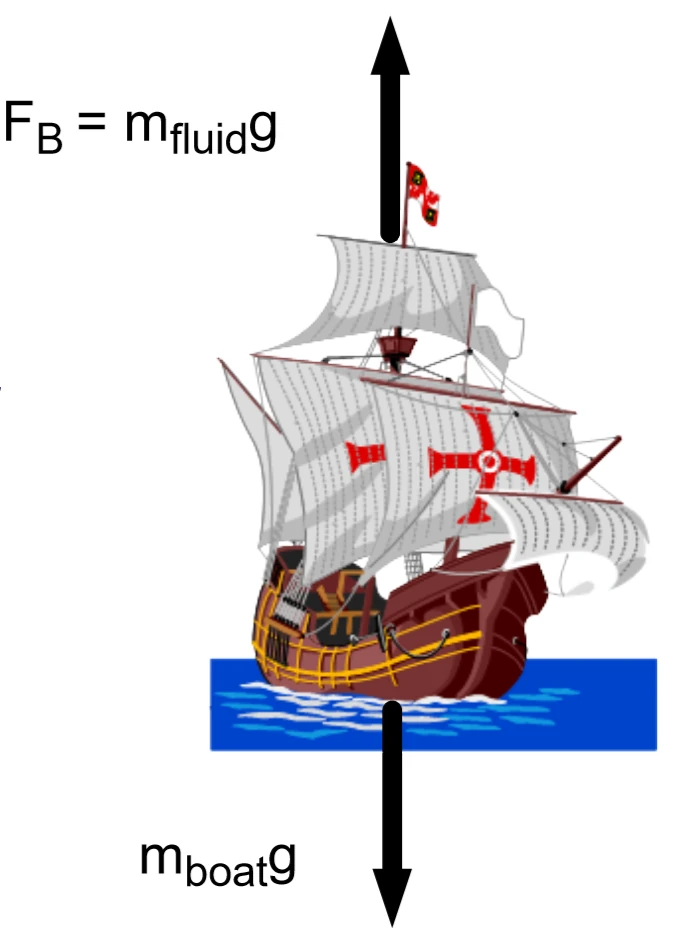
ReasoningFloating in either one, $F_B = mg$, so the ship displaces the same weight of water. Salt water is denser, so $V_{sub} = \frac{mg}{\rho g}$ is smaller.
93.4% submerged, $100\% - 93.4\%$ $= 6.6\%$ above water
(b) Salt water: $\dfrac{934}{1030} \times 100$ $= 90.7\%$ submerged
No – in salt water 90.7% is submerged and 9.3% is above.
(c) Floating in either one: $F_B$ $= mg$ → the ship displaces the same weight of water
$V_{sub}$ $= \dfrac{mg}{\rho g}$ → salt water has a larger $\rho$, so a smaller $V_{sub}$
B) Less
G. Explain This
Video loads when this section opens…
H. Pressure
$$P = \frac{F}{A}$$
Pressure – the force exerted by a fluid over an .
Units: Pascal (Pa) $= \text{N/m}^2$
Concept: Suppose someone in a crowded room accidentally stomps on your foot with the heel of one shoe. Would you be better off if that person were (a) a basketball player wearing sneakers or (b) a petite woman wearing spike-heeled shoes?
(a) The basketball player – the same force is spread over a larger area, so less pressure ($P$ $= F/A$).
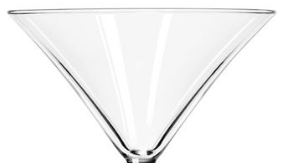
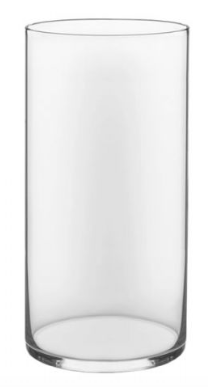
Compare Pressure: Two glasses have the same weight, so both exert the same force on the table. Glass A rests on a base of diameter L; glass B rests on a base of diameter 2L. Compare the pressure each exerts on the table.
Same weight → same force $F$ on the table
Glass B: twice the diameter → $4\times$ the area ($A$ $= \pi r^2$)
$P$ $= F/A$ → glass A exerts 4 times the pressure of glass B
Concepts:
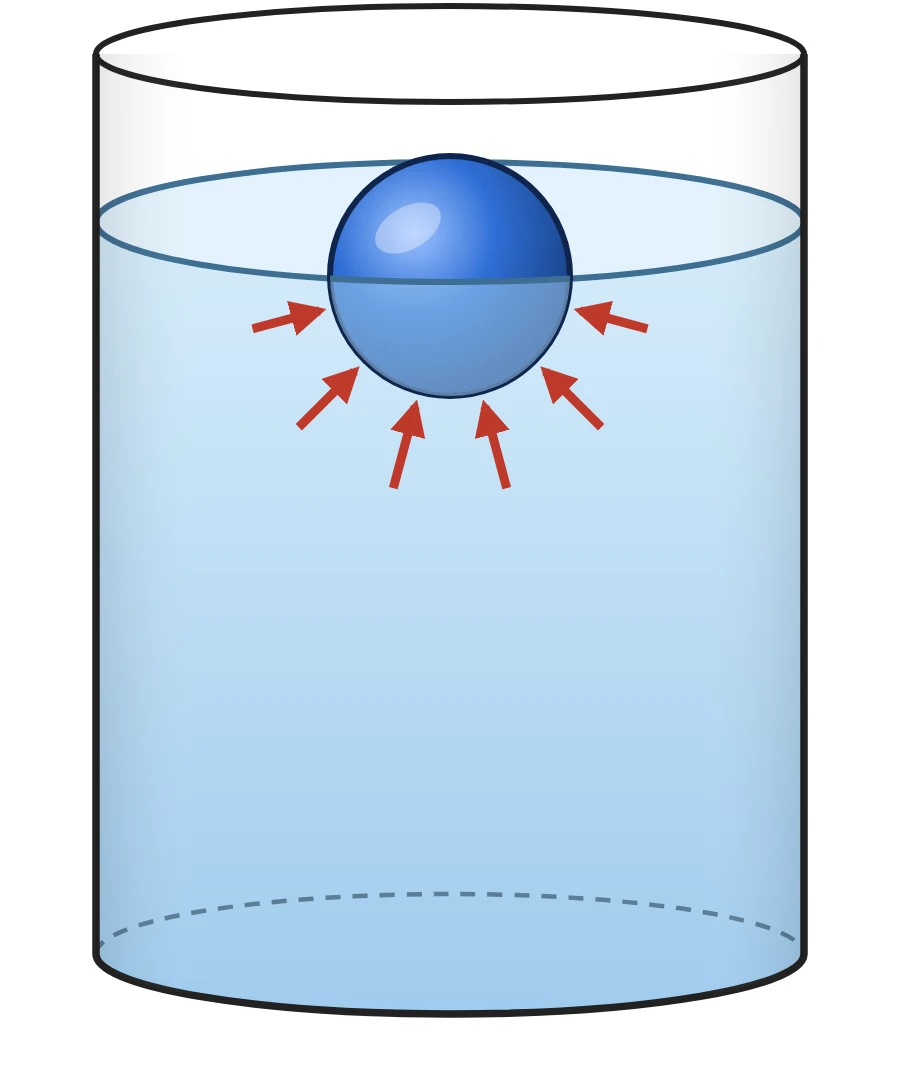
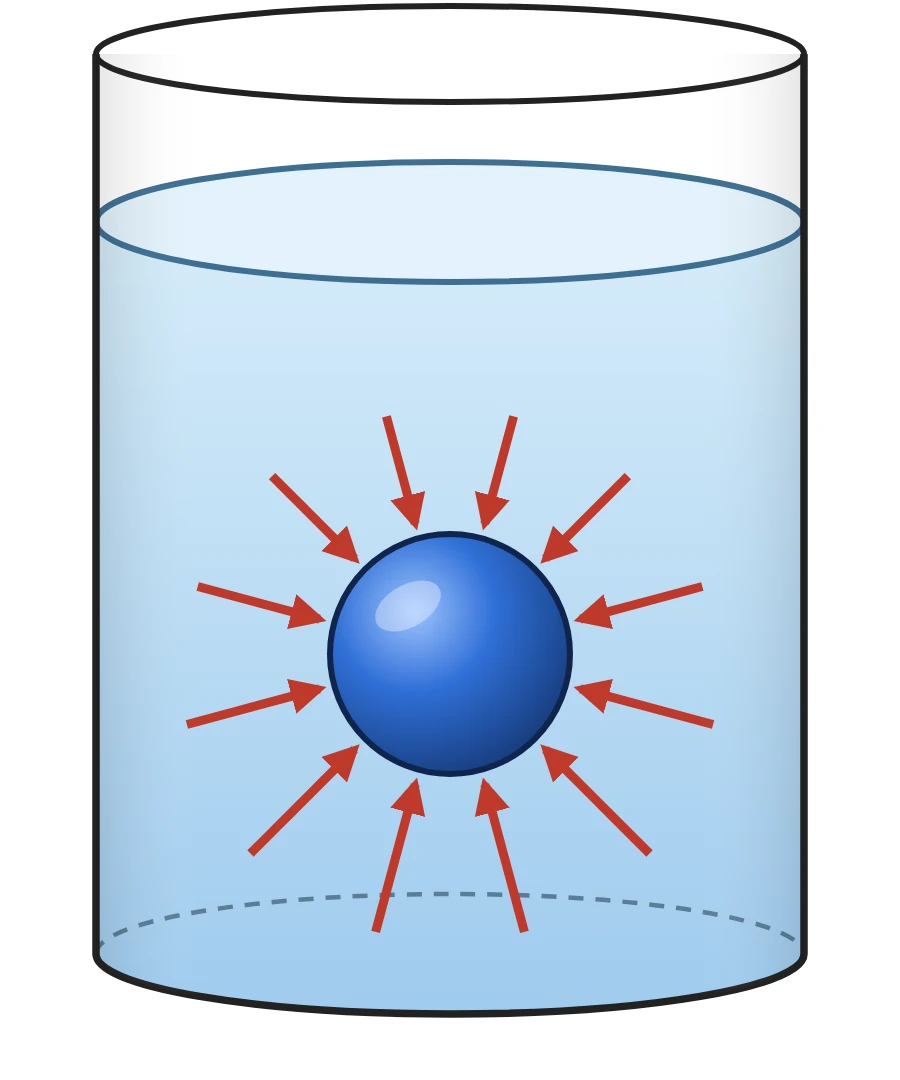
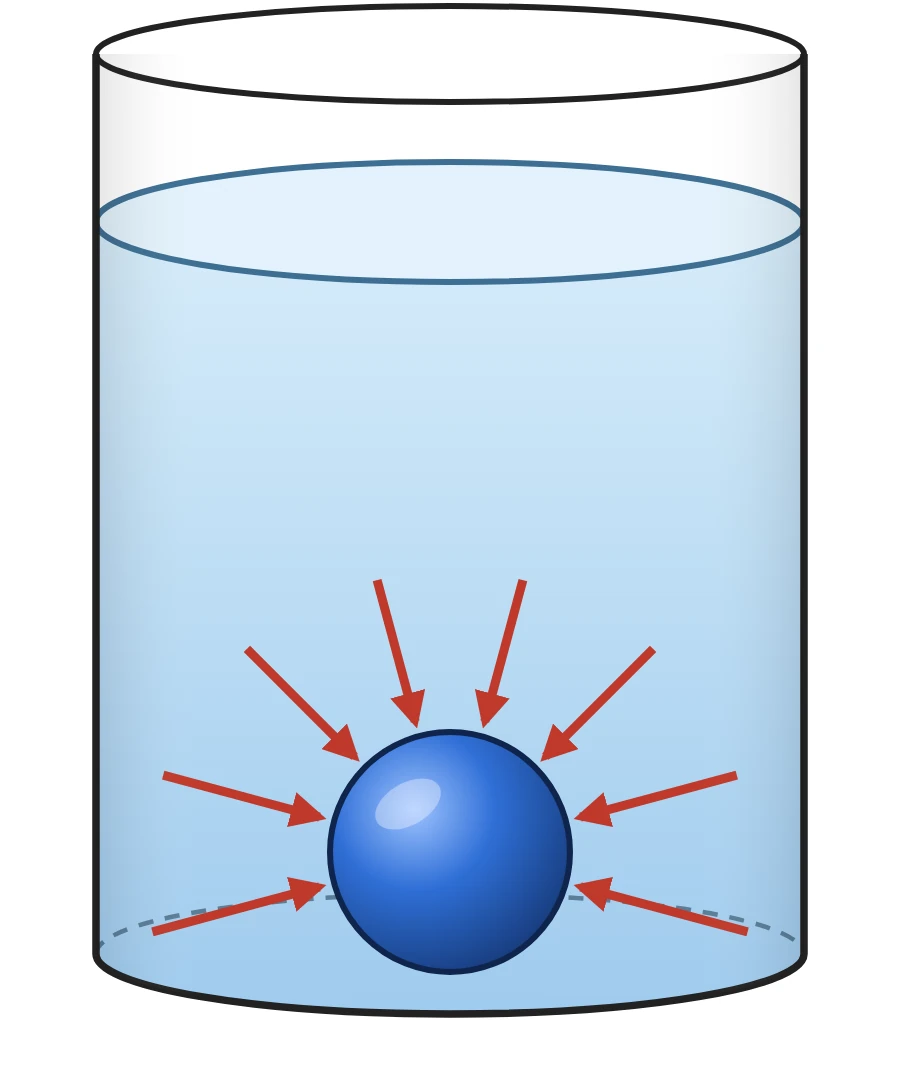
Pressure is the same in directions, and acts at to any surface.
A difference in pressure will create a . The direction of the force will be from pressure to pressure.
I. Atmospheric Pressure
Video loads when this section opens…
At sea level the atmospheric pressure ($P_0$) is about
Reasoning:A floating object displaces its own weight of fluid. The ship's weight is the same in both, but salt water is denser, so a smaller volume of salt water has that same weight.
Concepts:Floats when its density is LESS THAN the fluid. The basketball player (a) – the same force is spread over a larger area, so less pressure. Glass A exerts 4 times the pressure of glass B: twice the diameter means 4 times the area, and $P = F/A$. Pressure is the same in ALL directions and acts at RIGHT ANGLES to a surface; a pressure difference creates a FORCE directed from HIGH to LOW pressure.
Ex 4 – Claim:(a) About 5900 N down on the top. (b) The net force is zero.
Reasoning:The air pushes up on the bottom of the paper with the same pressure, so $\Delta P = 0$. The paper is not accelerating ($a = 0$), so $F_{net} = 0$.
II. Aim 32: Buoyancy Force (Archimedes' Principle)
Do Now: A ball will not float if its density is than the density of the liquid in which it is placed.
Video loads when this section opens…
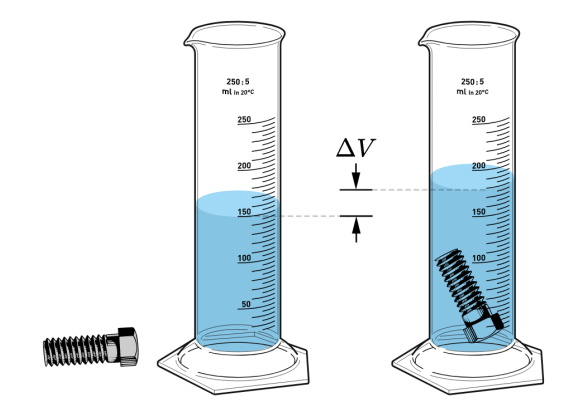
A. Finding Density Experimentally
Finding volume by displacement: When the screw is placed in the water, the water rises from 150 mL to 180 mL, so its volume is .
B. Archimedes' Principle
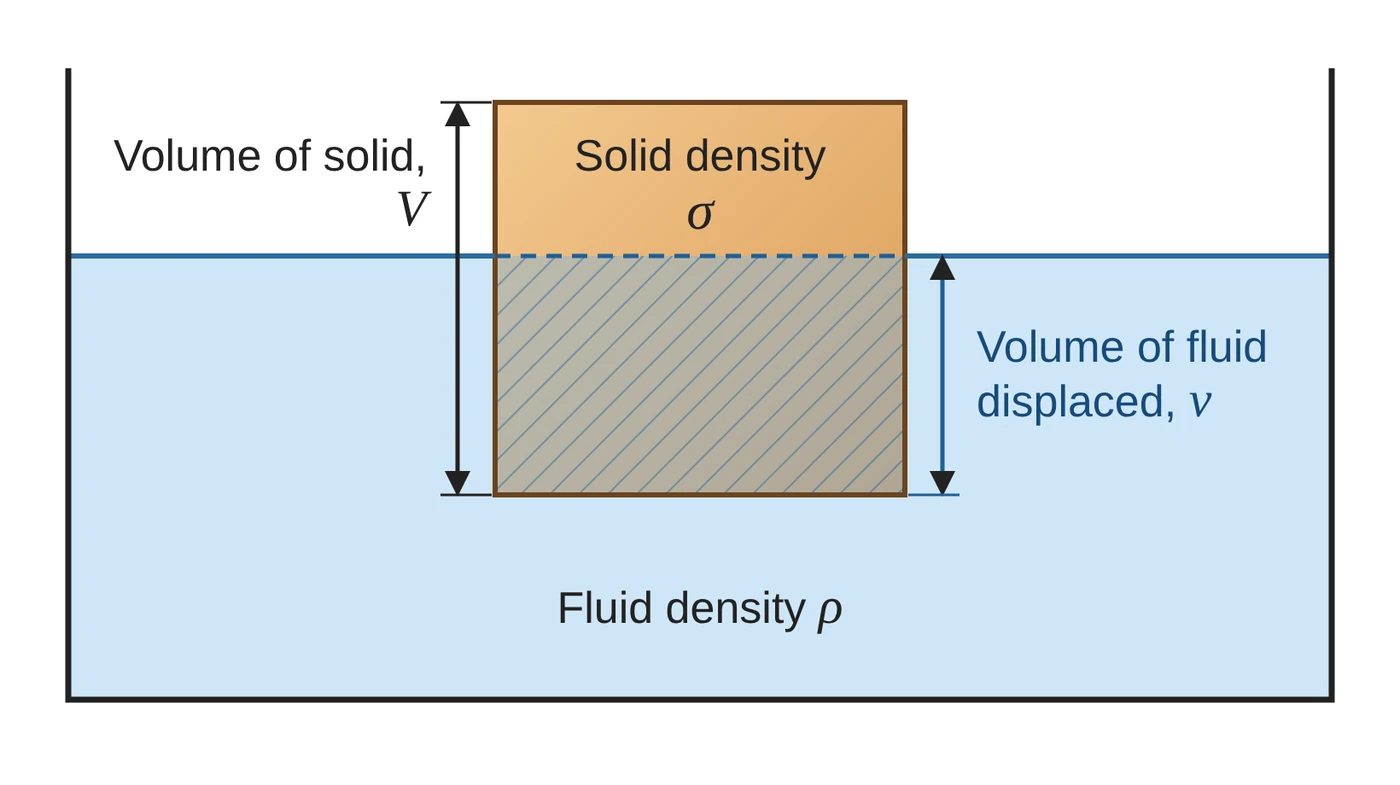
A fluid exerts a net force on any object it surrounds.
The buoyant force is always present regardless of whether the object sinks or floats in the fluid.
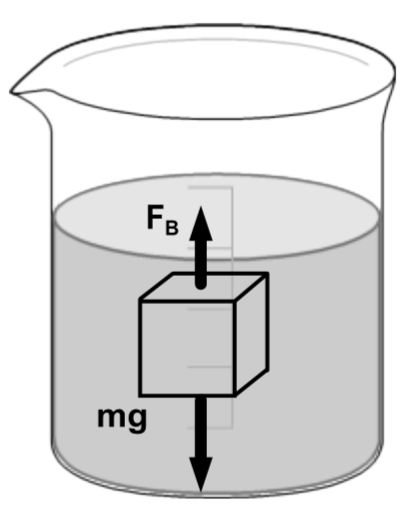
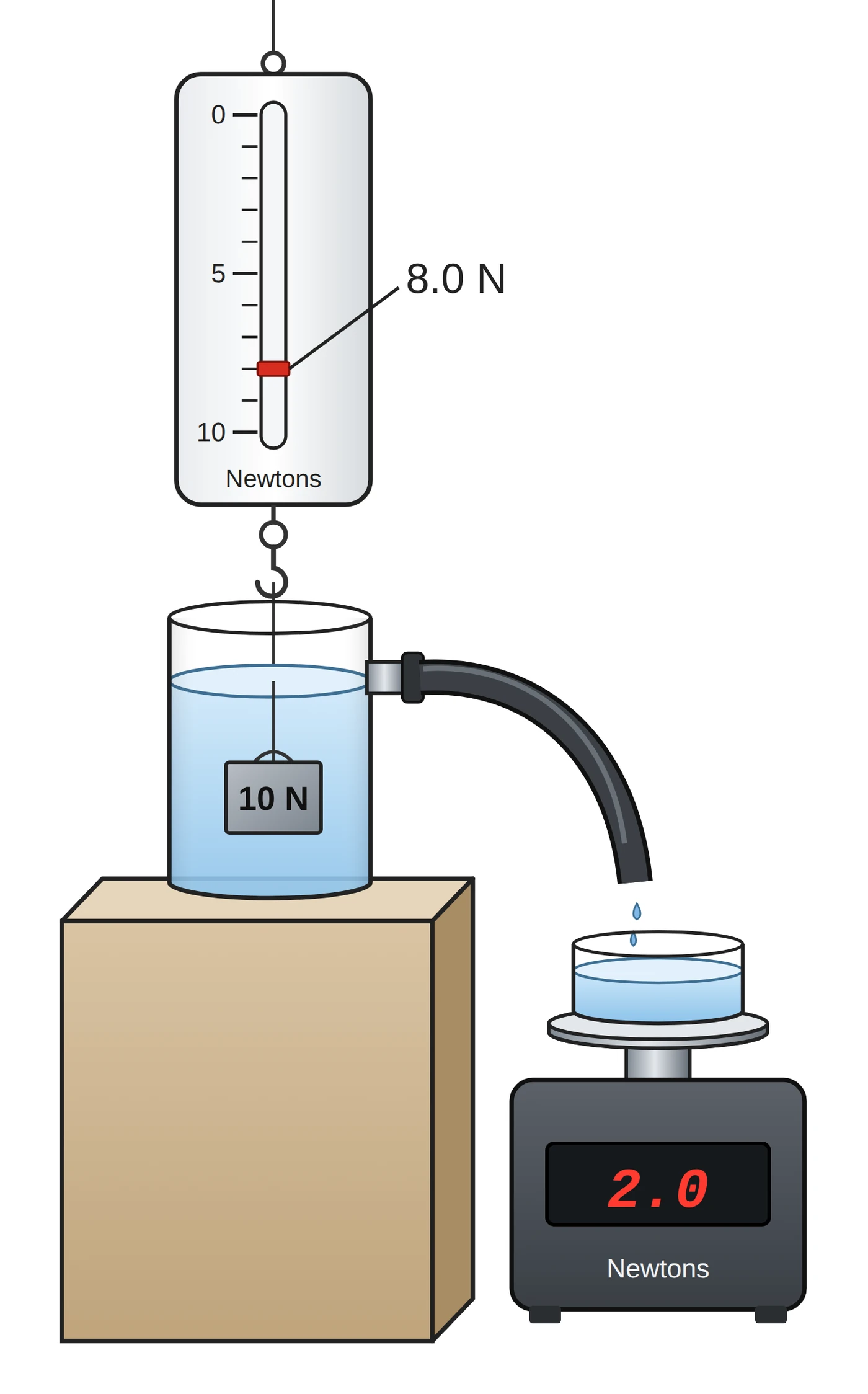
Buoyant Force ($F_B$) – equal to the force gravity would exert on the liquid.
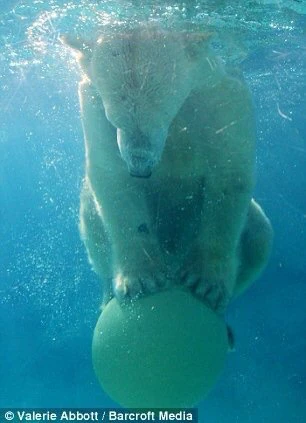
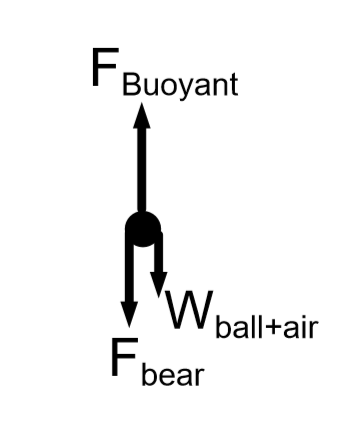
FBD – A beach ball is being held underwater (stationary) by a polar bear. Draw the forces.
The buoyant force upward is cancelled out by two downward forces: the bear pushing down, and the Earth pulling down on the plastic ball and the air inside it.
The net force on an immersed object is the difference between the buoyant force and the gravitational force.
(a) Is the buoyant force on a solid lead sphere more than, less than, or the same as the buoyant force on a solid aluminum sphere of the same diameter?
Claim(c) The same.
Reasoning$F_B = \rho_{fluid} V_{sub}\, g$ depends on the fluid and the volume displaced, not on what the object is made of. Both spheres sink, so each is fully submerged and displaces the same volume.
(b) Does your answer depend on the fluid that is causing the buoyant force? Explain.
No – $F_B$ $= \rho_{fluid} V g$. Changing the fluid changes both buoyant forces equally, so they stay equal.
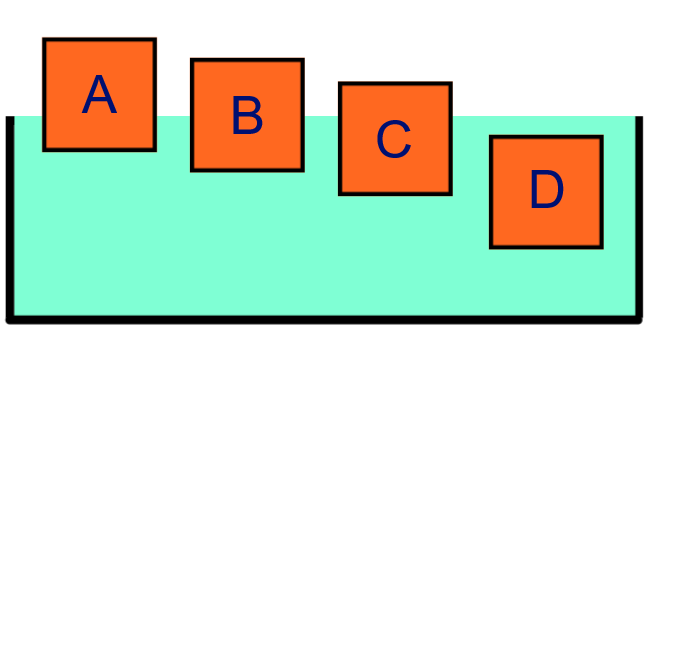
Concept 2 – Sinking and Floating: Density of cubes compared to water.
A wood block floats in a swimming pool. The buoyant force exerted on the block by the water depends on:
Claim(c) the volume of the wood block under water
Reasoning$F_B = \rho_{water} V_{sub}\, g$. The buoyant force equals the weight of the water displaced, and only the part of the block that is under water displaces water. The size of the pool doesn't matter, and the block's total volume only matters through how much of it is submerged.
Concept 3: If the density of an object is exactly equal to the density of a fluid, the object will… (as long as it is totally immersed). Why?
Claim(3) It stays at any height in the fluid.
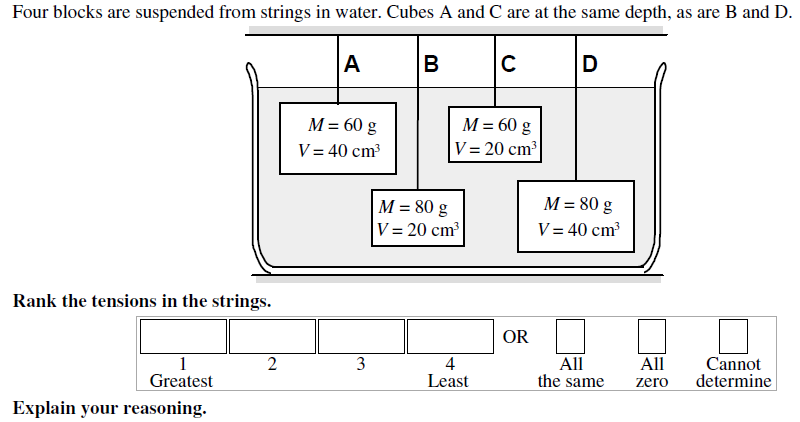
ReasoningTotally immersed, it displaces its own volume $V$, so $F_B = \rho_{fluid} V g$. Its weight is $mg = \rho_{object} V g$. With $\rho_{object} = \rho_{fluid}$, $F_B = mg$ and $F_{net} = 0$ at every depth (the fluid's density doesn't change with depth), so it stays wherever it is placed – like blocks A, B, C and D.
E. Buoyancy Animation
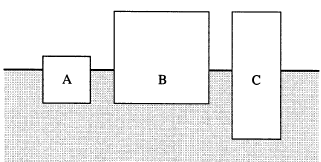
Example 2: Rank the densities of each floating block from smallest to largest.
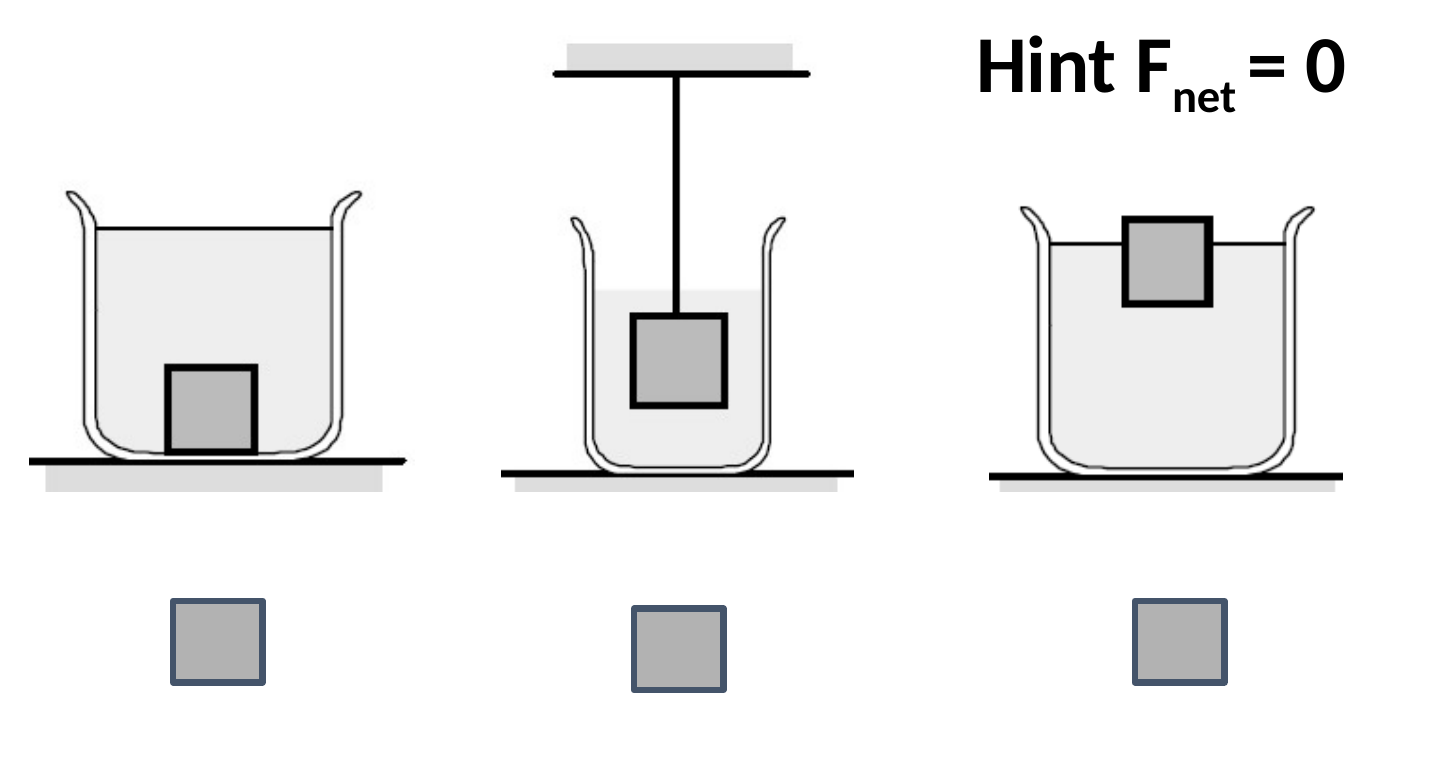
Example 3: Each block is at equilibrium. Draw the forces on each. Hint: $F_{net} = 0$
$F_B$ = Buoyant Force$T$ = Tension$F_g$ = Weight$N$ = Normal Force
Example 4: When an object floats, the acting on the object equals its weight.
Four blocks are suspended from strings in water ($\rho = 1 \text{ g/cm}^3$). Cubes A and C are at the same depth, as are B and D. Rank the tensions in the strings.
Do Now / Displacement:A ball will not float if its density is GREATER than the liquid. The screw's volume is $180 \text{ mL} - 150 \text{ mL}$ $= 30 \text{ mL}$ $= 30 \text{ cm}^3$.
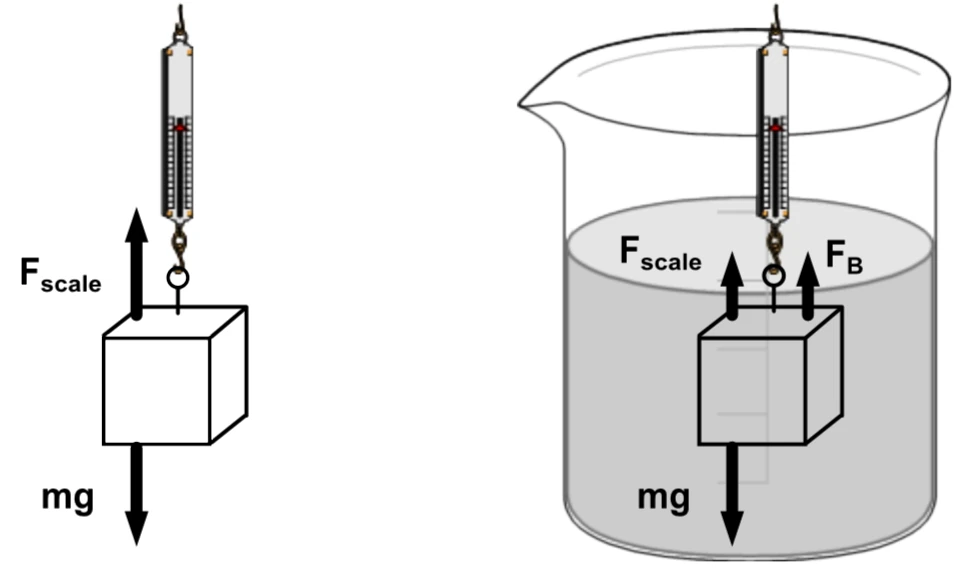
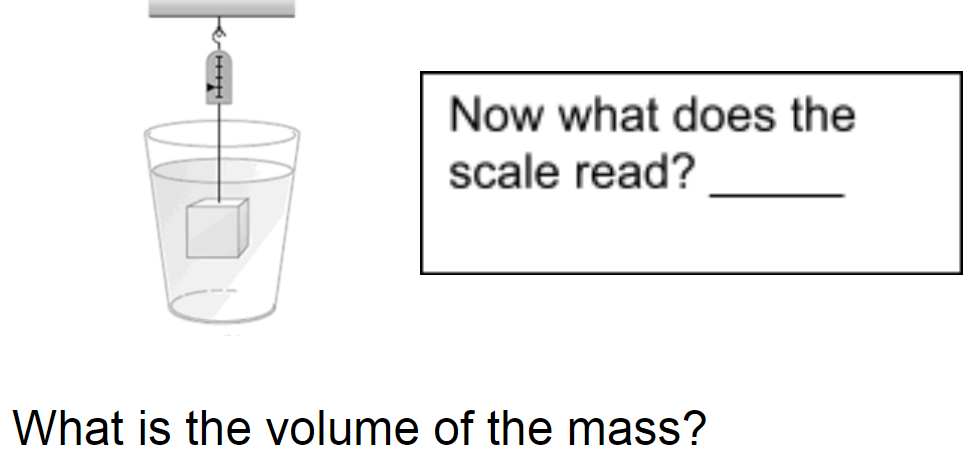
Reasoning:The cube is motionless, so $F_{scale} + F_B = mg$. The buoyant force equals the weight of the water the cube displaces.
Concept 1:(c) The SAME – both spheres displace the same volume, so the same mass of fluid. No – changing the fluid changes both buoyant forces equally, so they stay equal.
Concept 2:(c) The volume of the block under water – the buoyant force equals the weight of the water displaced.
Concept 3:(3) Stay at any height – when fully immersed, $F_B = \rho_{fluid} V g$ exactly equals $mg = \rho_{object} V g$ at every depth, so $F_{net} = 0$.
Ex 2 – Claim:Smallest to largest density: B, C, A.
Reasoning:Percent submerged $= \rho_{object}/\rho_{liquid} \times 100$, so a greater percent submerged means a greater density. A is about 2/3 submerged, B about 40%, C about 50%.
Ex 4 – Claim:BUOYANT FORCE (if it is the only upward force). Tensions: $T_B > T_C = T_D > T_A$
Reasoning:Depth does not matter for a fully submerged block – only its mass and the volume of water it displaces.
III. Aim 33: Solving Buoyancy Problems
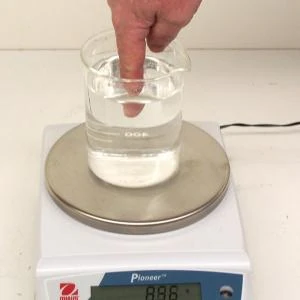
1. A flask of water rests on a scale. If you dip your finger into the water, without touching the flask, does the reading on the scale:
Claim(a) Increase.
ReasoningThe water pushes up on your finger with a buoyant force (the weight of the displaced water). By Newton's 3rd Law your finger pushes down on the water with an equal force, which is transmitted to the flask and the scale.
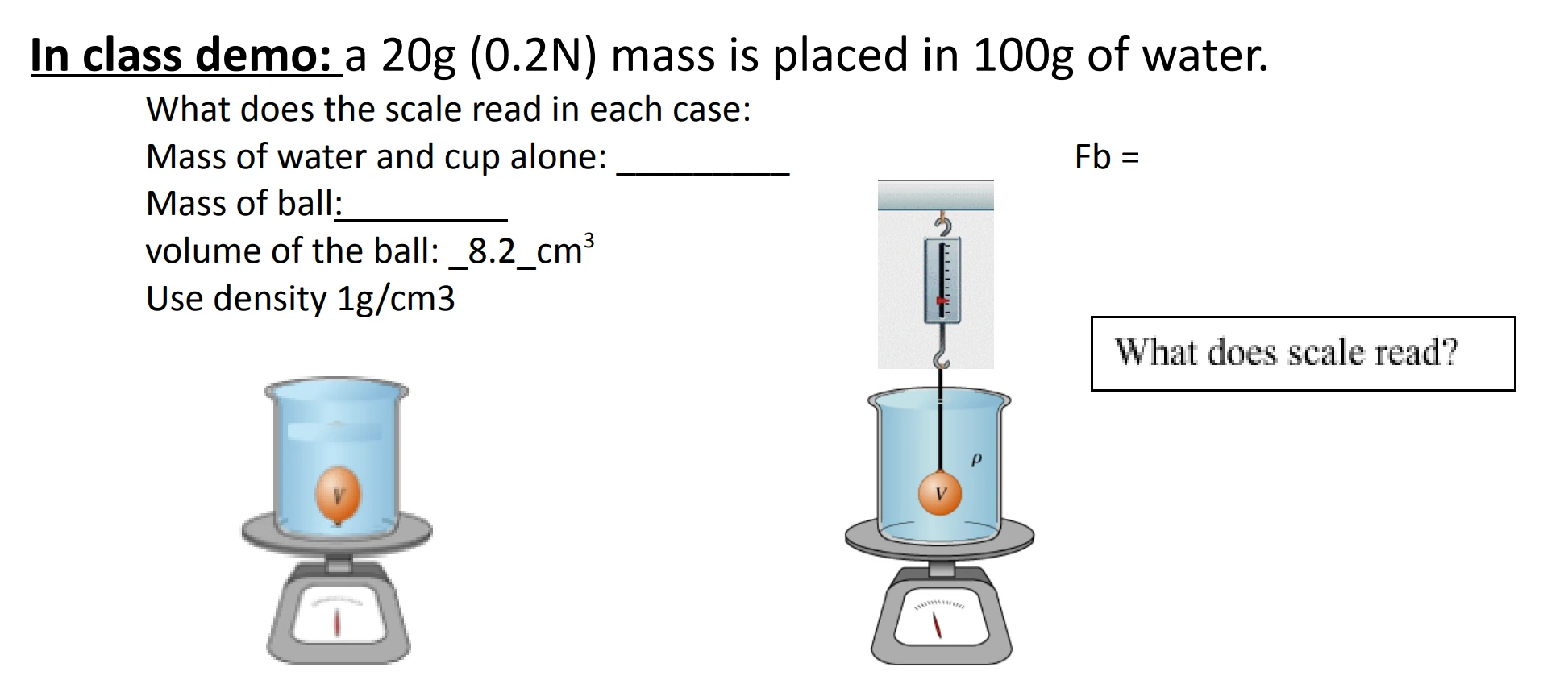
In-class demo: A 20 g (0.2 N) mass with a volume of 8.2 cm³ is placed in 100 g of water (use density 1 g/cm³). What does the scale read in each case?
Mass of water and cup alone: Mass of ball: $F_B =$
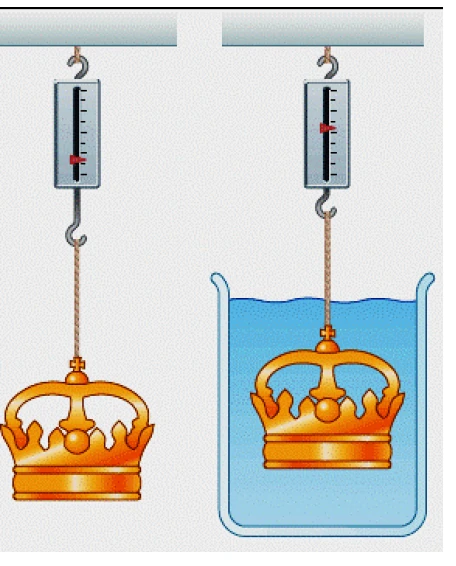
2. The crown weighs 6 N in air but only 4 N in water. What is the volume of the crown? ($\rho_w$ $= 1000 \text{ kg/m}^3$)
Teacher Workspace: Flask, Demo & Crown
1 Water pushes up on your finger ($F_B$); by Newton’s 3rd Law your finger pushes down on the water equally
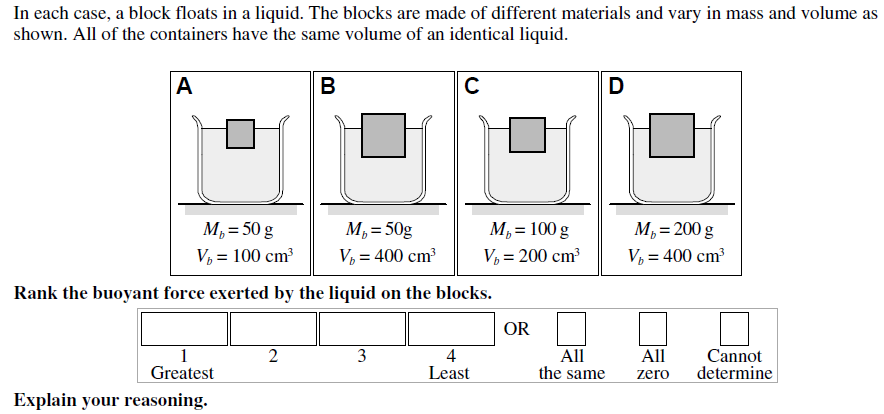
Ranking Task – Buoyant Force on Floating Blocks: In each case, a block floats in a liquid. The blocks are made of different materials and vary in mass and volume as shown. All of the containers have the same volume of an identical liquid. Rank the buoyant force exerted by the liquid on the blocks, from greatest to least (or all the same / all zero / cannot determine). Explain your reasoning.
$D > C > A$ $= B$ (only the mass matters, not the volume)
3. On a planet in a different solar system, the acceleration of gravity is greater than it is on Earth. If you float in the water on this planet, is it:
Claim(c) The same.
ReasoningFloating: $F_B = mg \Rightarrow \rho_w V_{sub} g = mg$. The $g$ cancels, so the volume submerged does not depend on gravity.
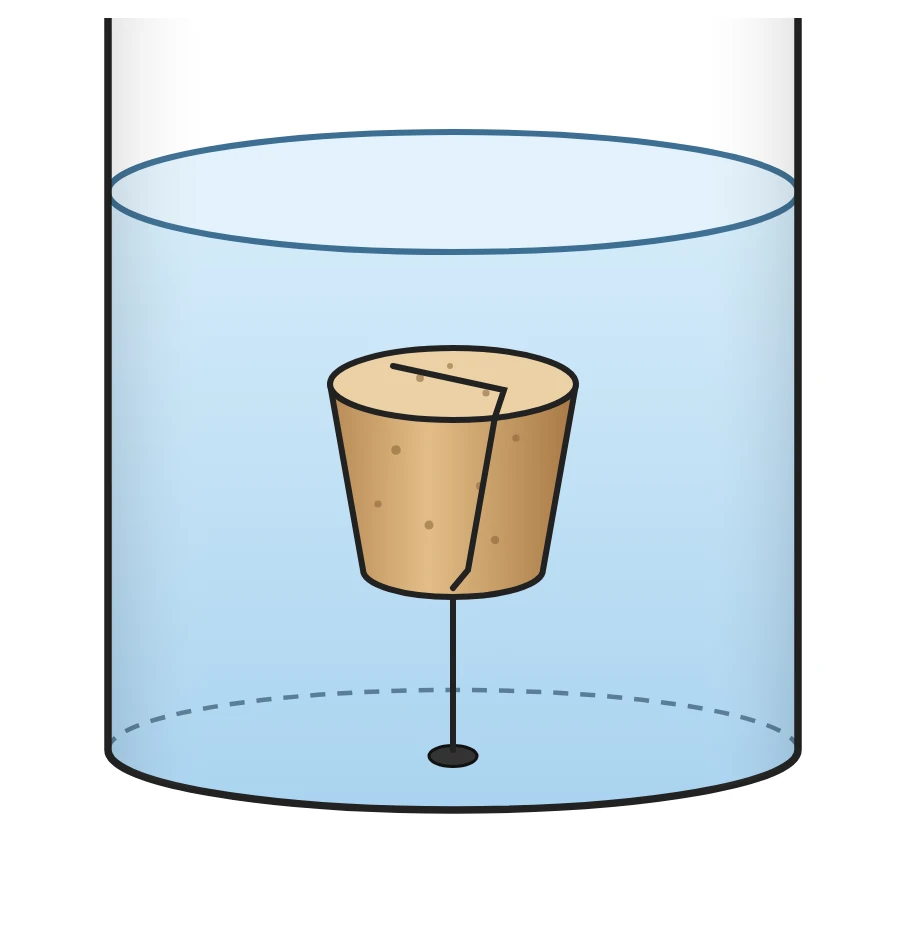
4. A cork has weight $mg$ and density 25% of water's density. A string is tied around the cork and attached to the bottom of a water-filled container. The cork is totally immersed. Express the tension in the string in terms of the cork's weight $mg$.
Claimd) $T = 3mg$
Reasoning$F_{net} = 0 \Rightarrow T + mg = F_B$. Since $\rho_{water} = 4\rho_{cork}$: $F_B = \rho_{water} V g = 4\rho_{cork} V g = 4mg$, so $T = 4mg - mg = 3mg$.
5. When submerged under water, the apparent mass of one cubic meter of pure gold is 18,300 kg. What would be its mass in air?
ClaimD) 19,300 kg
ReasoningMass itself never changes, but the "apparent mass" is reduced by the buoyant force. 1 m³ of gold displaces 1 m³ of water = 1000 kg, so the true mass is $18,300 + 1000 = 19,300 \text{ kg}$ (the density of gold is $19,300 \text{ kg/m}^3$).
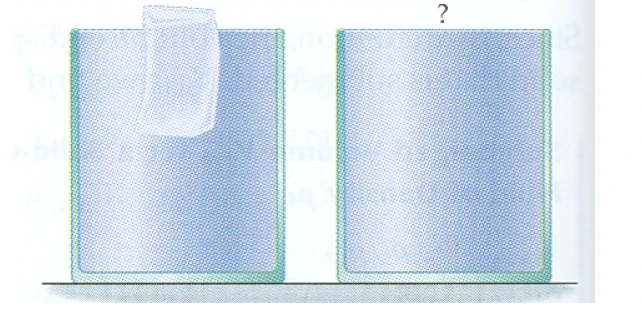
6. A cup is filled to the brim with water and a floating ice cube. When the ice melts, which of the following occurs?
Claim(c) The water level remains the same.
ReasoningThe floating ice displaces an amount of water equal to its weight. When it melts it becomes exactly that much water, which fills exactly the volume it was displacing.
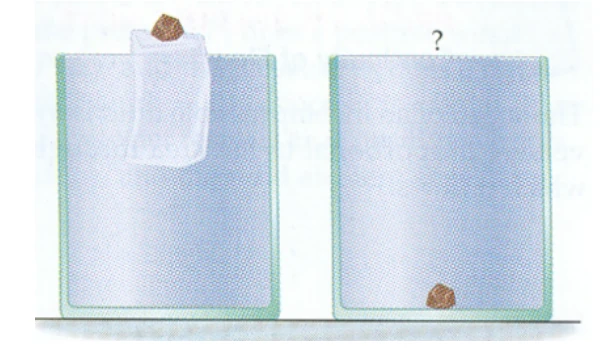
7. A cup is filled to the brim with water and a floating ice cube. Resting on top of the ice cube is a small pebble. When the ice melts, which of the following occurs? Hint – the pebble is more dense than water.
Claim(b) The water level decreases.
ReasoningWhile riding on the ice, the pebble displaces its weight of water – a volume greater than the pebble's own volume (it is denser than water). Once it sinks, it only displaces its own volume.
8. A cube of unknown material and uniform density floats in a container of water with 60% of its volume submerged. If this same cube were placed in a container of oil with density $800 \text{ kg/m}^3$, what portion of the cube's volume would be submerged while floating?
In oil: $\dfrac{\rho_u}{\rho_{oil}}$ $= \dfrac{600}{800}$ $= 0.75$ → (E) 75%
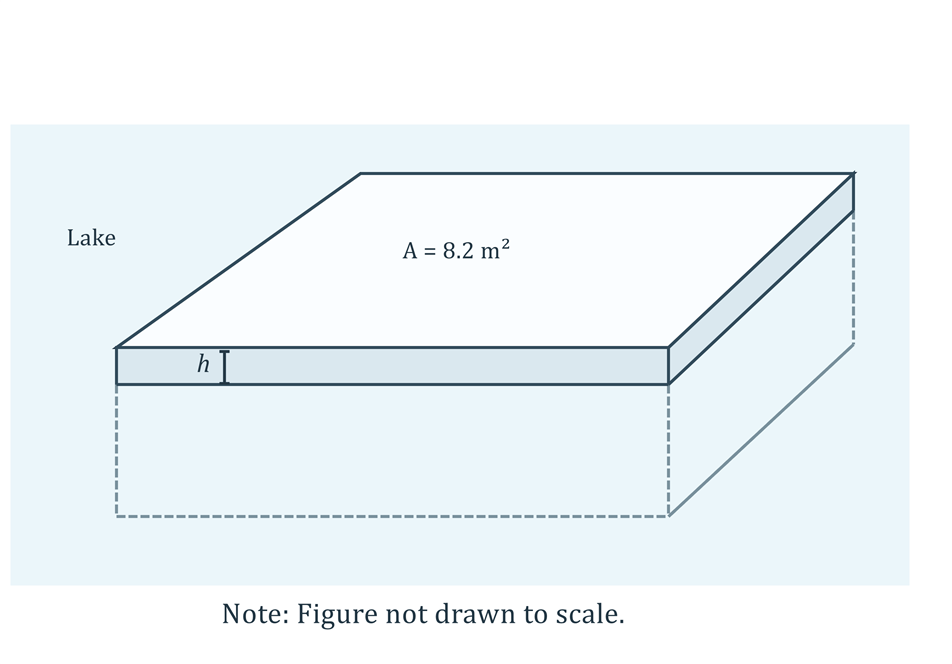
9. (AP 2005 B5) A large rectangular raft (density $650 \text{ kg/m}^3$) is floating on a lake. The surface area of the top of the raft is $8.2 \text{ m}^2$ and its volume is $1.80 \text{ m}^3$. The density of the lake water is $1000 \text{ kg/m}^3$.
(a) Calculate the height $h$ of the portion of the raft that is above the surrounding water.
(b) Calculate the magnitude of the buoyant force on the raft and state its direction.
(c) If the average mass of a person is 75 kg, calculate the maximum number of people that can be on the raft without the top of the raft sinking below the surface of the water. (Assume the people are evenly distributed on the raft.)
Reasoning:The water pushes up on your finger with a buoyant force (the weight of the displaced water). By Newton's 3rd Law your finger pushes down on the water with an equal force, which is transmitted to the flask and the scale.
Demo:$F_B$ $= \rho V g$ $= (8.2 \text{ g})(g)$ $\approx 0.082 \text{ N}$. Resting on the bottom, the scale reads water + cup + 20 g. Hanging from the spring scale, the spring scale reads $0.2 - 0.082$ $\approx 0.12 \text{ N}$ and the bottom scale reads water + cup + 8.2 g.
2 – Claim:$V$ $= 2 \times 10^{-4} \text{ m}^3$
Evidence:$F_B = 6 - 4 = 2 \text{ N}$ = weight of water displaced → mass of water $= 0.2 \text{ kg}$. $V$ $= m/\rho$ $= 0.2/1000$ $= 2 \times 10^{-4} \text{ m}^3$
Reasoning:The crown is fully submerged, so the volume of water displaced equals the volume of the crown.
Ranking – Claim:$D > C > A = B$
Evidence:Floating: $F_B = mg$. A $= 0.5 \text{ N}$, B $= 0.5 \text{ N}$, C $= 1.0 \text{ N}$, D $= 2.0 \text{ N}$
Reasoning:Every block floats, so $F_{net} = 0$ and the buoyant force equals each block's weight. The volume of the block doesn't matter – only its mass.
3 – Claim:(c) The same.
Reasoning:Floating: $F_B$ $= mg$ $\Rightarrow \rho_w V_{sub} g$ $= mg$. The $g$ cancels, so the volume submerged does not depend on gravity.
4 – Claim:(d) $T = 3mg$
Evidence:$F_{net}$ $= 0$ $\Rightarrow T + mg$ $= F_B$. Since $\rho_{water} = 4\rho_{cork}$: $F_B$ $= \rho_{water} V g$ $= 4\rho_{cork} V g$ $= 4mg$. $T = 4mg - mg = 3mg$
5 – Claim:D) 19,300 kg
Reasoning:Mass itself never changes, but the "apparent mass" is reduced by the buoyant force. 1 m³ of gold displaces 1 m³ of water = 1000 kg, so the true mass is $18,300 + 1000$ $= 19,300 \text{ kg}$ (the density of gold is $19,300 \text{ kg/m}^3$).
6 – Claim:(c) The water level remains the same.
Reasoning:The floating ice displaces an amount of water equal to its weight. When it melts it becomes exactly that much water, which fills exactly the volume it was displacing.
7 – Claim:(b) The water level decreases.
Reasoning:While riding on the ice, the pebble displaces its weight of water – a volume greater than the pebble's own volume (it is denser than water). Once it sinks, it only displaces its own volume.
Reasoning:Each added person must be supported by extra buoyant force from pushing more of the raft underwater. Round down – a 9th person would sink the top below the surface.
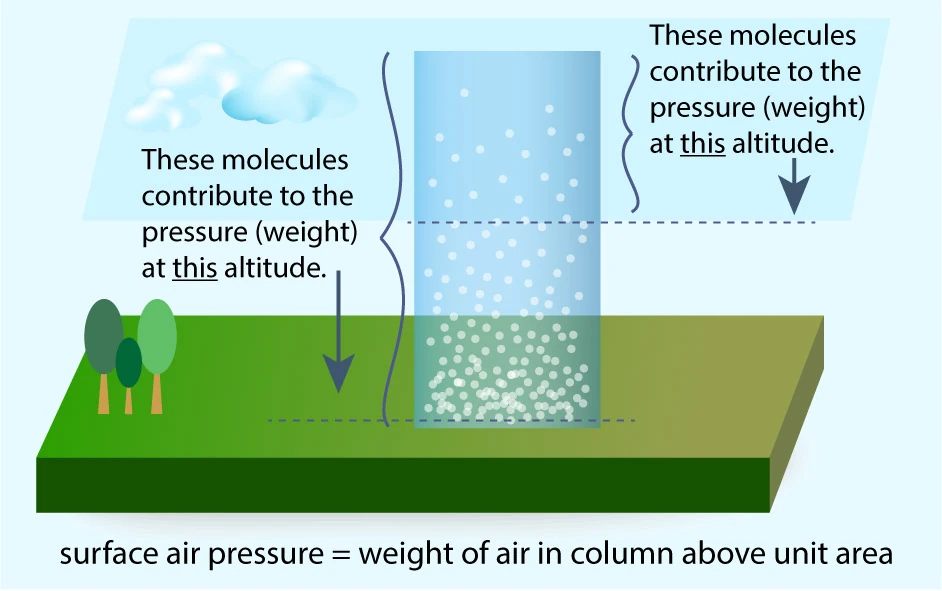
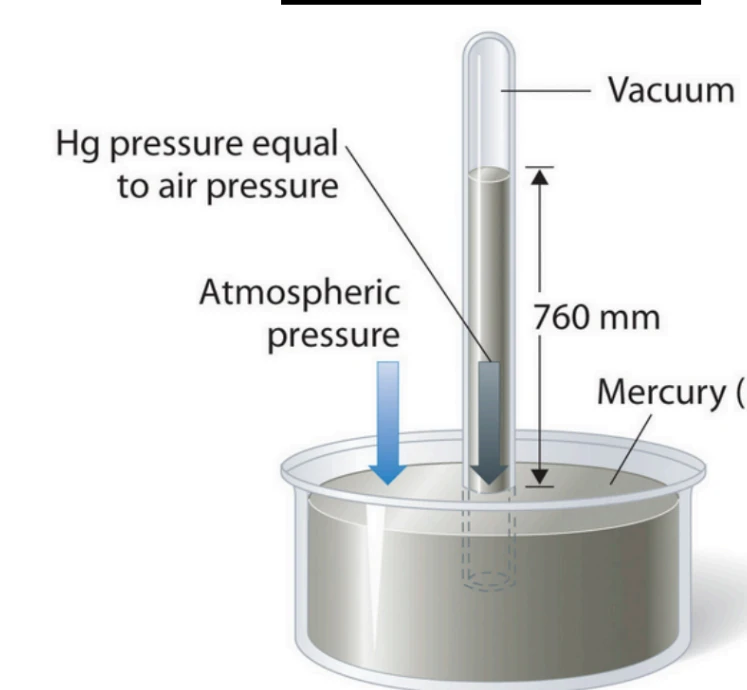
A barometer measures atmospheric pressure. The air pressure we feel all the time is due to approximately 62 miles of air above us.
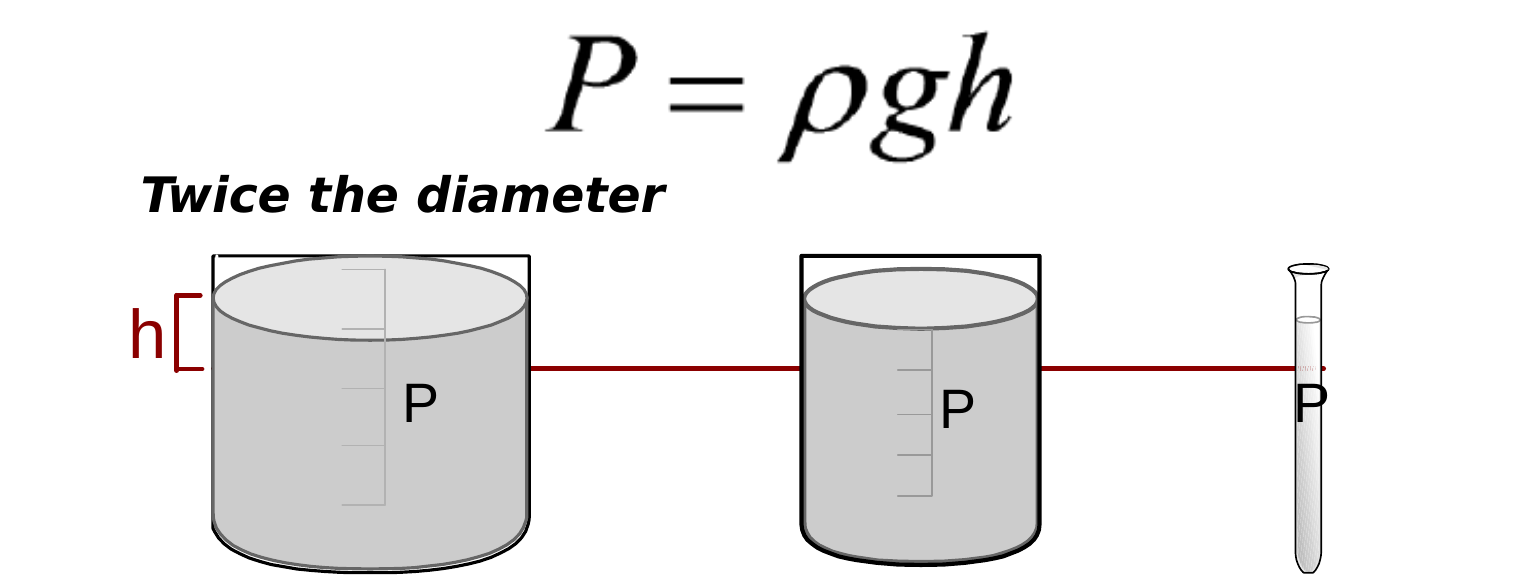
Pressure in a liquid does not depend on the of the container (incompressible fluids only).
Twice the diameter: the larger glass has times the weight. Compare the pressure at the bottom:
Simulation – Pascal's Vases
C. Concept Problems
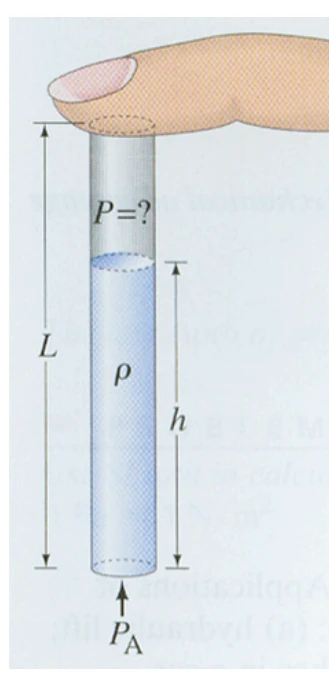
1. Concept: You insert a straw of length $L$ into a tall glass of water, place your finger over the top, and lift the straw. Does the air in the space between your finger and the top of the water have a pressure $P$ that is ___ the atmospheric pressure $P_{atm}$ outside the straw?
Claim(c) Less than atmospheric pressure.
ReasoningThe water column is at rest, so $F_{net} = 0$: $P_{top} + \rho g h = P_{atm}$. The trapped air must push down with less than $P_{atm}$ so that the weight of the water is supported.
2. Concept: Two drinking glasses, A and B, are filled with water to the same depth. Glass A has twice the diameter of glass B. (a) Compare the weight of water in the two glasses. (b) Compare the pressure at the bottom of the two glasses. Hint: area $= \pi r^2$
Teacher Workspace: Straw & Glasses
1 Water column at rest: $P_{top}$ ${}+ \rho g h$ $= P_{atm}$
$P_{top} < P_{atm}$ → (c) less than
2a $2\times$ the diameter → $4\times$ the area ($\pi r^2$) → $4\times$ the volume
Glass A holds 4 times the weight of water.
2b $P$ $= P_0$ ${}+ \rho g h$ depends only on depth
The pressures at the bottom are the SAME.
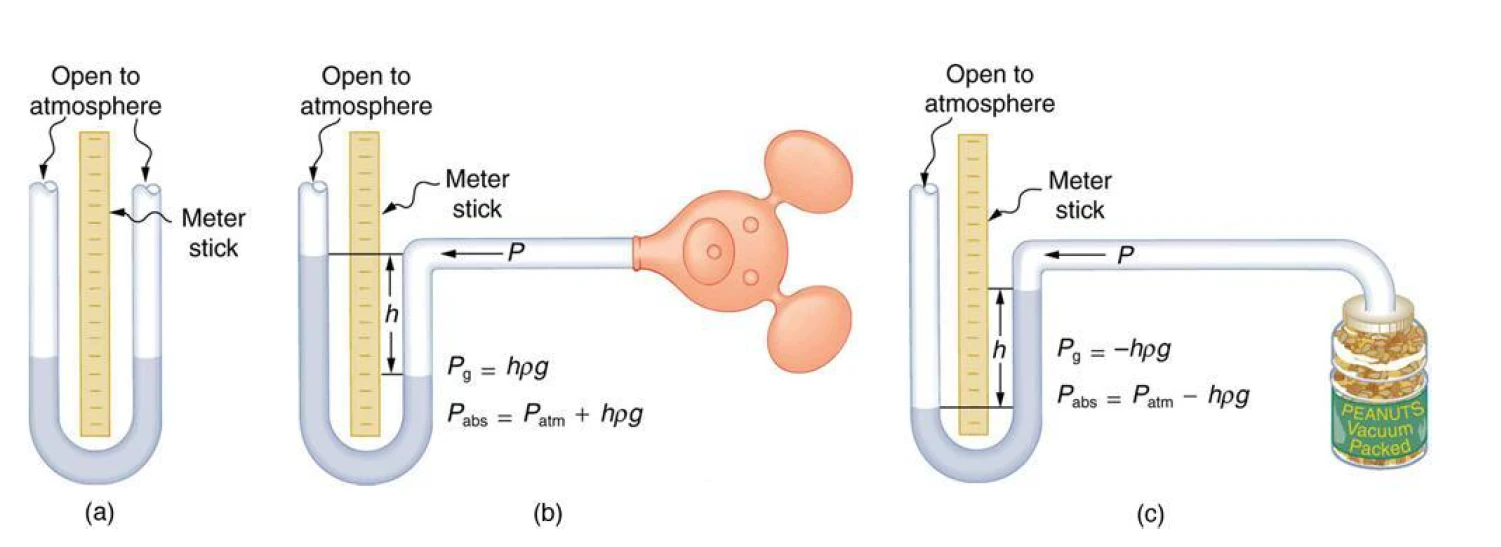
D. U-Shaped Open Tube Manometer
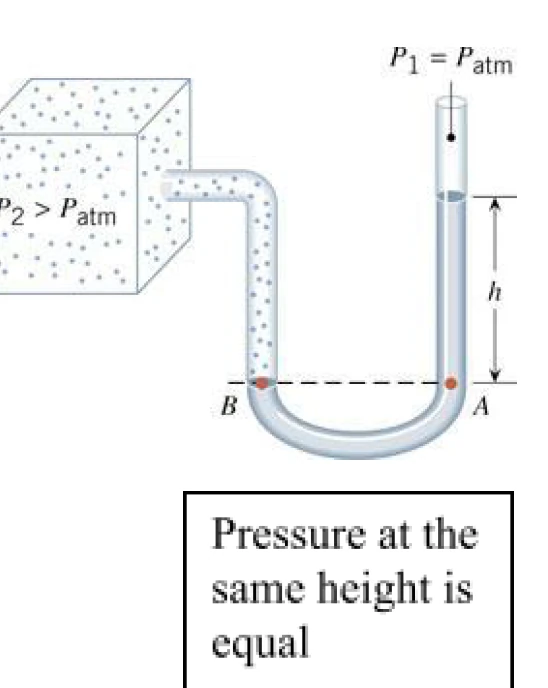
A U-shaped open tube manometer measures the pressure of an enclosed gas.
3. Calculate the pressure in the box ($P_2$) if the height is 12 cm. The tube is filled with mercury (density $= 13.6 \times 10^3 \text{ kg/m}^3$).
Pressure at the same height is equal.
(b) What would happen to $h$ if atmospheric pressure drops to $9 \times 10^4 \text{ Pa}$?
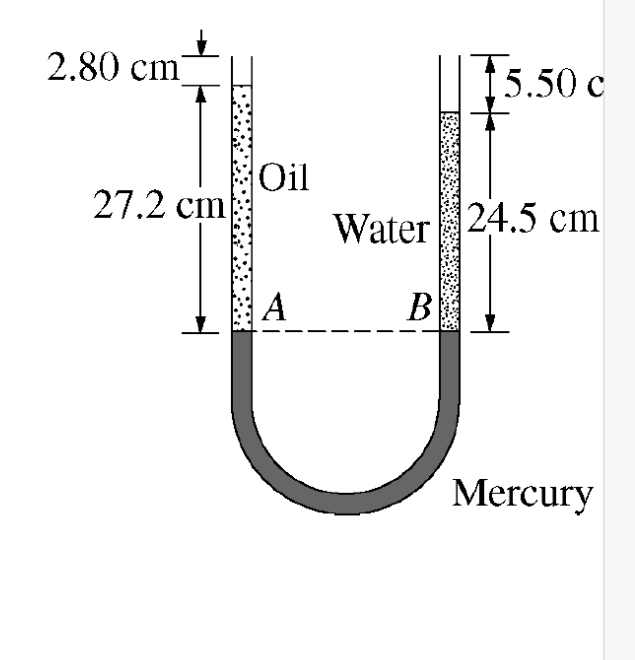
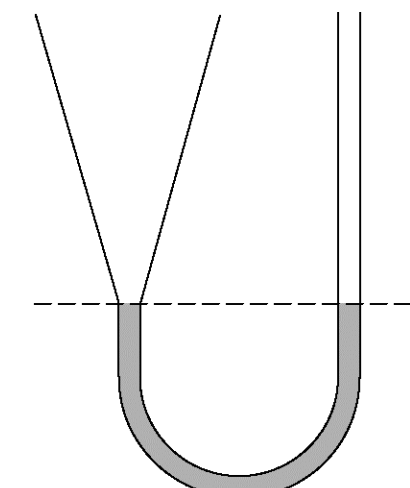
5. (AP) A glass U-tube with a uniform diameter of 0.850 cm is used to determine the density of an oil. As shown, a 24.5 cm column of water balances a 27.2 cm column of the oil so that interfaces A and B of the mercury with the other liquids are at the same height. The density of water is $1.00 \times 10^3 \text{ kg/m}^3$.
(a) Calculate the density of the oil.
(b) Calculate the absolute pressure at B, the interface between the water and the mercury.
(c) A new tube, identical to the U-tube except for a cone shape on the left, is filled with the same volume of mercury, at the same height on both sides. The same volumes of oil and water are poured into the new tube, on the left and right respectively. Indicate the new position of B relative to A: ___ Above A ___ Below A ___ At the same height as A. Justify your answer.
(d) A small piece of wood with density less than that of the oil is placed so that it floats in the left side of the tube. Indicate whether the pressure at the bottom of the tube increases, decreases, or remains the same.
(c) Below A – in the wide cone the oil forms a shorter column, so it exerts less pressure
(d) Increases – the floating wood displaces fluid, the columns rise, and greater height means greater pressure
Aim 34 Teacher Key
Fill-ins:Pressure does not depend on the SHAPE of the container. The larger glass has FOUR times the weight; the pressure at the bottom is the SAME.
1 – Claim:(c) Less than atmospheric pressure.
Reasoning:The water column is at rest, so $F_{net} = 0$: $P_{top} + \rho g h$ $= P_A$ $= P_{atm}$. The trapped air must push down with less than $P_{atm}$ so that the weight of the water is supported.
2 – Claim:(a) Glass A holds 4 times the weight of water. (b) The pressures are the SAME.
Reasoning:2× the radius means 4× the area, so 4× the volume and weight. But $P = P_0 + \rho g h$ depends only on depth – the extra weight is spread over 4× the area.
Evidence:(a) $P_A = P_B$: $P_0 + \rho_{oil} g (0.272)$ $= P_0 + \rho_w g (0.245)$ $\Rightarrow \rho_{oil}$ $= 1000(0.245/0.272)$ $\approx 900 \text{ kg/m}^3$
(b) Absolute pressure includes the atmosphere: $P_B$ $= 1.01 \times 10^5 + (1000)(10)(0.245)$ $= 103,450 \text{ Pa}$
Reasoning:(c) In the wide cone, the same volume of oil forms a much shorter column, so it exerts less pressure; the mercury on the water side is pushed down less, leaving B lower than A. (d) The floating wood displaces some fluid, so both columns rise a little; greater height means greater pressure at the bottom.
V. Aim 35: What is Pascal's Principle?
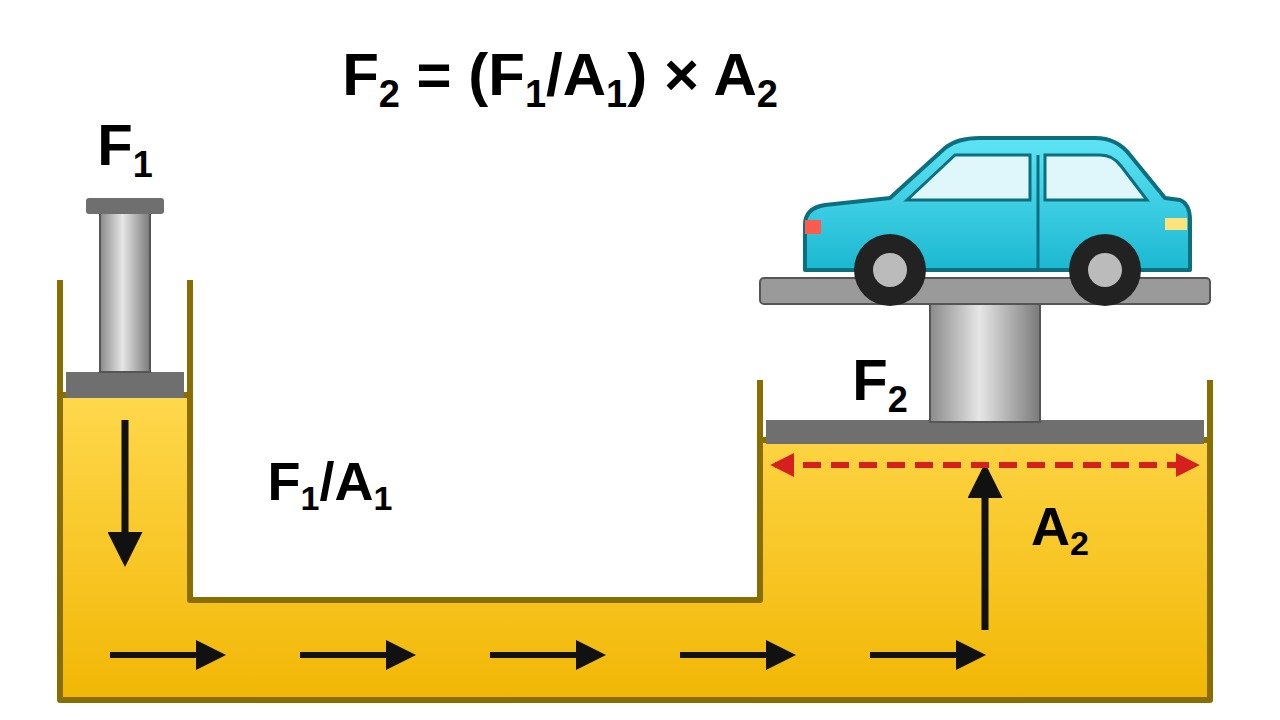
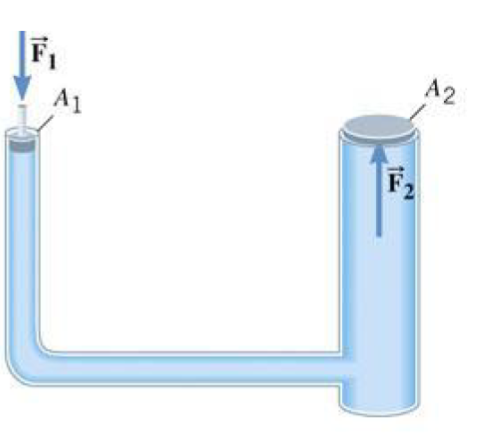
Do Now: Which force is greater in this video – $F_1$ or $F_2$? If $A_1$ were smaller, would $F_2$ increase or decrease?
Video loads when this section opens…
$F_2$ is greater.
If $A_1$ were smaller, $F_2$ $= F_1\left(\dfrac{A_2}{A_1}\right)$ would increase.
A. Ideal Fluids
will NOT compress
transmit applied pressure in all directions
have no viscosity (friction) or turbulent flow
B. Pascal's Principle
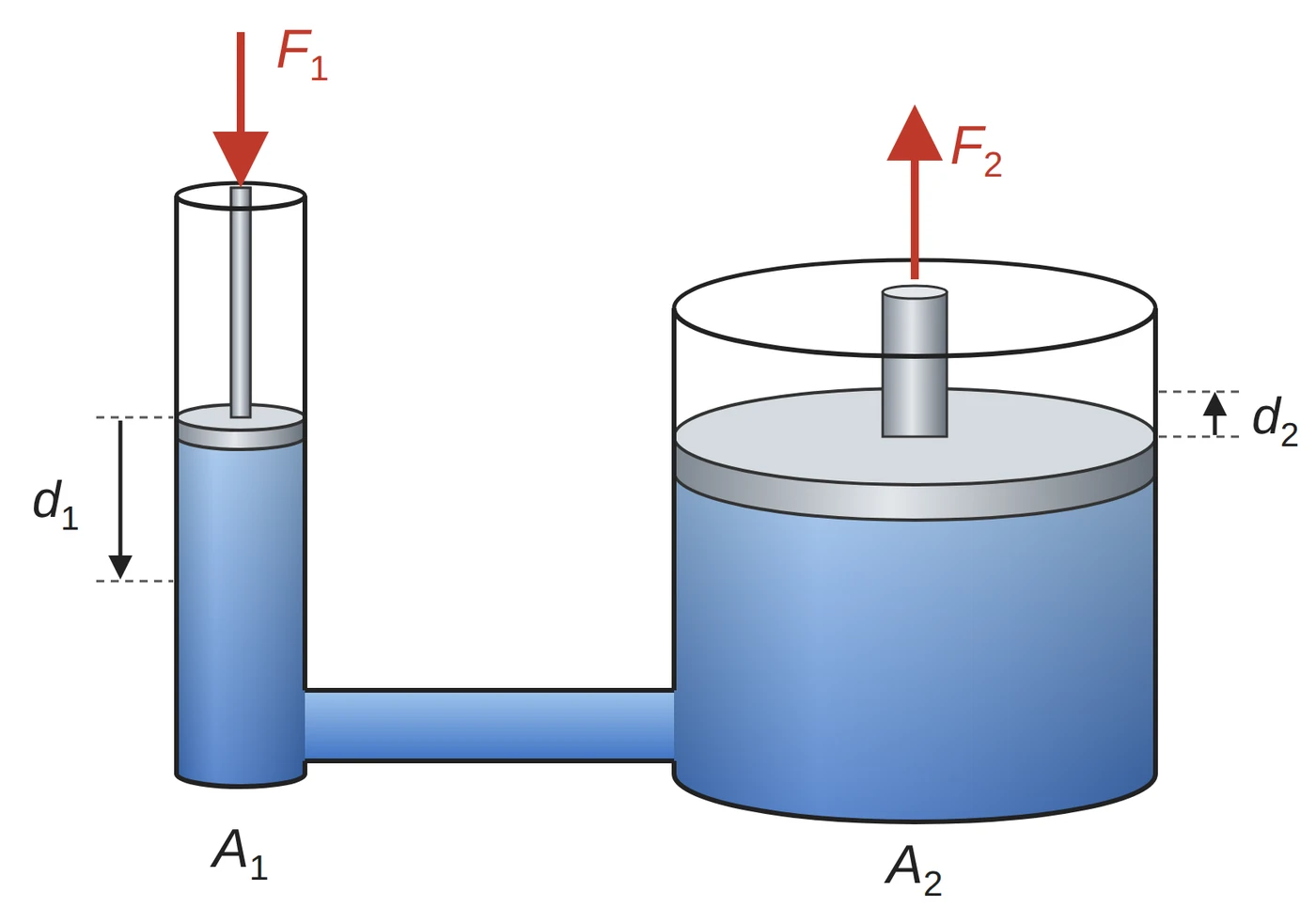
Any change in the pressure applied to a completely closed fluid is transmitted to all parts of the fluid and its container.
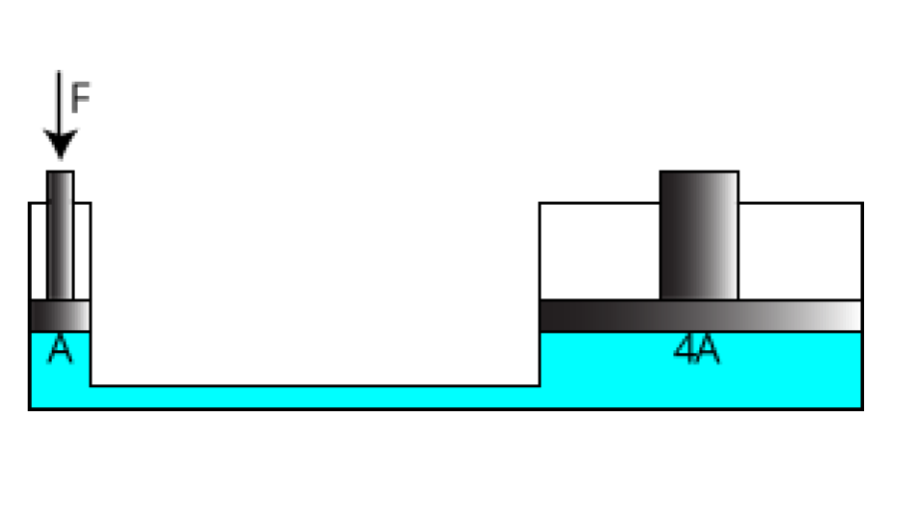
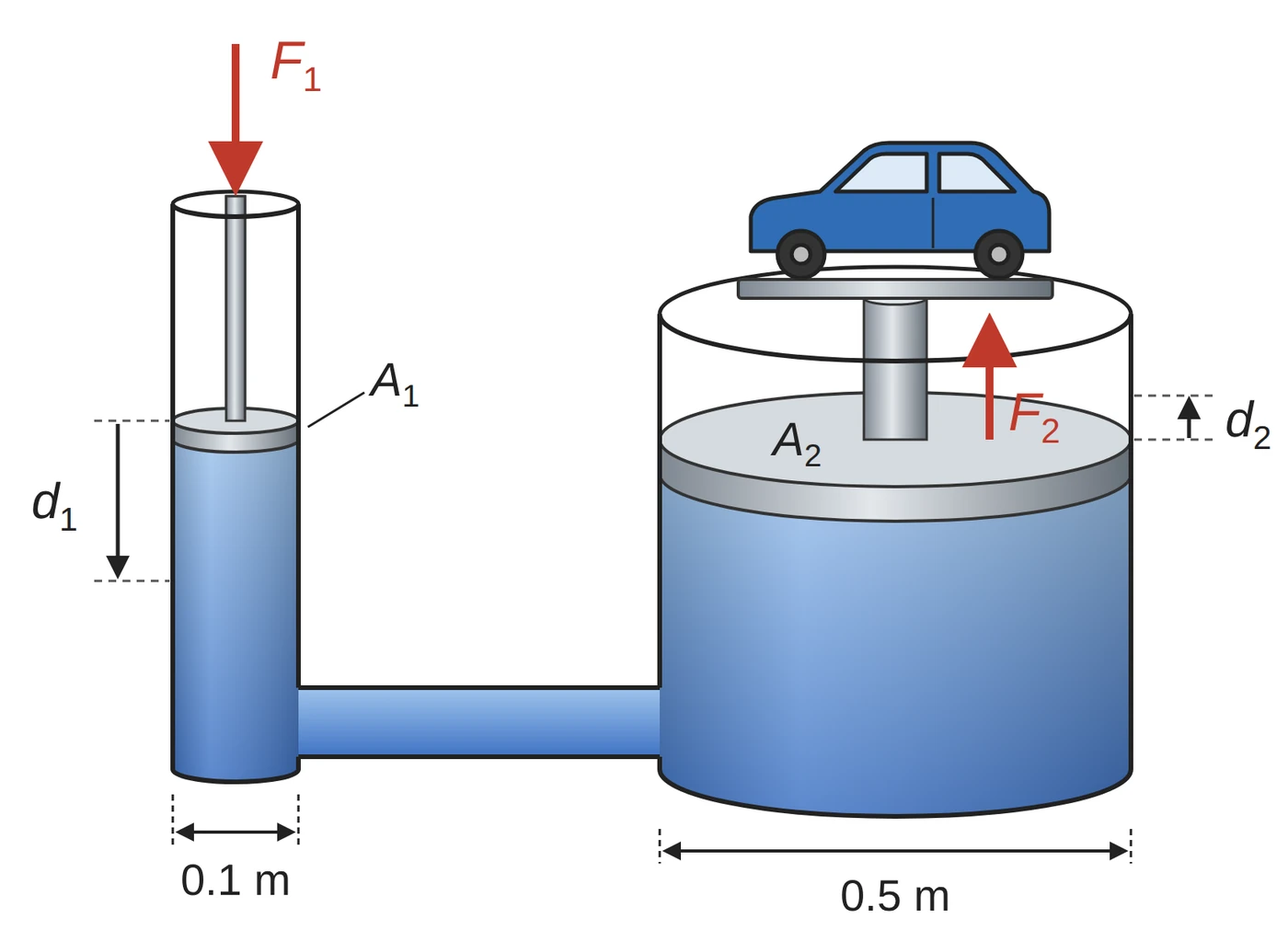
1. A reservoir of incompressible fluid is topped by two pistons of non-equal areas (not drawn to scale). The larger piston has four times the surface area of the smaller piston. If a force $F$ pushes the smaller piston down by some distance $d$, which of the following best describes the upward force and distance traveled by the larger piston?
Claim(A) $4F$ and $d/4$
ReasoningEqual pressure: $F/A = F_2/4A \Rightarrow F_2 = 4F$. Equal volume moved: $A d = 4A\, d_2 \Rightarrow d_2 = d/4$. Work in = work out: $F d = (4F)(d/4)$.
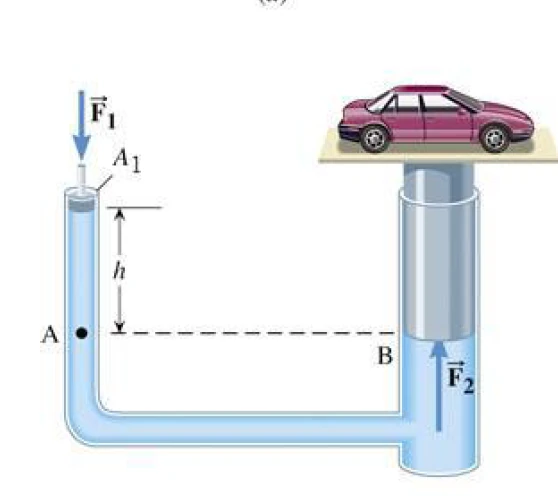
2. (a) Calculate the force $F_1$ that can lift a 20,500 N car. The bottom surface of the plunger and the lift are at the same level ($h = 0$). The radius $r_1$ is 0.012 m and the radius $r_2$ is 0.15 m.
(b) Now the plunger is not at the same level. Calculate $F_1$ if $h = 1.1 \text{ m}$ (density of hydraulic oil is $8 \times 10^2 \text{ kg/m}^3$).
A car tire is filled up to a pressure of 241 kPa (35 lb/in²). This is called the .
However, the pressure inside the tire is the gauge pressure (241 kPa) plus the atmospheric pressure ($P_{atm} = 101 \text{ kPa}$), for a total pressure of 342 kPa.
$$P = P_{atm} + P_{gauge}$$
Aim 35 Teacher Key
Do Now:$F_2$ is greater. If $A_1$ were smaller, $F_2$ would increase ($F_2 = F_1 A_2 / A_1$). Pascal's principle: pressure is transmitted UNDIMINISHED.
Gauge Pressure:241 kPa is the GAUGE PRESSURE. $P$ $= P_{atm} + P_{gauge}$ $= 101 + 241$ $= 342 \text{ kPa}$.
VI. Fluids Questions
Total Score: 0 / 23
Check Your Understanding
5 quick questions — pick an answer to see if you’re right.
1. A liquid has a specific gravity of 0.357. What is its density?
2. Ice has a density of 934 kg/m³. What percent of an ice cube floating in fresh water (1000 kg/m³) is submerged?
3. A ship sails from fresh water into denser salt water. Compared with fresh water, the volume of water it displaces is…
4. Two glasses have the same weight. Glass B's base has twice the diameter of glass A's. Compared with B, the pressure A exerts on the table is…
5. A solid lead sphere and a solid aluminum sphere of the same diameter are both fully submerged in water. How do their buoyant forces compare?
What, If Anything, Is Wrong?No calculator
Floating in Salt Water
A wooden block floats in fresh water with half of it under the surface. The same block is moved to salt water, which is denser than fresh water. A student draws a prediction:
Student: "Salt water is heavier than fresh water, so it pushes down harder on the block. The block will float lower in the salt water, with more of it under the surface."
What, if anything, is wrong? If something is wrong, explain the error and fix it. If nothing is wrong, explain why it is correct.