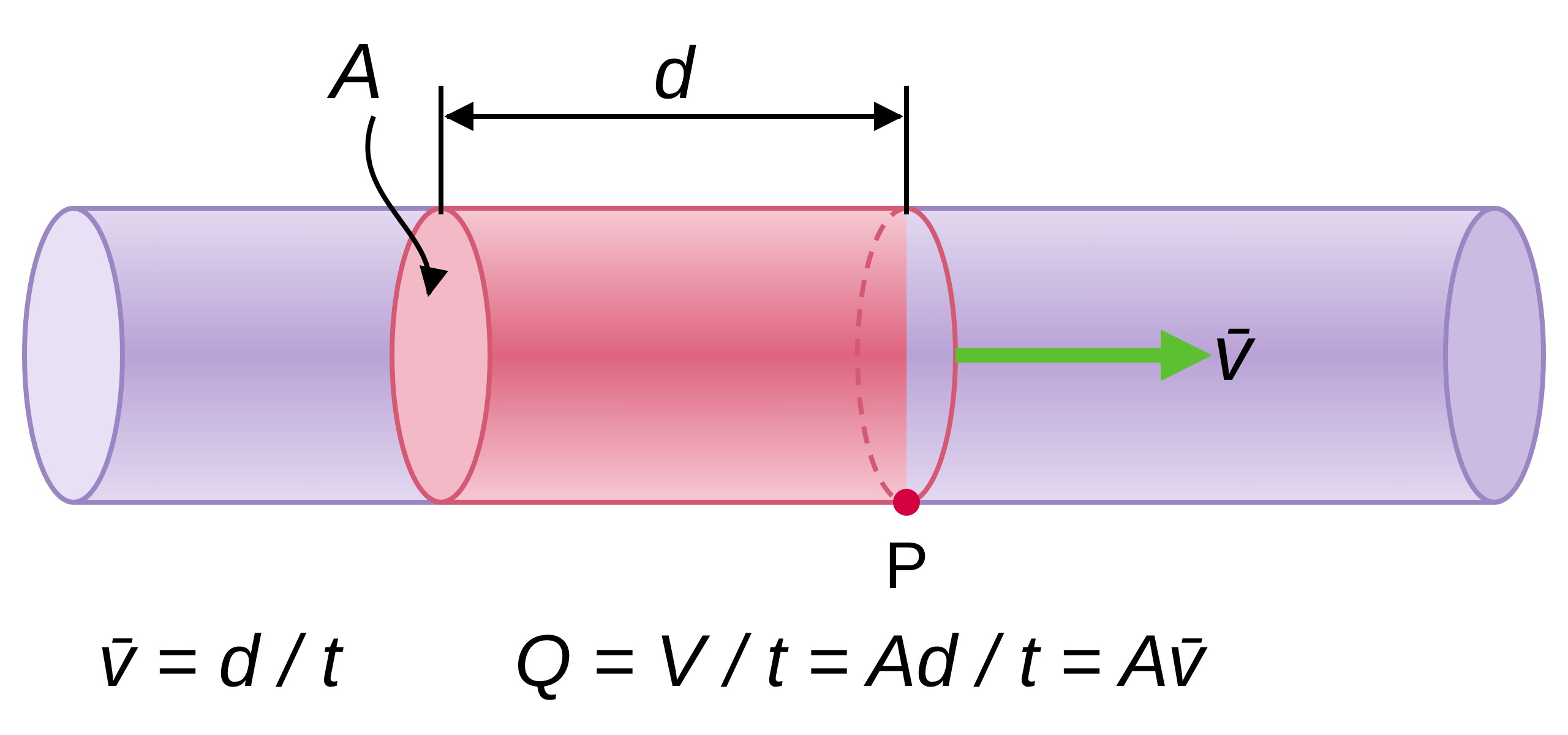
Example 1: Water runs through a main with a cross-sectional area of $0.4 \text{ m}^2$ with a velocity of $6 \text{ m/s}$. What is the rate of water usage?
Teacher Workspace: Volume Flow Rate
$Q$ $= A v$ $= (0.4 \text{ m}^2)(6 \text{ m/s})$
$Q$ $= 2.4 \text{ m}^3/\text{s}$
C. Fluid Speed and Cross-Section
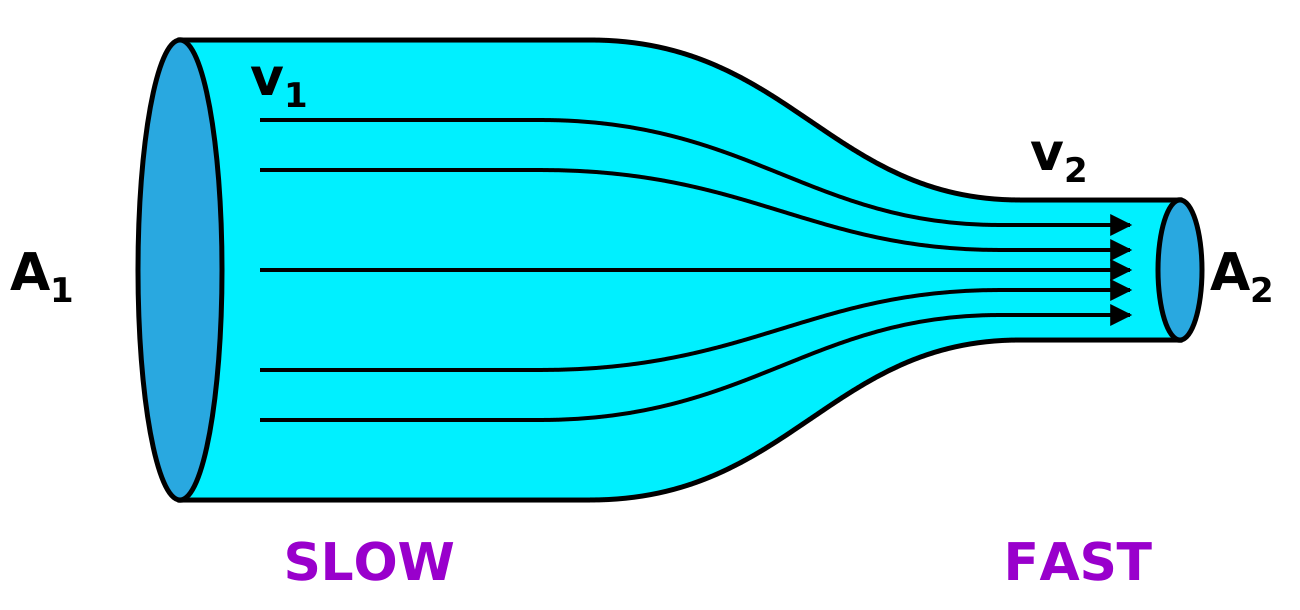
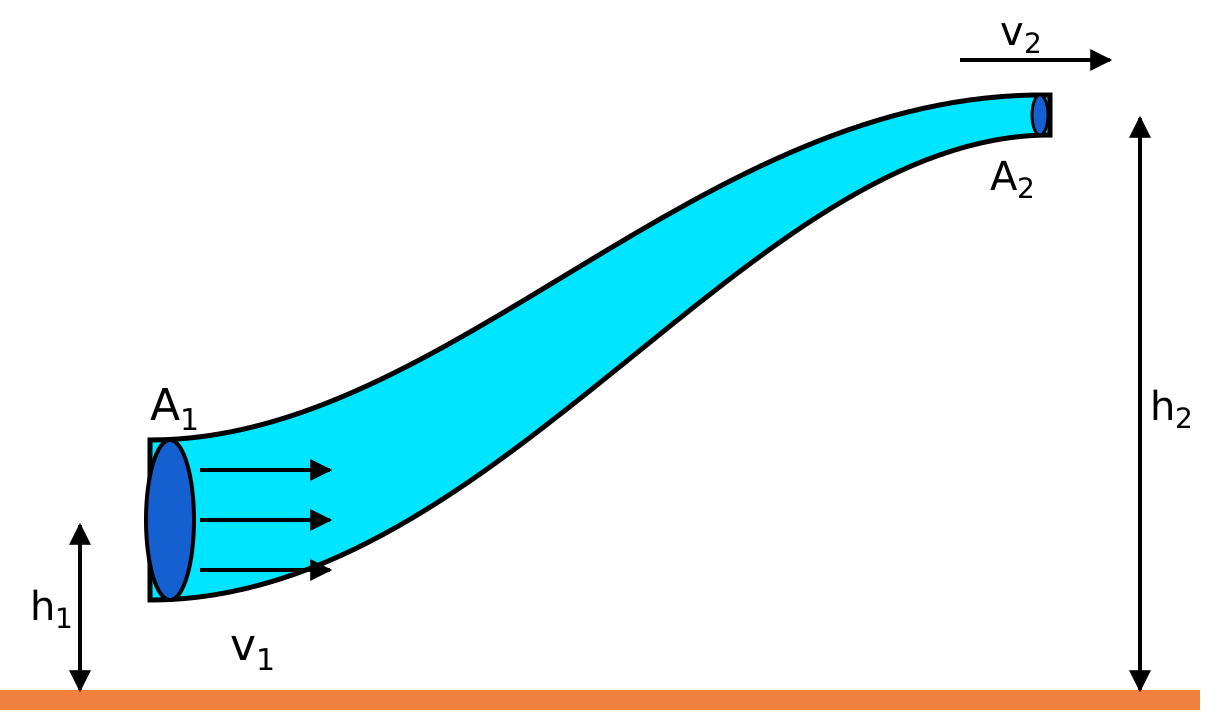
Speed increases in sections of the pipe.
$$A_1 v_1 = A_2 v_2$$
Mass Flow Rate (Continuity)
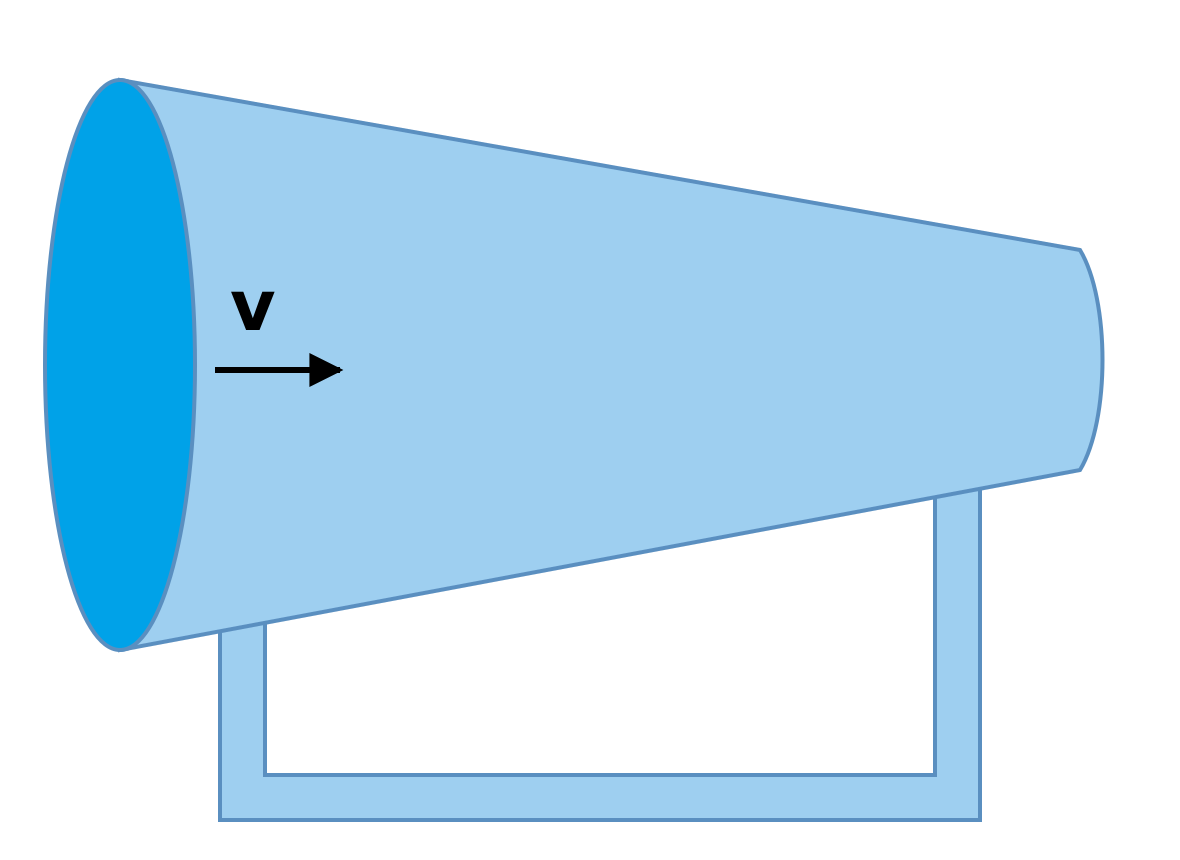
Density does not typically change in liquids. This means that where a pipe is wider, the flow is .
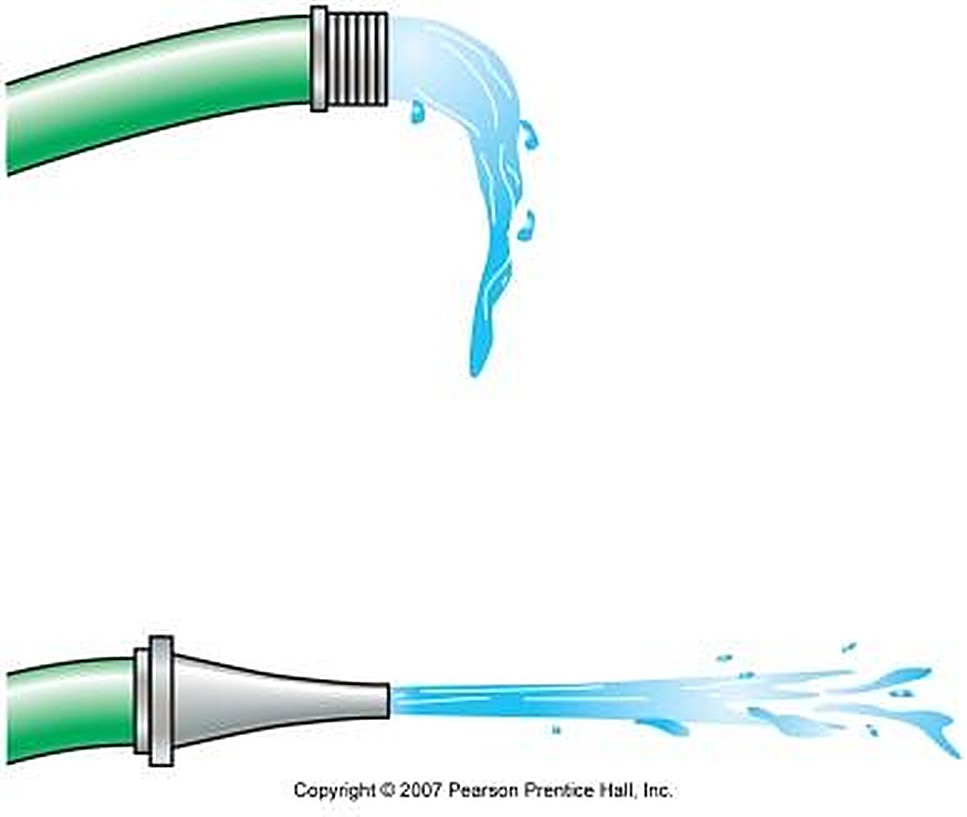
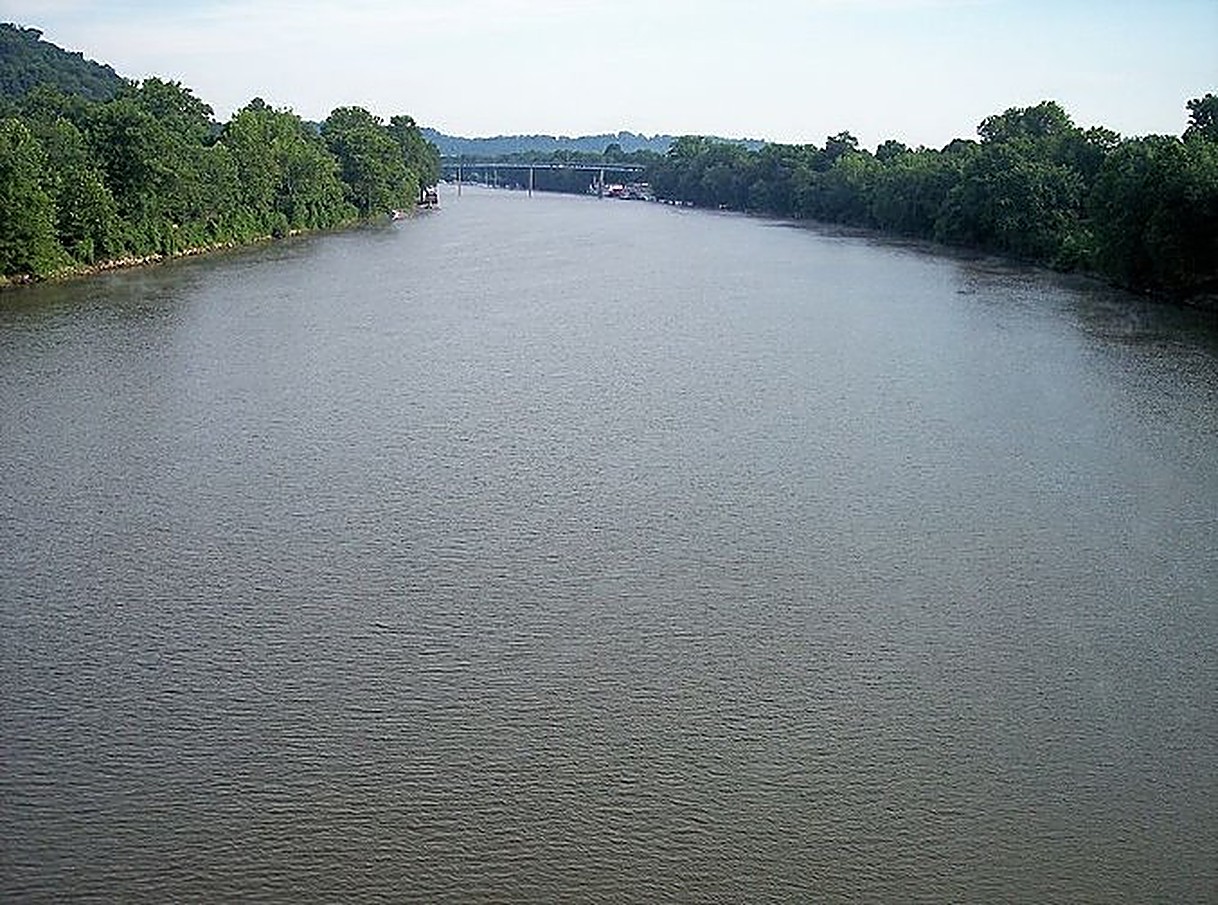
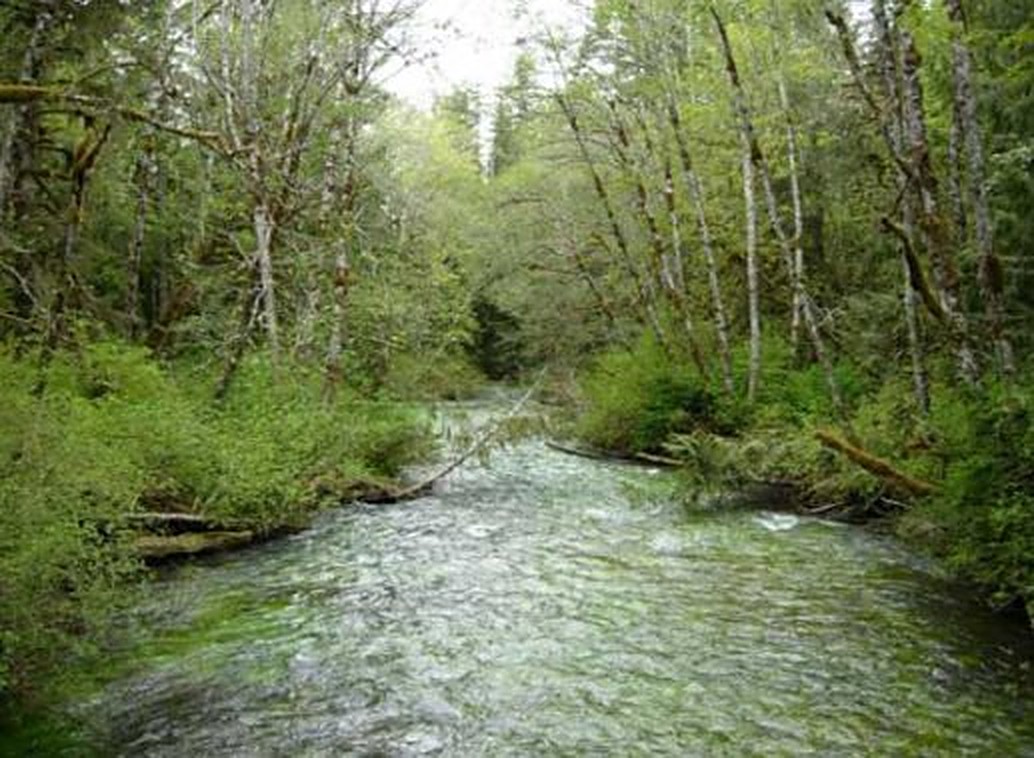
Which body of water is faster?
The narrow stream is faster – where the channel is narrower, the water moves faster ($A_1 v_1$ $= A_2 v_2$).
D. Continuity Animation
E. Continuity Problems
1. Water flows at a constant speed through one section of a pipe. When it enters another section with half the cross-sectional area, what happens to the speed of the water?
Half the area means twice the speed: $A_1 v_1$ $= (\tfrac{1}{2}A_1) v_2$ $\Rightarrow v_2$ $= 2v_1$.
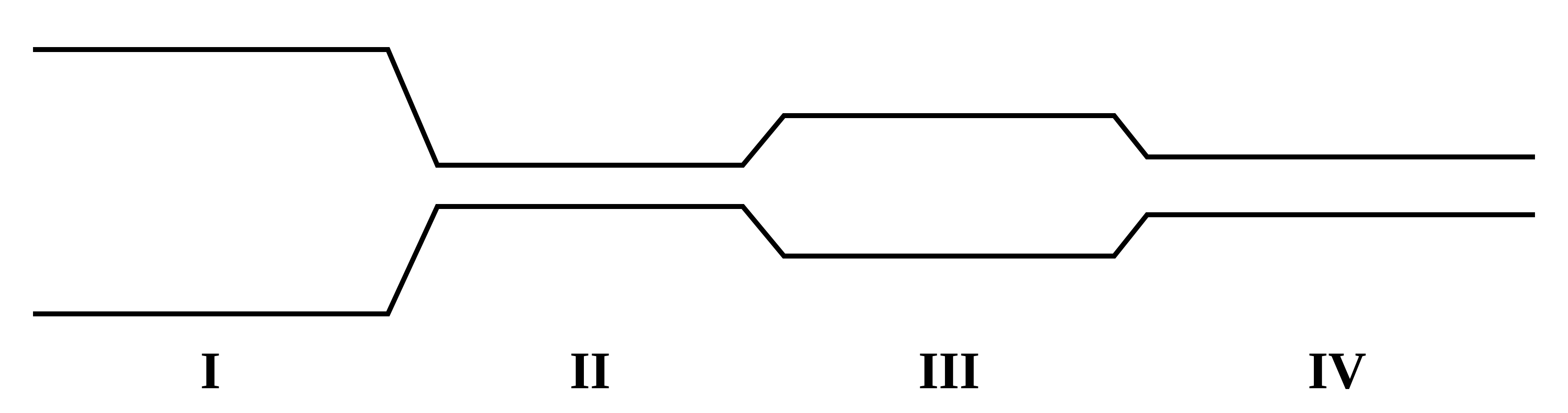
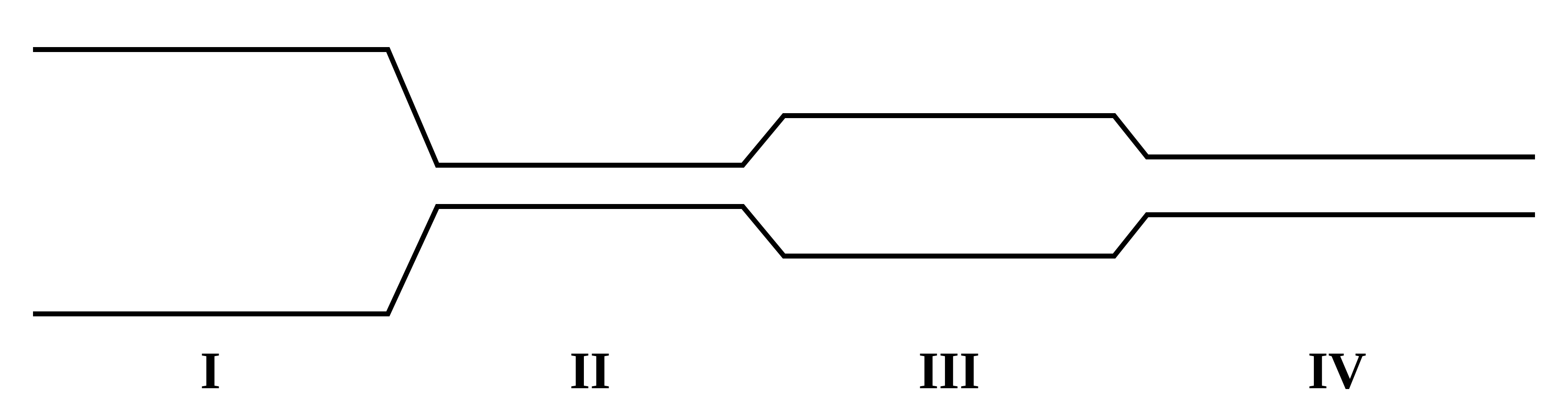
2. A fluid is forced through a pipe of changing cross-section as shown. In which section would the speed of the fluid be a minimum?
Section I is the widest, so the fluid is slowest there.
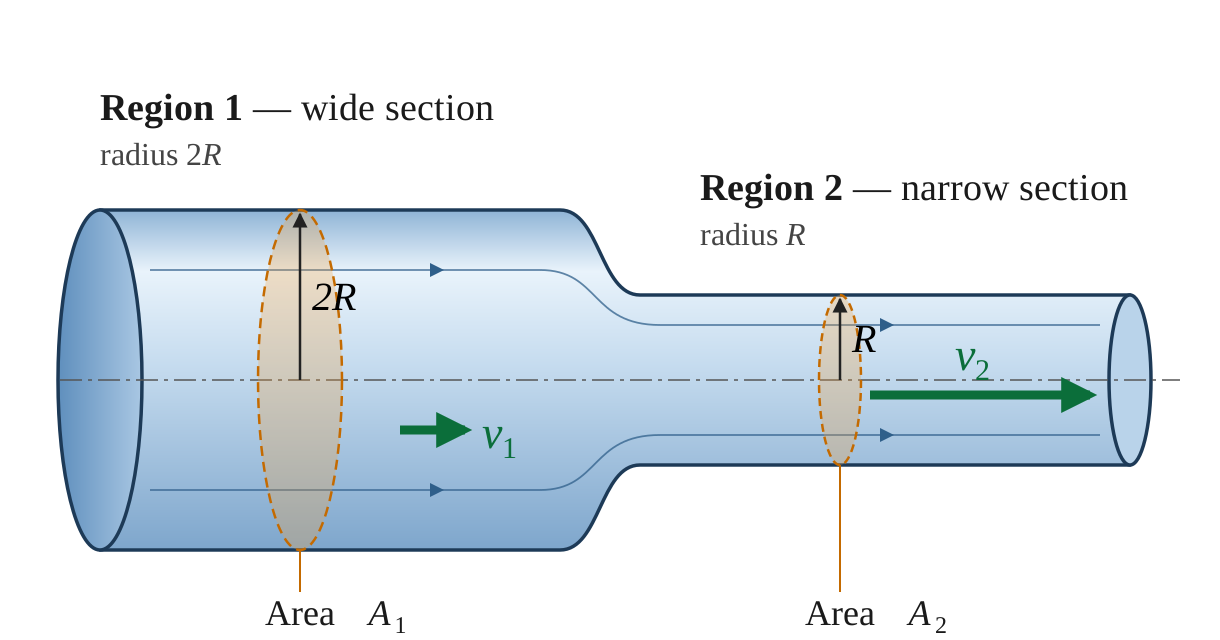
3. An ideal fluid flows through a long horizontal circular pipe. In one region the pipe has a radius of $2R$. The pipe then narrows to radius $R$. What is the ratio of the fluid speed in the region of radius $2R$ to the speed in the region with radius $R$?
2 A) Section I – it is the widest, so the fluid is slowest there.
3 $v_1 (\pi r_1^2)$ $= v_2 (\pi r_2^2)$
$\dfrac{v_1}{v_2}$ $= \dfrac{r_2^2}{r_1^2}$ $= \dfrac{R^2}{(2R)^2}$ $= \dfrac{1}{4}$ → A)
4. Fluid Splitting: An ideal fluid flows with a speed of 12 cm/s through a pipe of diameter 5 cm. The pipe splits into three smaller pipes, each with a diameter of 2.0 cm. What is the speed of the fluid in the smaller pipes?
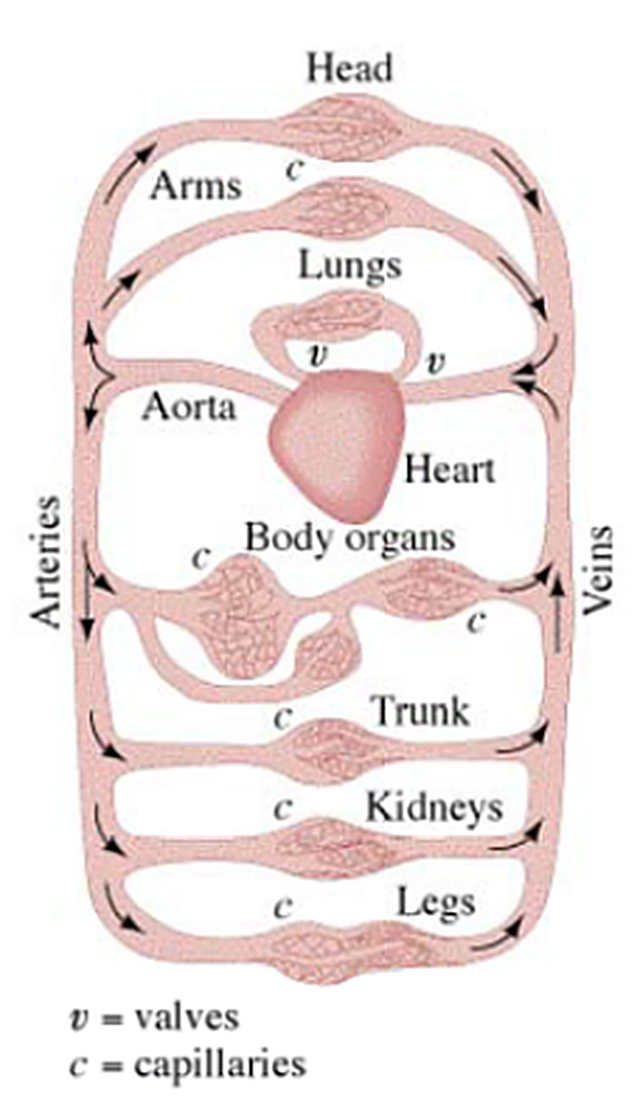
5. Aorta and Capillaries: The radius of the aorta is 1 cm and that of the capillaries is 7 µm. If the average speed of blood in the aorta is 40 cm/s and in the capillaries is about 0.6 mm/s, what is the number of capillaries in the human body?
Fill-ins:Ideal fluid: no internal FRICTION, constant DENSITY. Speed increases in NARROWER sections. Where a pipe is wider, the flow is SLOWER – the narrow stream is the faster body of water.
Reasoning:The area is already given, so there is no need to use $\pi r^2$. Each second, a column of water $6 \text{ m}$ long with a $0.4 \text{ m}^2$ cross-section passes any point.
1 – Claim:B) The speed doubles.
Evidence:$A_1 v_1$ $= \left(\tfrac{1}{2}A_1\right) v_2$ so $v_2 = 2 v_1$
2 – Claim:A) Section I – it is the widest, so the fluid is slowest there.
Reasoning:All the blood leaving the aorta must pass through the capillaries, so the total flow rate is the same. Each capillary is tiny and the blood is slow, so there must be an enormous number of them.
II. Aim 37: How Does the Speed of a Fluid Affect the Pressure?
As fluid speed increases, the pressure .
1. A fluid is forced through a pipe of changing cross-section as shown. In which section would the pressure of the fluid be a minimum?
Section II is the narrowest, so the fluid is fastest and the pressure is lowest.
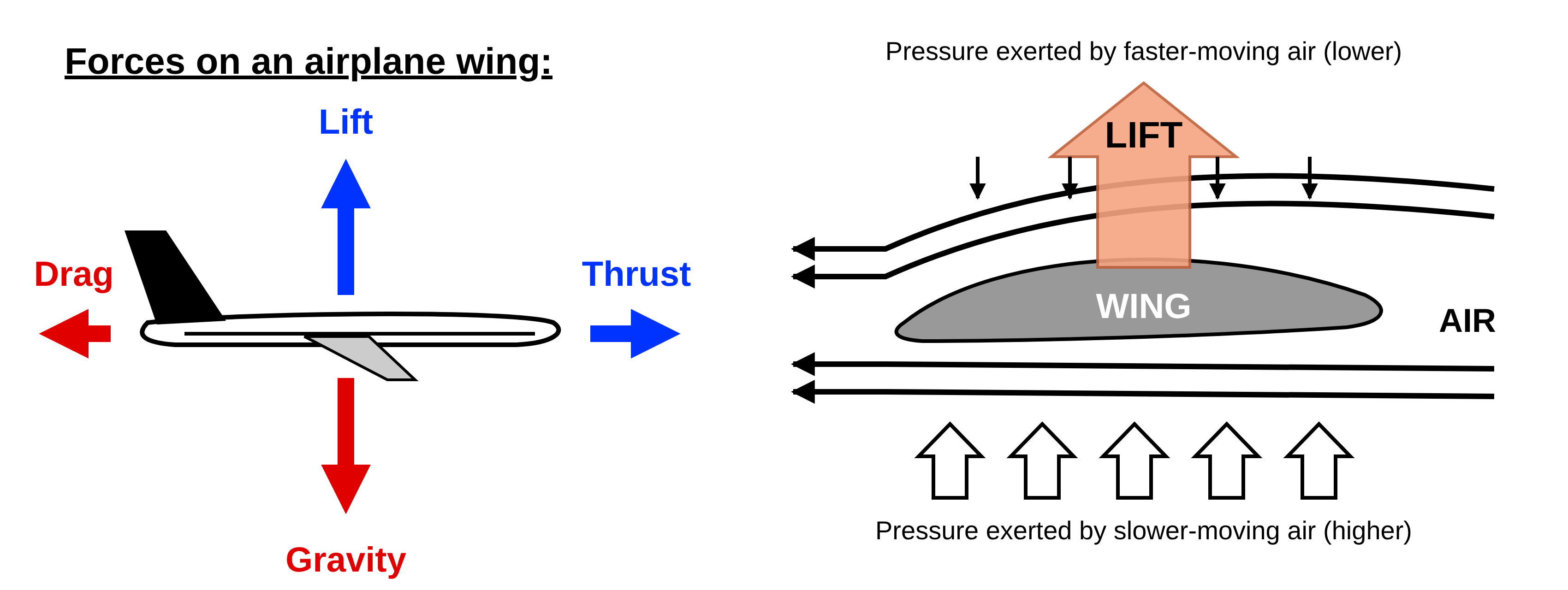
A. Forces on a Wing
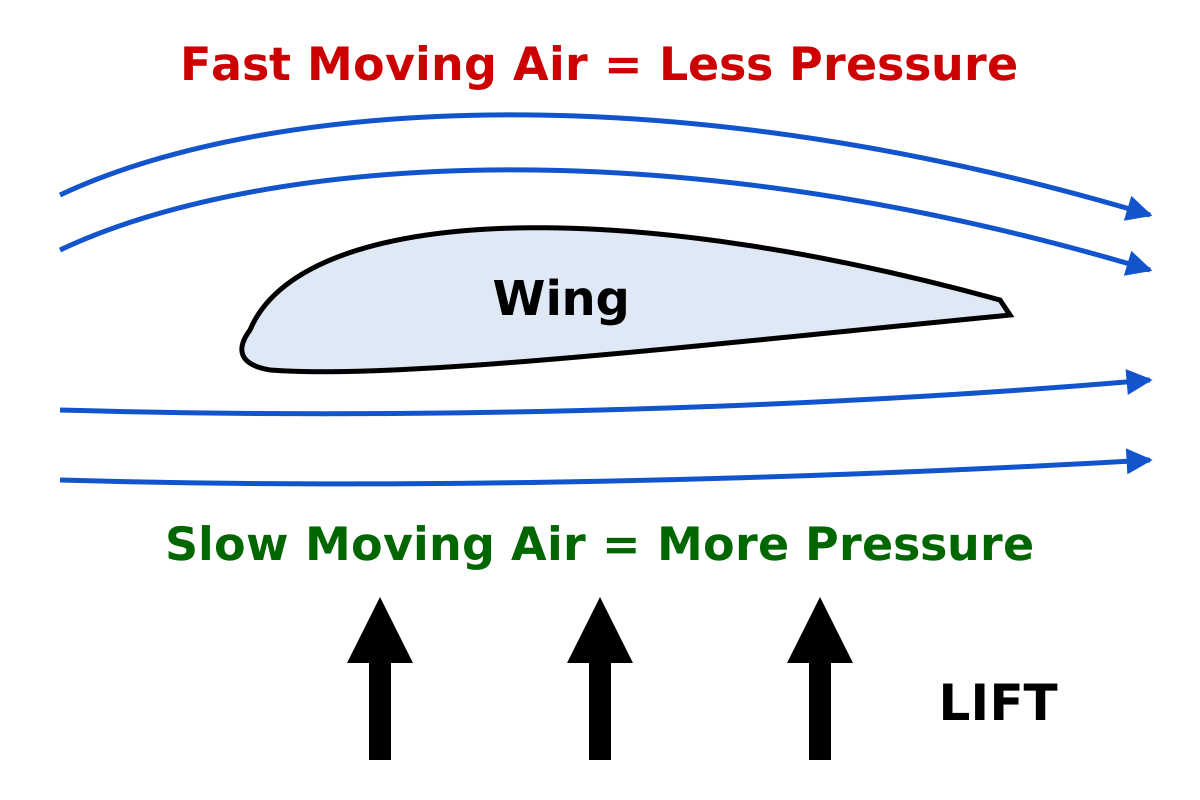
Air moves faster over the top of the wing → lower pressure. Air moves slower under the wing → higher pressure. The pressure difference pushes the wing .
2. A small ranger vehicle has a soft, ragtop roof. When the car is at rest, the roof is flat. When the vehicle is cruising at highway speeds with its windows rolled up, does the roof (a) bow upward, (b) remain flat, or (c) bow downward?
Fast air over the roof has low pressure; the still air inside pushes the roof up.
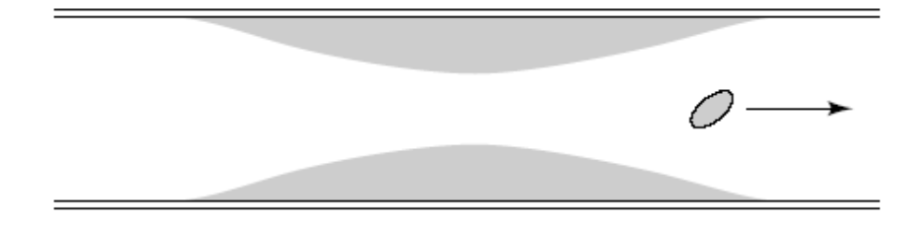
3. Blood Flow: A blood platelet drifts along with blood flow through an artery partially blocked by deposits. As the platelet moves from the narrow region to the wider region, it experiences (1) an increase in pressure, (2) no change in pressure, or (3) a decrease in pressure.
The blood slows down in the wider region, so its pressure increases.
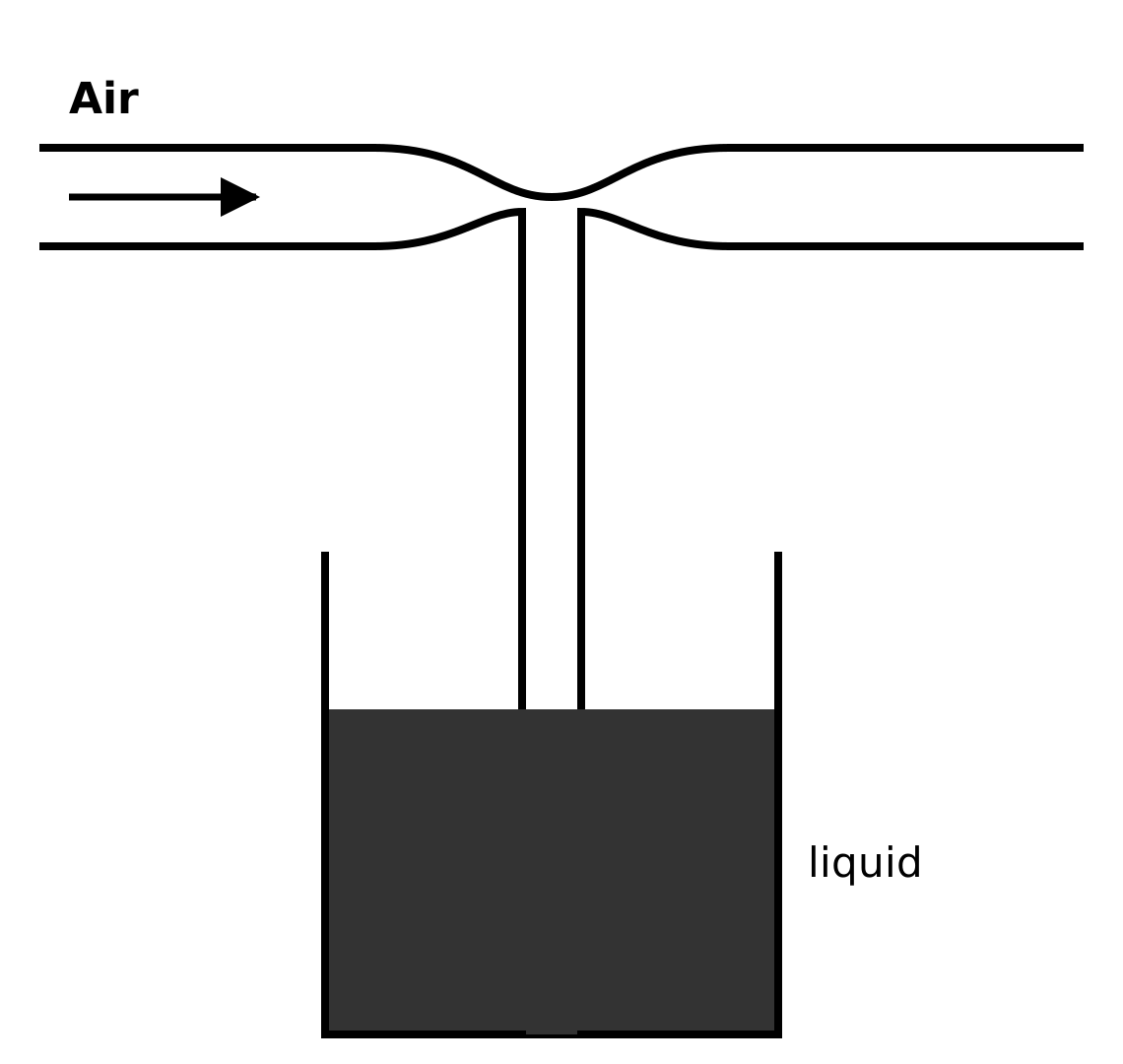
4. T-Shaped Tube: A T-shaped tube with a constriction is inserted in a liquid vessel, as shown. What happens if air is blown through the tube from the left?
The air speeds up at the constriction, so its pressure drops and the liquid is pushed up the stem.
Teacher Workspace: Speed & Pressure Concepts
1 B) Section II – narrowest, so fastest flow and lowest pressure
2 (a) Bows upward – fast air over the roof has low pressure; the still air inside pushes up
3 (1) Pressure increases – the blood slows down in the wider region
4 (A) The liquid rises – air speeds up at the constriction, so its pressure drops
B. I Cut One in Half to Find Out
Video loads when this section opens…
C. Bernoulli's Principle
Video loads when this section opens…
5. Water flows through a section of thick piping with some velocity $v$ as shown. Based on the diagram, in which direction would you expect water to flow through the narrow section?
The narrow right end has faster flow and lower pressure, so water in the connecting pipe is pushed from left (high P) to right (low P).
6. Water is in free fall from an open faucet. As the stream of water falls, which of the following statements is true?
The water speeds up as it falls, and faster-moving fluid has lower pressure.
Teacher Workspace: Thick Pipe & Falling Stream
5 Narrow right end: $v$ up, $P$ down
(A) To the right – from high pressure (left) to low pressure (right)
6 B) The water speeds up as it falls, so the pressure is lower at lower points.
Aim 37 Teacher Key
Rule:As fluid speed increases, pressure DECREASES. The wing is pushed UP (lift).
1 – Claim:B) Section II – the narrowest section has the fastest flow and the minimum pressure.
2 – Claim:(a) The roof bows upward.
Reasoning:Fast-moving air over the roof has low pressure. The still air trapped inside the car has higher pressure, so it pushes the roof up.
3 – Claim:(1) An increase in pressure.
Reasoning:Moving from the narrow region to the wider region, the blood slows down ($A_1 v_1 = A_2 v_2$), so its pressure increases.
4 – Claim:(A) The liquid level in the tube rises.
Reasoning:The air speeds up where the tube narrows, so the pressure there goes down. The higher pressure on the surrounding liquid pushes liquid up the stem.
5 – Claim:(A) To the right.
Reasoning:The right side of the thick pipe is narrow, so $v$ goes up and $P$ goes down on the right. The water in the connecting pipe is pushed from the high pressure (left) to the low pressure (right).
6 – Claim:B) The pressure in the water is lower at lower points of the stream.
Reasoning:The water speeds up as it falls. As the velocity goes up, the pressure goes down. (The density of a liquid does not change.)
III. Aim 38: What is Bernoulli's Equation?
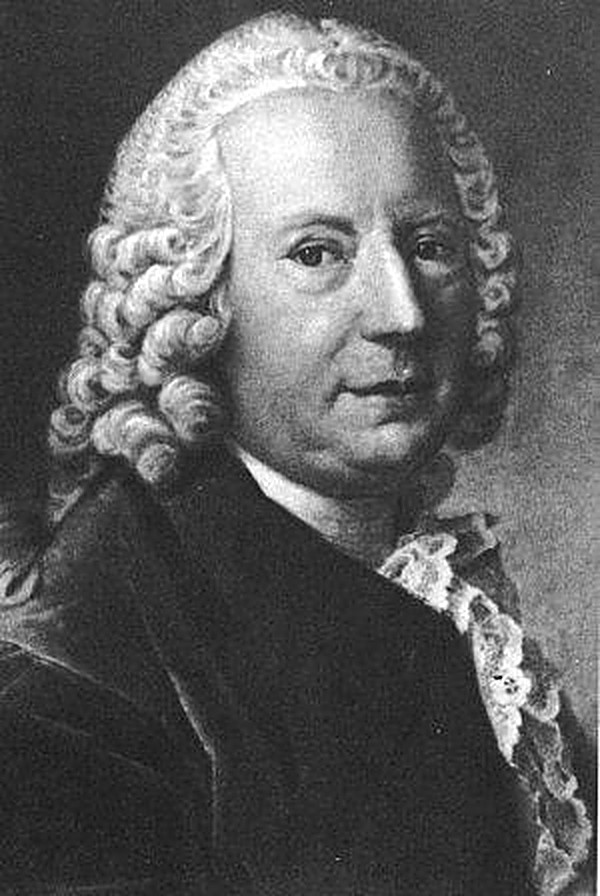
Daniel Bernoulli (1700 – 1782) – Energy in a fluid is conserved.
What factors affect static pressure?
What factors affect dynamic pressure?
Bernoulli's equation is the Conservation of equation for fluids.
A. Deriving Bernoulli's Equation
The total mechanical energy of the moving fluid remains constant unless work is done by a net force, or pressure difference.
$$\begin{gathered} W + mgy + \frac{1}{2}mv^2 \\ = \text{constant} \end{gathered}$$
Since we are dealing with a fluid, let's look at each term per unit volume. Divide each term by the volume $V$:
$$\begin{gathered} \frac{W}{V} + \left(\frac{m}{V}\right) g y + \frac{1}{2}\left(\frac{m}{V}\right) v^2 \\ = \text{constant} \end{gathered}$$
Since $m/V = \rho$ and $W = Fd$:
$$\begin{gathered} F\left(\frac{d}{V}\right) + \rho g y + \frac{1}{2}\rho v^2 \\ = \text{constant} \end{gathered}$$
The volume of fluid in the pipe equals $A$ times $d$ ($V = Ad$):
$$\begin{gathered} F\left(\frac{d}{Ad}\right) + \rho g y + \frac{1}{2}\rho v^2 \\ = \text{constant} \end{gathered}$$
$$\begin{gathered} \frac{F}{A} + \rho g y + \frac{1}{2}\rho v^2 \\ = \text{constant} \end{gathered}$$
Bernoulli's Equation
$$\begin{gathered} P + \rho g y + \frac{1}{2}\rho v^2 \\ = \text{constant} \end{gathered}$$
$$\begin{gathered} P_1 + \rho g y_1 + \frac{1}{2}\rho v_1^2 \\ = P_2 + \rho g y_2 + \frac{1}{2}\rho v_2^2 \end{gathered}$$
B. Bernoulli's Principle Simulation
Strategies:
Draw and label a diagram
Evaluate velocity changes due to diameter
Make a data table
Plug and chug!
C. Problems
1. Water leaves a hot water heater in a basement through a pipe of radius 2.5 cm at a speed of 1 m/s under a pressure of 200 kPa. What is the speed and pressure of the water in the bedroom 6 meters above, where the pipe has narrowed to a 2-cm diameter? ($\rho = 1000 \text{ kg/m}^3$)
2. Lift Force: What is the lift force due to Bernoulli's principle on a pair of wings of total area $100 \text{ m}^2$ if the air passes over the top and bottom surfaces at speeds of 300 m/s and 260 m/s, respectively? ($\rho_{air}$ $= 1.29 \text{ kg/m}^3$)
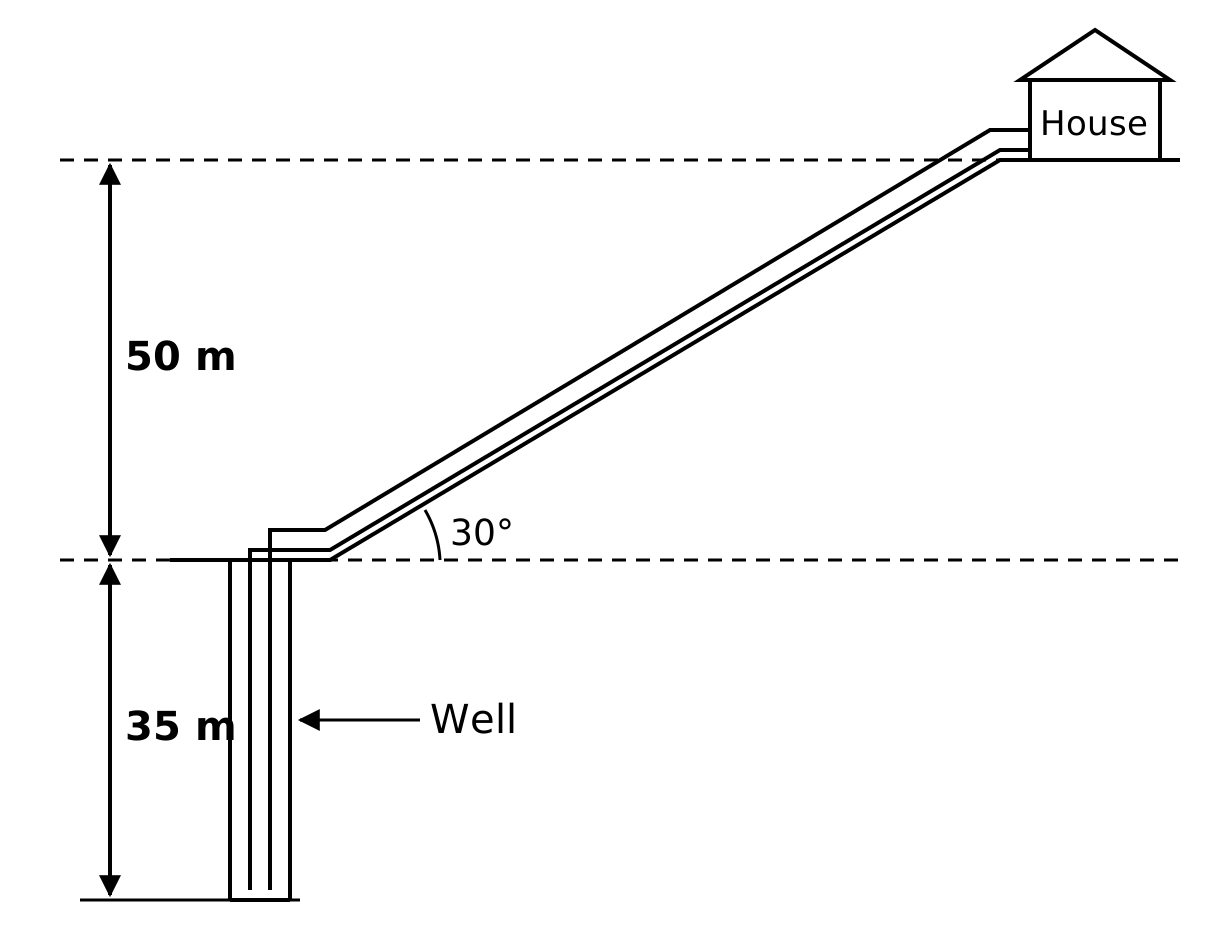
3. A pump, submerged at the bottom of a well that is 35 m deep, is used to pump water uphill to a house that is 50 m above the top of the well, as shown. The density of water is $1000 \text{ kg/m}^3$. Neglect the effects of friction, turbulence, and viscosity.
(a) Residents of the house use $0.35 \text{ m}^3$ of water per day. The day's pumping is completed in 2 hours.
i. Calculate the minimum work required to pump the water used per day.
ii. Calculate the pump's minimum power rating.
(b) In the well, the water flows at 0.50 m/s and the pipe has a diameter of 3.0 cm. At the house the diameter of the pipe is 1.25 cm.
i. Calculate the flow velocity at the house when a faucet in the house is open.
ii. Calculate the pressure at the well when the faucet in the house is open.
Fill-ins:Static pressure: DEPTH (height) and ATMOSPHERIC pressure. Dynamic pressure: VELOCITY. Bernoulli's equation is the Conservation of ENERGY equation for fluids.
Evidence:$r_1 = 0.015 \text{ m}$, $r_2 = 0.00625 \text{ m}$, $v_1 = 0.50 \text{ m/s}$
(i) $r_1^2 v_1$ $= r_2^2 v_2$ $\Rightarrow (0.015)^2(0.50)$ $= (0.00625)^2 v_2$
$v_2 = 2.88 \text{ m/s}$
(ii) Set $h_1 = 0$ at the pump; the open faucet is at $P_{atm}$ $= 1 \times 10^5 \text{ Pa}$:
$P_1 + \tfrac{1}{2}\rho v_1^2$ $= P_{atm} + \tfrac{1}{2}\rho v_2^2 + \rho g h_2$
$P_1 + 125$ $= 100{,}000 + 4147 + 850{,}000$
$P_1$ $\approx 9.5 \times 10^5 \text{ Pa}$
Quick Check
3 questions on III. Aim 38: Bernoulli's Equation — pick an answer to check yourself.
1. Water flows through a horizontal pipe that narrows. In the narrow section, compared to the wide section, the water's…
2. Air (ρ = 1.2 kg/m³) moves over a 20 m² wing at 50 m/s on top and 40 m/s underneath. What is the lift force?
3. Bernoulli's equation, P + ρgy + ½ρv² = constant, is a statement of conservation of…
IV. Aim 39: Problem Solving with Bernoulli's Equation
$$\begin{gathered} P_1 + \rho g y_1 + \frac{1}{2}\rho v_1^2 \\ = P_2 + \rho g y_2 + \frac{1}{2}\rho v_2^2 \end{gathered}$$
A. The Drinking Fountain
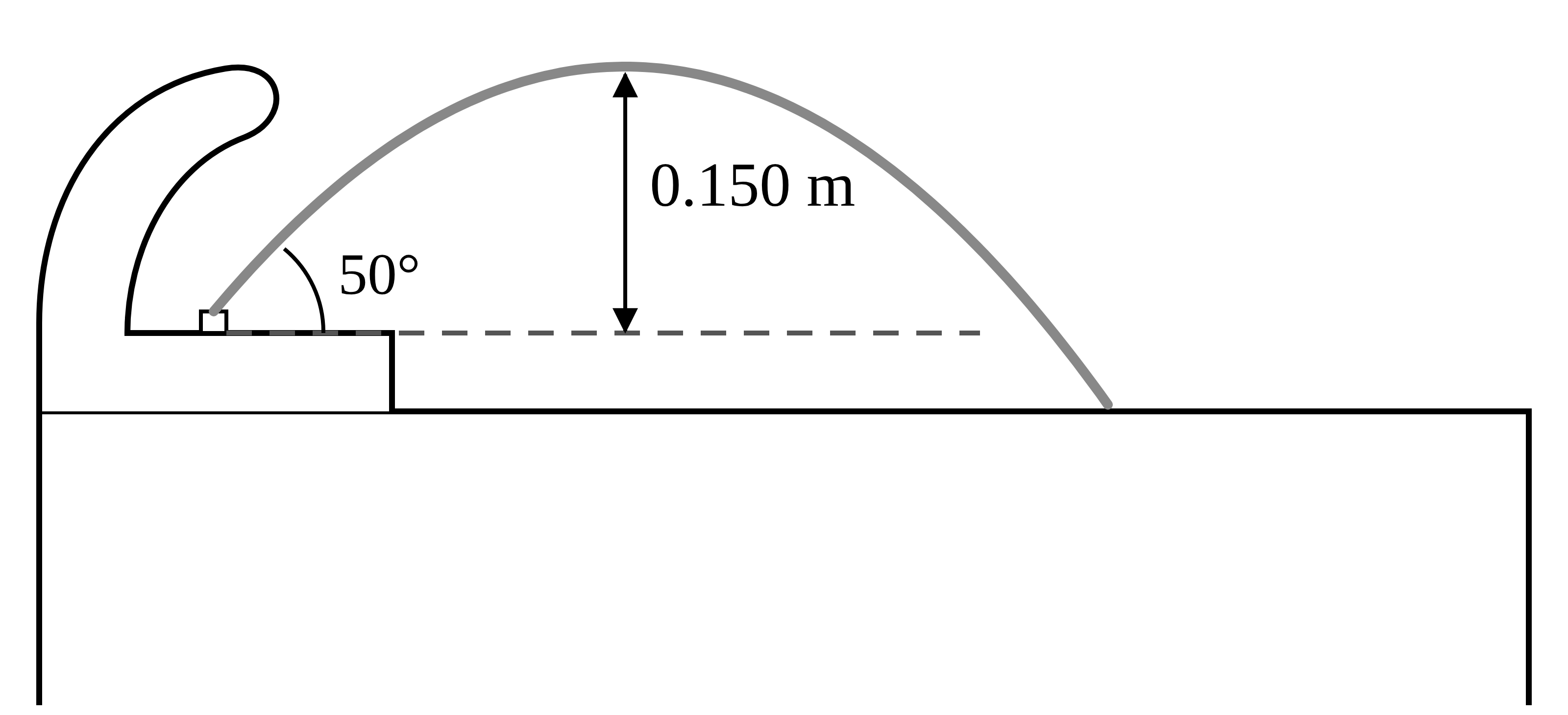
1. A drinking fountain projects water at an initial angle of 50° above the horizontal, and the water reaches a maximum height of 0.150 m above the exit point. Assume air resistance is negligible.
(a) Calculate the speed at which the water leaves the fountain.
(b) The radius of the fountain's exit hole is $4.00 \times 10^{-3} \text{ m}$. Calculate the volume rate of flow of the water.
(c) The fountain is fed by a pipe that at one point has a radius of $7.00 \times 10^{-3} \text{ m}$ and is 3.00 m below the fountain's opening. The density of water is $1.0 \times 10^3 \text{ kg/m}^3$. Calculate the gauge pressure in the feeder pipe at this point.
Teacher Workspace: Drinking Fountain
(a) At the top $v_{fy}$ $= 0$: $0$ $= v_{iy}^2$ ${}+ 2(-10 \text{ m/s}^2)(0.150 \text{ m})$
$v_{iy}$ $= 1.73 \text{ m/s}$ and $v_{iy}$ $= v \sin 50^\circ$
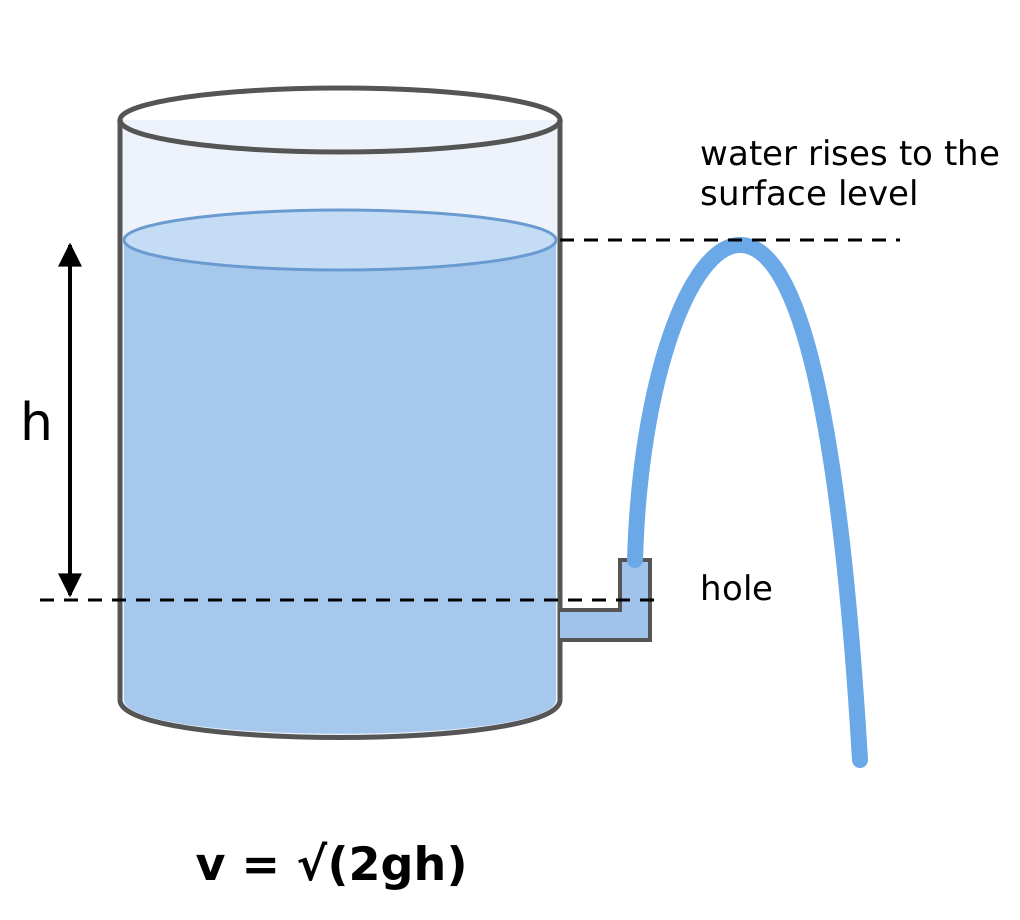
Efflux speed – the speed a fluid leaves a container. It is related to the of the water.
Torricelli's Law – the speed of water coming out of a hole in a bucket is:
$$\begin{gathered} mgh = \frac{1}{2}mv^2 \\ v = \sqrt{2gh} \end{gathered}$$
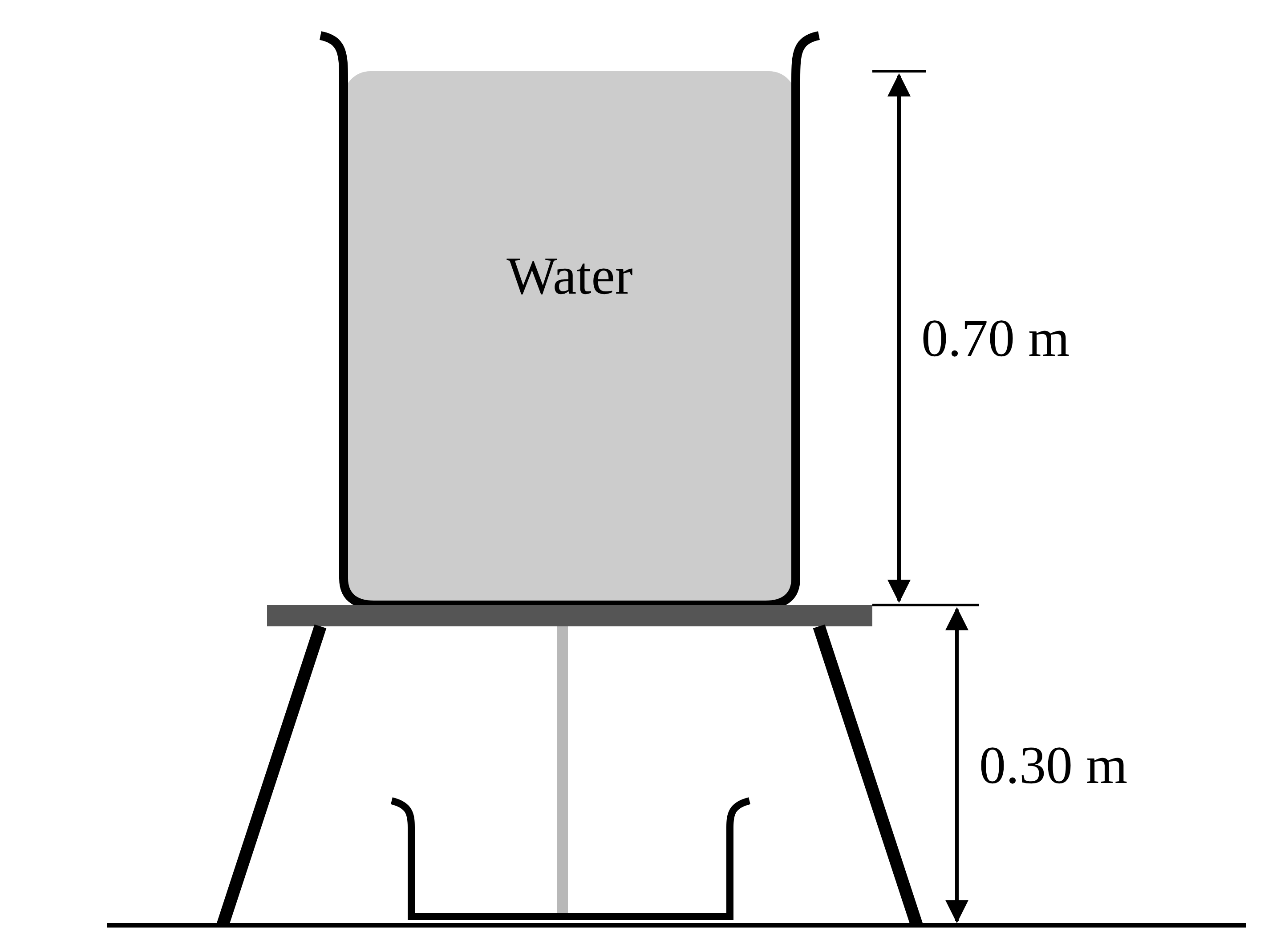
2. A cylindrical tank containing water of density $1000 \text{ kg/m}^3$ is filled to a height of 0.70 m and placed on a stand as shown. A hole of radius 0.0010 m in the bottom of the tank is opened. Water then flows through the hole and through an opening in the stand and is collected in a tray 0.30 m below the hole. At the same time, water is added to the tank at an appropriate rate so that the water level in the tank remains constant.
(a) Calculate the speed at which the water flows out from the hole.
(b) Calculate the volume rate at which water flows out from the hole.
(c) Calculate the volume of water collected in the tray in $t = 2.0$ minutes.
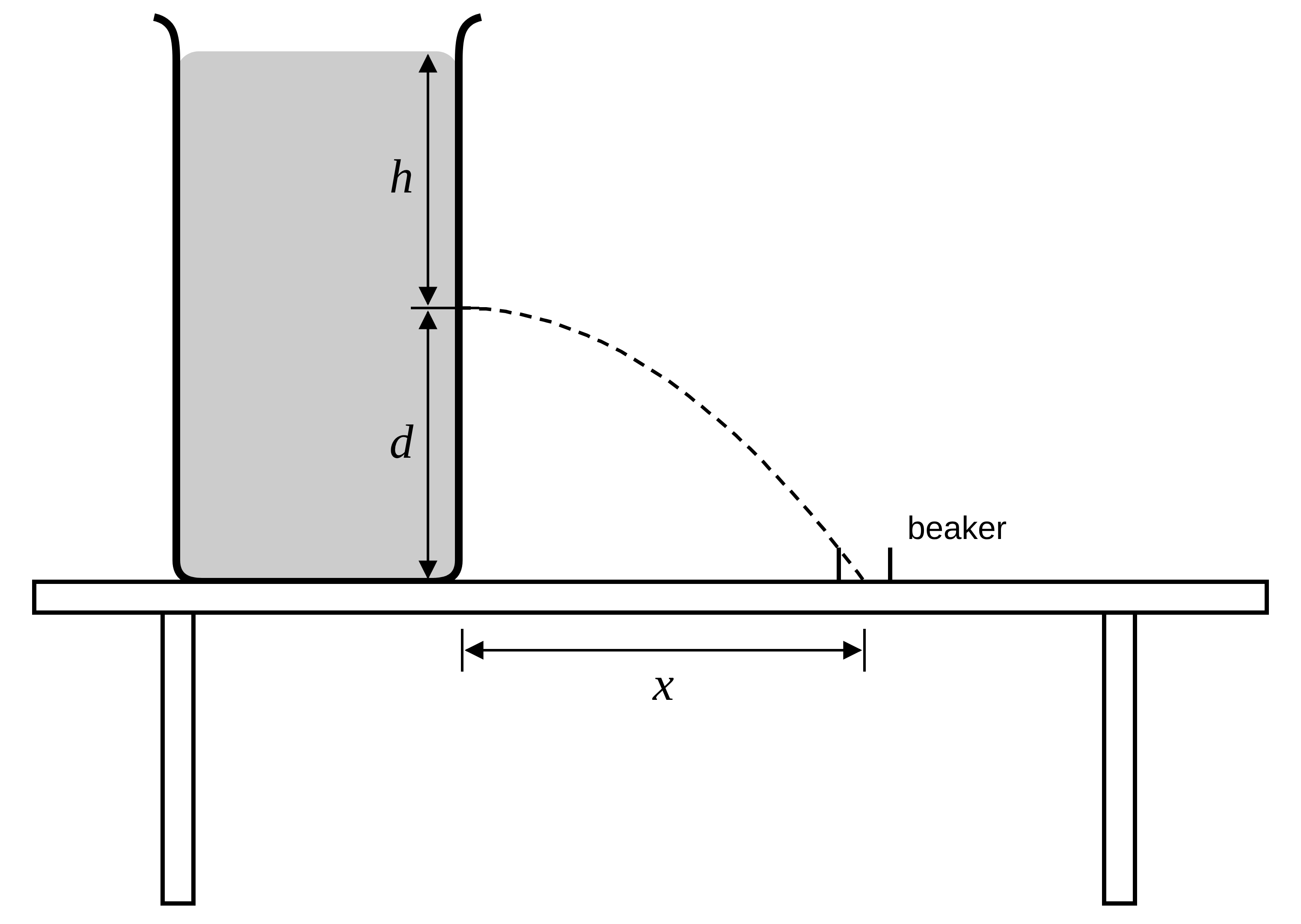
3. (AP 2007 B4) The large container shown is filled with a liquid of density $1.1 \times 10^3 \text{ kg/m}^3$. A small hole of area $2.5 \times 10^{-6} \text{ m}^2$ is opened in the side of the container a distance $h$ below the liquid surface, which allows a stream of liquid to flow through the hole and into a beaker placed to the right of the container. At the same time, liquid is also added to the container at an appropriate rate so that $h$ remains constant. The amount of liquid collected in the beaker in 2.0 minutes is $7.2 \times 10^{-4} \text{ m}^3$.
(a) Calculate the volume rate of flow of liquid from the hole in m³/s.
(b) Calculate the speed of the liquid as it exits from the hole.
(c) Calculate the height $h$ of liquid needed above the hole to cause the speed you determined in part (b).
(d) Suppose that there is now less liquid in the container so that the height $h$ is reduced to $h/2$. In relation to the collection beaker, where will the liquid hit the tabletop? Justify your answer.
A smaller $h$ gives a smaller exit speed $v = \sqrt{2gh}$. The fall time is the same, so the stream lands closer to the container – to the left of the beaker.
(d) Smaller $h$ → smaller exit speed; same fall time → shorter horizontal distance
It lands to the LEFT of the beaker.
C. Pumps, Venturi Meters & Falling Water
4. A pump, submerged at the bottom of a well that is 30 meters deep, is used to pump water up to faucets in a house. The highest faucet is 10 m above the top of the well. The average gauge pressure at the pump is 403,700 Pa, the radius of the pipe connected to the pump is 0.03 m, and the radius of the faucet opening is 0.01 m. Find the flow speed when the highest faucet in the house is open.
Teacher Workspace: Pump to the Highest Faucet
The faucet is $30 \text{ m}$ ${}+ 10 \text{ m}$ $= 40 \text{ m}$ above the pump; the open faucet is at $P_{atm}$
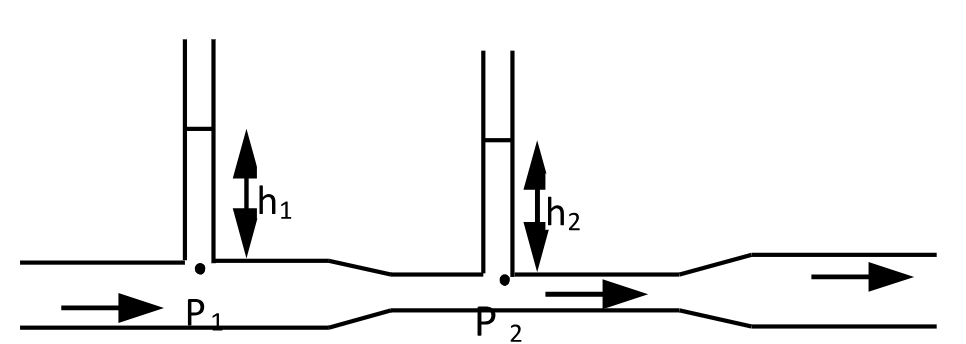
5. Venturi Meter: A Venturi meter measures the speed of water flow in a pipe with a cross-sectional area of $0.01 \text{ m}^2$. The pipe is constricted to a cross-sectional area of $0.002 \text{ m}^2$. Two vertical tubes, open to the atmosphere, rise from two points, one of which is in the constriction.
(a) Compare $h_1$ and $h_2$. Which one should be higher?
(b) Let's say that $h_1 = 1.5 \text{ m}$ and $h_2 = 0.6 \text{ m}$. Find $P_1$, $P_2$ and the flow speeds $v_1$ and $v_2$ in the pipe.
Teacher Workspace: Venturi Meter
(a) Slower at 1 → higher pressure at 1 → $h_1$ is higher
(b) Each tube is open to the air: $P$ $= P_{atm}$ ${}+ \rho g h$
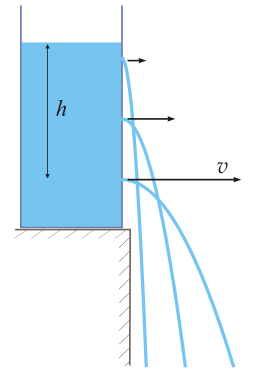
Sample Problem 1: Water streams out of holes at different depths below the water surface. Which stream leaves the container with the greatest speed? Explain using $v = \sqrt{2gh}$.
The lowest hole – it is deepest, and $v$ $= \sqrt{2gh}$ grows with depth $h$.
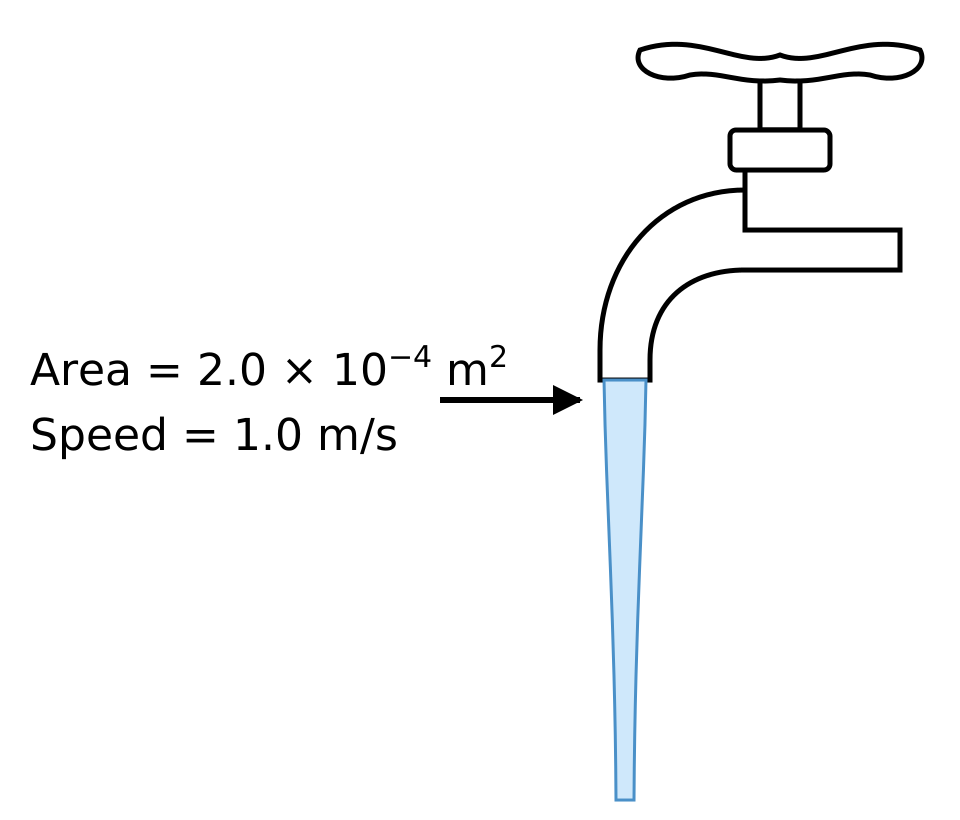
6. Water is in free fall from an open faucet. As the water leaves the faucet the stream is uniform and has a cross-sectional area of $2.0 \times 10^{-4} \text{ m}^2$. At that point the stream has a speed of 1.0 m/s. How far will the water fall before the stream has an area of $1.2 \times 10^{-4} \text{ m}^2$?
$v_2 = 1.67 \text{ m/s}$ from continuity; $(1.67)^2$ $= (1.0)^2 + 2(10)d$ $\Rightarrow d$ $\approx 0.09 \text{ m}$. The stream starts at 1.0 m/s, not from rest.
Reasoning:(d) A smaller $h$ means a smaller exit speed ($v = \sqrt{2gh}$). The hole is at the same height, so the fall time is the same and the stream travels a shorter horizontal distance – it lands to the LEFT of the beaker.
4 – Claim:$v_{faucet}$ $\approx 2.7 \text{ m/s}$
Evidence:The faucet is $30 + 10 = 40 \text{ m}$ above the pump, and the open faucet is at atmospheric pressure.
Continuity: $v_1$ $= v_2 \dfrac{r_2^2}{r_1^2}$ $= v_2 \dfrac{(0.01)^2}{(0.03)^2}$ $= \dfrac{v_2}{9}$
$P_{gauge}$ $= \rho g h + \tfrac{1}{2}\rho\,(v_2^2 - v_1^2)$
$403{,}700 = (1000)(10)(40)$ $\quad + \tfrac{1}{2}(1000)\,v_2^2\left(1 - \tfrac{1}{81}\right)$
$3700 = 494\, v_2^2$
$v_2 \approx 2.7 \text{ m/s}$
Evidence:(a) The speed is lower at 1, so $P_1$ is higher, so $h_1$ is higher.
(b) Each tube is open to the air: $P = P_{atm} + \rho g h$
$P_1$ $= 1.01 \times 10^5 + (1000)(10)(1.5)$ $= 1.16 \times 10^5 \text{ Pa}$
$P_2$ $= 1.01 \times 10^5 + (1000)(10)(0.6)$ $= 1.07 \times 10^5 \text{ Pa}$
Continuity: $0.01\, v_1$ $= 0.002\, v_2$ $\Rightarrow v_2$ $= 5 v_1$
Bernoulli: $g h_1 + \tfrac{1}{2}v_1^2$ $= g h_2 + \tfrac{1}{2}v_2^2$
$15 + \tfrac{1}{2}v_1^2$ $= 6 + \tfrac{1}{2}(25)v_1^2$
$9$ $= 12\, v_1^2$ $\Rightarrow v_1$ $= 0.87 \text{ m/s}$ $v_2 = 4.3 \text{ m/s}$
Sample Problem 1 – Claim:The stream from the lowest hole leaves the fastest.
Reasoning:By Torricelli's law, $v = \sqrt{2gh}$, where $h$ is the depth of the hole below the water surface. The lowest hole has the greatest depth, so its stream has the greatest speed.
Reasoning:The stream already has a speed of 1.0 m/s when it leaves the faucet, so $v_i = 1.0 \text{ m/s}$, not zero. (Using $v_i = 0$ gives 0.14 m.)
V. Fluids in Motion Questions
Total Score: 0 / 20
Check Your Understanding
5 quick questions — pick an answer to see if you’re right.
1. Water flows through a main with a cross-sectional area of 0.4 m² at 6 m/s. What is the volume flow rate?
2. Water enters a section of pipe with half the cross-sectional area. What happens to its speed?
3. An ideal fluid flows from a pipe of radius 2R into a pipe of radius R. The speed in the narrow pipe is how many times the speed in the wide pipe?
4. According to Bernoulli's principle, as the speed of a fluid increases, its pressure…
5. A car with a soft fabric roof cruises at highway speed with the windows closed. What does the roof do?
What, If Anything, Is Wrong?No calculator
Water in a Narrowing Pipe
Water (an ideal fluid) flows steadily to the right through a horizontal pipe. The pipe narrows at B, then widens again at C to the same size as A. A student draws velocity arrows and ranks the pressures:
Student: "The water slows down at B because it gets squeezed into the narrow part. For pressure, PA > PB > PC. The water loses pressure squeezing through B and never gets it back."
What, if anything, is wrong? If something is wrong, explain the error and fix it. If nothing is wrong, explain why it is correct.