Total Internal Reflection lesson illustration

AI Discussion of
What Makes a Diamond Sparkle.


Total Internal Reflection lesson illustration 

Total Internal Reflection - PHET

showmethephysics Instruction

Assessment


Show Me The Physics


Total Internal Reflection lesson illustration

| Rutgers University Physics |


internalReflection2
 St. Mary's University


[ Flash ]
Show Me The Physics


Show Me The Physics


Did you know ...


Skipping a rock across water has one thing in common with 'skipping' light off a media boundary.


Total Internal Reflection lesson illustration

Wikimedia


Total Internal Reflection lesson illustration

Prostoneskipping.com


A stone will skip across a pond only at wide angles
from the normal
(about 70 degrees)


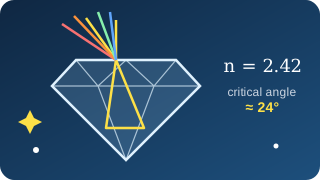
2. Critical Angle θc– angle of incidence for which the angle of refraction equals 900 when light travels inside one medium that borders on air or a vacuum

Total Internal Reflection lesson illustration


Deriving Critical Angle Equation


n1sinθ1 = n2 sinθ2


    Substitute θc, θ2 = 90, n2 = 1


n1sinθc = 1sin90


n1sinθc = 1


 sinθc = 1/n1


Ex) Find θc for Lucite


sin θc = 1/n1


From reference table, n1 = 1.50 


sinθc = 1/1.50


θc = 41.8


3. Total Internal Reflection


Total Internal Reflection lesson illustration

[ HTML5 ]

Show Me The Physics


What is this called? 

Total Internal Reflection lesson illustration

Rutgers University Physics 


[ Flash ]

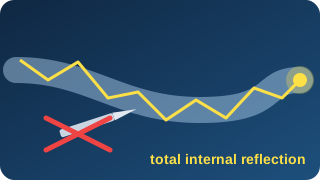
(These kinds of fibers are coated with materials that have a low index of refraction (fast).
These materials are called cladding.)


St. Mary's University's Astronomy
 and Physics Dept.


When θ1 > θc
Total Internal Reflection

(Outside Medium Must Be Faster)

 Trouble Viewing Video Above?

| Total Internal Reflection |

Rutgers U. Physics


Ex) Lucite

θc = 41.8


Total Internal Reflection lesson illustration

Air


When θ1 = θc


θ2 = 900


Total Internal Reflection lesson illustration


When θ < θc Refraction

Total Internal Reflection lesson illustration


Refraction of Light

Rick Reed


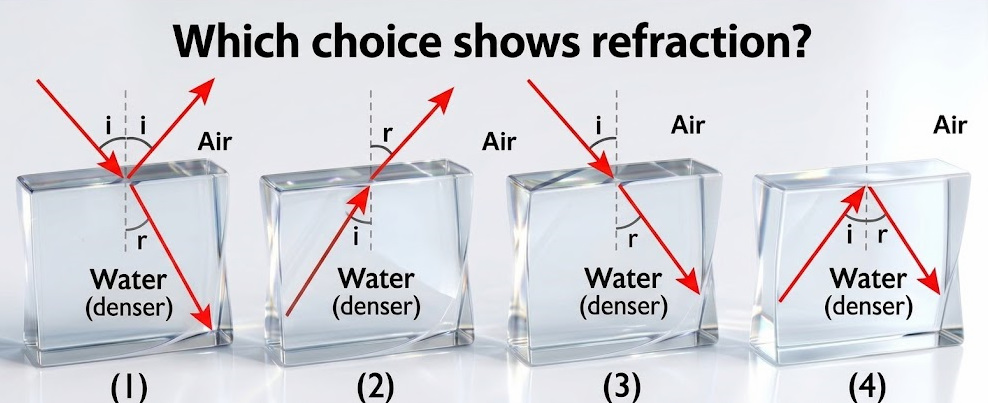
a) Total Internal Reflection?

Total Internal Reflection lesson illustration


Choice 2

(Outside Medium Must be Fast)


b) Refraction?

Total Internal Reflection lesson illustration


Choice 3


c) Impossible?

Total Internal Reflection lesson illustration


Choice 1

(Light always crosses over normal)


What's wrong with this picture?


Total Internal Reflection lesson illustration


Part of the ray
would be refracted.
 
Total Internal Reflection only occurs when the outside
 medium is very fast.


Total Internal Reflection lesson illustration

Enrichment

| Onsite |

St. Mary's U Astronomy and Physics Dept.


Light reflecting inside a diamond

🎧 Podcast · 5 min

Why Diamonds Sparkle: The Physics of Brilliance

More episodes →

Light bouncing down an optical fiber

🎧 Podcast · 21 min

How Fiber Optics Replaced the Scalpel

More episodes →

Check Your Understanding

5 quick questions — pick an answer to see if you’re right.

1. What is the critical angle?

2. A material bordering air has an index of refraction of 2.00. What is its critical angle?

3. Lucite's critical angle is 41.8°. Light inside Lucite hits the Lucite–air boundary at 50° from the normal. What happens?

4. Total internal reflection can occur only when light travels

5. Fiber optic cables carry light long distances through bends. What keeps the light inside the fiber?

NYSSLS Regents Practice · Waves · Fiber Optics

Light in an Optical Fiber

Internet data travels as pulses of light through glass optical fibers. The light stays inside the fiber because of total internal reflection at the boundary between the glass core (n = 1.52) and its surroundings.

Under which conditions does total internal reflection occur?

▶ Want a challenge? Open 6 more Regents-style questions  (harder · mixed formats)

Challenge score: 0 / 6

Substitute values

C1. In a real fiber, the glass core (n = 1.52) is surrounded by glass cladding with n = 1.46. Substitute numerical values into a mathematical representation that can be used to determine the critical angle at the core–cladding boundary. Then calculate the critical angle.

sin θc = ()(), so θc = °
Multiple choice

C2. A ray inside the glass hits the glass–air surface at 30.° from the normal. What happens?

Support or Refute · Justify

C3. A student makes the following claim.

Claim: A ray inside a bare glass core (surrounded by air) that strikes the glass–air surface at 50.° from the normal will stay trapped inside the fiber.

Place a check mark in either the Support or Refute box. Justify your response using a mathematical relationship.

Determine the value

C4. Determine the minimum time for a light pulse to travel through 1.0 km of the glass core (n = 1.52), assuming it travels straight along the fiber.

t = × 10−6 s
Multiple choice

C5. Engineers surround the glass core with a layer of glass with a slightly lower index (the cladding). Why?

Constructed response

C6. Installers know that if an optical fiber is bent too sharply, the signal becomes weak. Explain why a sharp bend causes light to escape from the core.