Standing Waves
Nodes, antinodes, harmonics, and resonant patterns

|
Standing Waves
School blocks YouTube?
Kieff, Ptj, Wikipedia, public domain
B. Standing Wave – waves produced when two waves of the same frequency and amplitude travel in opposite directions in the same medium (Musical instruments)
School blocks YouTube? Remember the old slinky song?
Standing Waves Interactive 1. Select PLAY
This interactive graph was created by HS physics teacher and Ed Tech wizard, Dan Hosey
Parts of a Standing Wave
Show Me The Physics Online
School blocks YouTube?
Mythbusters from YouTube
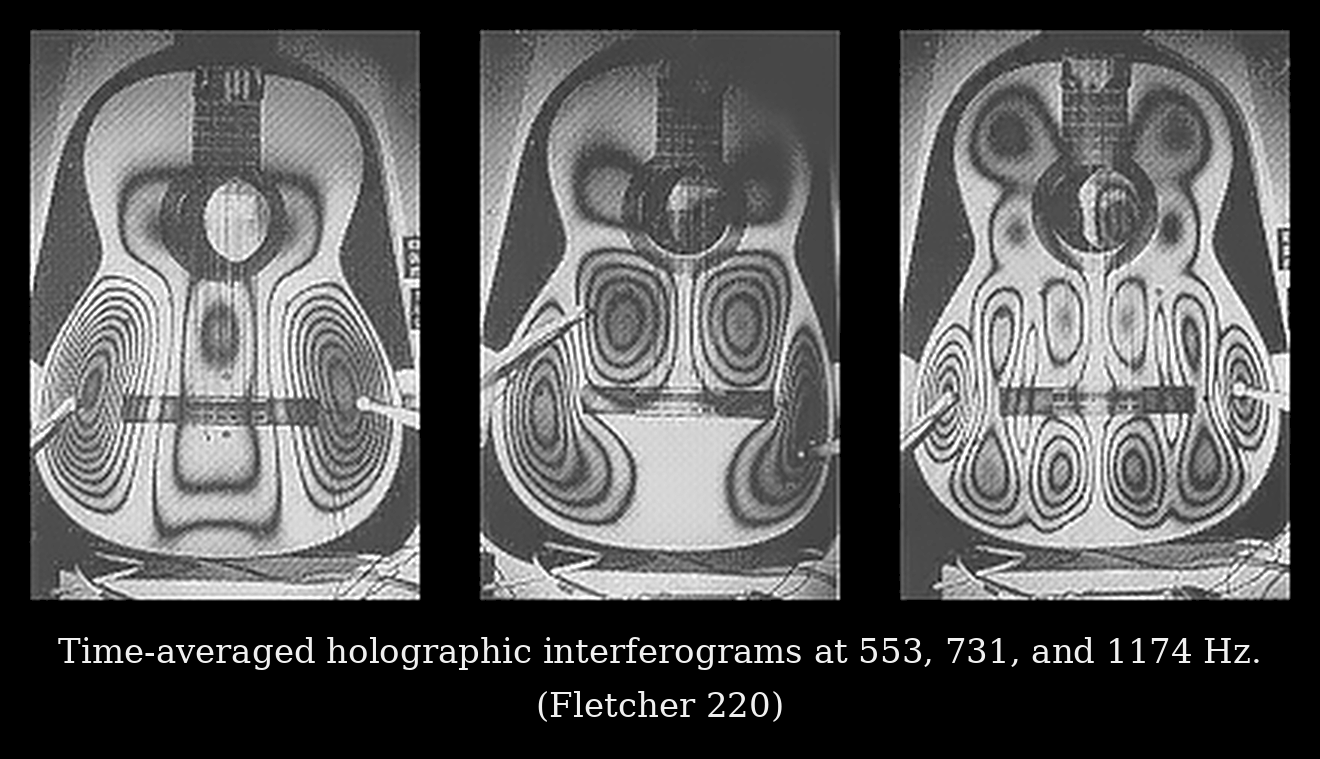
How many antinodes are in each picture? (focus on the lower half of the guitar)
Physics of the
2, 4, 10
Click on the frequencies above | Flash |
Standing waves can
How many nodes?
5
How many antinodes?
4
How many waves?
2
C. K. Eng
How many wavelengths?
Wikipedia, Houtlijm, public domain
| HTML5 | | Flash |
Illustration of
vibrations
of a drum -
Oleg Alexandrov
2 antinodes, wavelength = 3.0 m
Identify the NODES and the ANTINODES
June 2016
Enrichment
Standing
Waves/
Standing Waves (Chladni Disk)
Water Drop in Zero g
School blocks YouTube?
Standing Waves
|
||||||||





Check Your Understanding
5 quick questions — pick an answer to see if you’re right.
1. A standing wave is produced when two waves of the same frequency and amplitude
2. Destructive interference occurs when a crest overlaps a
3. In a standing wave, maximum destructive interference occurs at the
4. A standing wave has 5 nodes and 4 antinodes. How many wavelengths does it contain?
5. A 3.0 m string fixed at both ends vibrates in a standing wave with 2 antinodes. What is the wavelength?
The Physics of a Guitar String
A guitar string is 0.65 m long between its fixed ends. When plucked, it vibrates in its fundamental mode: one loop, with a node at each end and an antinode in the middle. Waves travel along this string at 429 m/s.
What is the wavelength of the fundamental standing wave?
▶ Want a challenge? Open 6 more Regents-style questions (harder · mixed formats)
Challenge score: 0 / 6
C1. Substitute numerical values into a mathematical representation that can be used to determine the frequency of the fundamental standing wave on the string. Then calculate the frequency.
C2. The guitarist lightly touches the string at its midpoint, producing a standing wave with two loops. What is its frequency?
C3. The guitarist makes the string vibrate with three loops. Place a check mark in two boxes to indicate the positions, measured from one end, of the nodes between the two fixed ends.
C4. A student makes the following claim.
Place a check mark in either the Support or Refute box. Justify your response using a mathematical relationship.
C5. The guitarist presses the string against a fret, shortening the vibrating length. How does the pitch change?
C6. Explain how waves on the plucked string produce a standing wave, and explain why the two ends of the string must be nodes.