Impulse & Stopping Time
Why a longer stop means a smaller force
Do Now: When you catch a fast baseball, why do you pull your glove back instead of holding it stiff?
Pulling back makes the catch take longer. The ball loses the same momentum, but over more time, so the force on your hand is smaller.
A. The Impulse Equation
Impulse (N•s or kg•m/s)
When an object stops, its change in momentum Δp is set by its mass and speed. Solving for force:
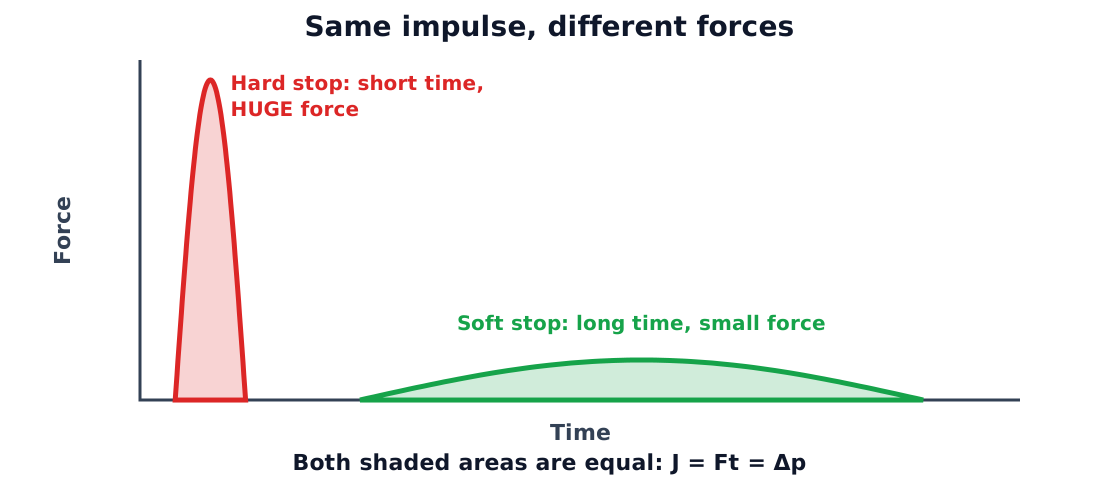
The area under a force-time graph is the impulse. A safety device can’t change the area (that’s set by Δp), but it can spread it out so the peak force is much lower.
B. The Egg Drop
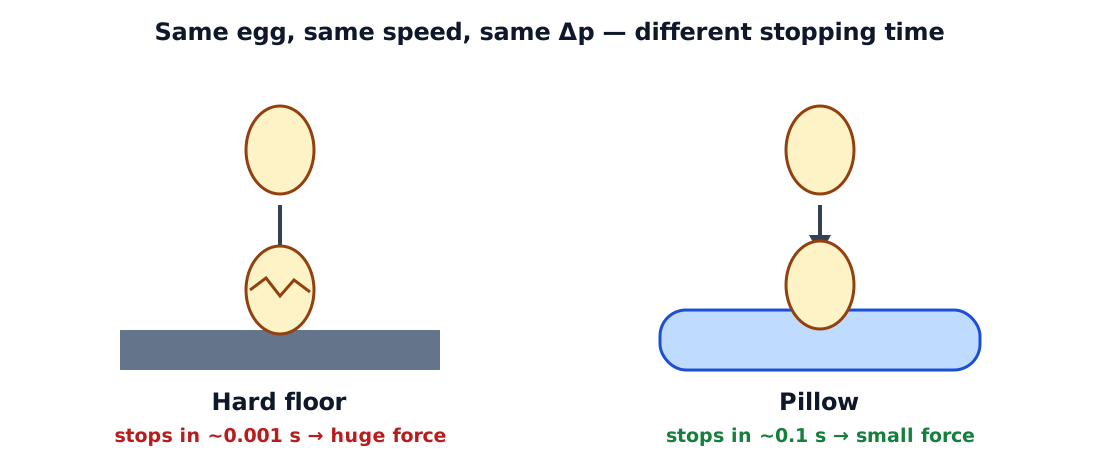
A 0.060-kg egg hits the ground at 6.0 m/s. Find the force if it stops in 0.0020 s on a hard floor, and in 0.10 s on a pillow.
Δp = mΔv = (0.060 kg)(6.0 m/s) = 0.36 kg•m/s
Floor: F = 0.36 N•s0.0020 s = 180 N
Pillow: F = 0.36 N•s0.10 s = 3.6 N
The pillow makes the stop 50 times longer, so the force is 50 times smaller.
C. More Examples
A 0.145-kg baseball moving at 40. m/s is caught. Compare the force on the glove if the catch takes 0.0050 s (stiff) or 0.050 s (pulling back).
Δp = (0.145 kg)(40. m/s) = 5.8 kg•m/s
Stiff: F = 5.80.0050 = 1,160 N
Pulling back: F = 5.80.050 = 116 N — ten times smaller
A 70.-kg passenger moving at 15 m/s is stopped in a crash. Find the force if the passenger hits the dashboard (0.010 s) or is held by a seat belt (0.080 s).
Δp = (70. kg)(15 m/s) = 1,050 kg•m/s
Dashboard: F = 1,0500.010 = 1.05 × 10⁵ N (about 150 times body weight)
Seat belt: F = 1,0500.080 = 1.3 × 10⁴ N (about 19 times body weight)
Explore: Crash Test Lab
Choose a speed and protection, then press Crash! Compare the force graph with the previous trial.
1. Crash with no seat belt, then with a seat belt. Compare the graphs.
2. Is the shaded area the same for both? Why?
3. Double the speed. What happens to the force?
1. The seat belt makes a lower, wider graph — much smaller force. 2. Yes — the area is the impulse, which equals Δp, and that only depends on mass and speed. 3. Doubling the speed doubles Δp, so with the same stopping time the force doubles.
Check Your Understanding
5 quick questions — pick an answer to see if you’re right.
1. A safety device that makes a collision last longer will
2. The area under a force-versus-time graph equals the
3. A 2.0-kg object moving at 5.0 m/s is stopped in 0.50 s. The average force is
4. Why do gymnasts land on thick mats?
5. If the stopping time is cut in half while Δp stays the same, the force