Collision Safety Review
Everything in one place, plus mixed practice
The Big Ideas
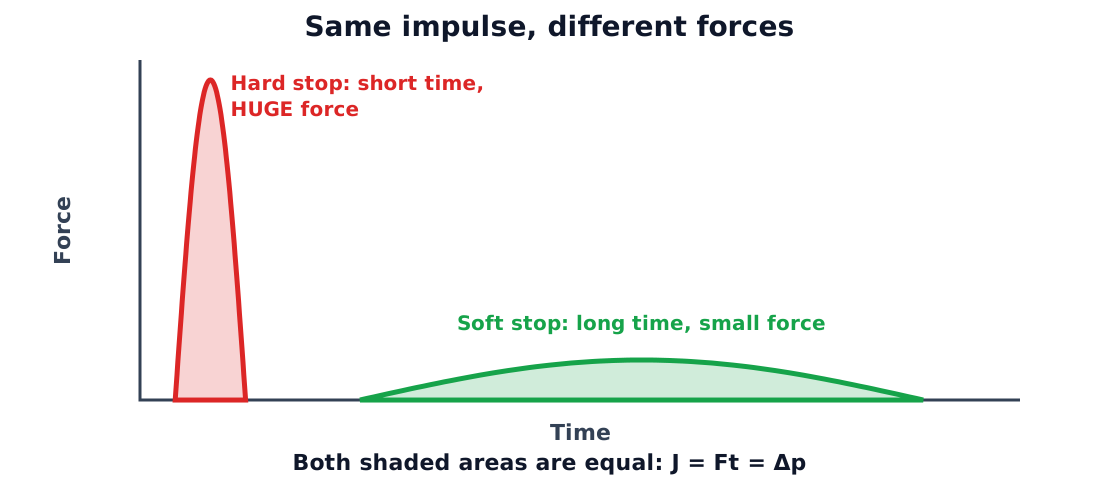
Stopping an object takes a fixed impulse: Δp = mΔv.
F = Δp/t: increase the time → decrease the force.
Area under a force-time graph = impulse.
Safety devices: crumple zones, seat belts, airbags, helmets, pads, mats.
Explore
Choose a speed and protection, then press Crash! Compare the force graph with the previous trial.
Mixed Practice
A 0.50-kg ball moving at 10. m/s is stopped in 0.020 s. Find the average force.
Δp = 5.0 kg•m/s; F = 5.0/0.020 = 250 N
In a fall, a 5.0-kg head moving at 6.0 m/s stops in 0.0020 s without a helmet, or 0.010 s with one. Find both forces.
Δp = 30. kg•m/s. Without: 15,000 N. With helmet: 3,000 N — five times smaller.
An airbag must keep the force on a 60.-kg driver moving at 20. m/s below 8,000 N. What is the minimum stopping time?
Δp = 1,200 kg•m/s; t = Δp/F = 1,200/8,000 = 0.15 s
Why do you bend your knees when you land from a jump?
Bending your knees increases the stopping time, so the same change in momentum happens with a smaller force on your legs.
A ball hits a wall at 4.0 m/s. In case A it stops; in case B it bounces back at 4.0 m/s. Which case has the larger impulse?
Case B. Its velocity changes by 8.0 m/s instead of 4.0 m/s, so Δp (and the impulse) is twice as large.
Check Your Understanding
5 quick questions — pick an answer to see if you’re right.
1. Impulse is equal to
2. Two identical cars stop from the same speed. Car A stops in 0.1 s, car B in 0.3 s. Compared with car A, the force on car B is
3. Which quantity is the same whether an egg lands on a pillow or the floor (from the same height)?
4. Which design feature mainly reduces landing speed rather than increasing stopping time?
5. A 1,000-kg car moving at 10. m/s stops in 0.50 s. The average force on the car is