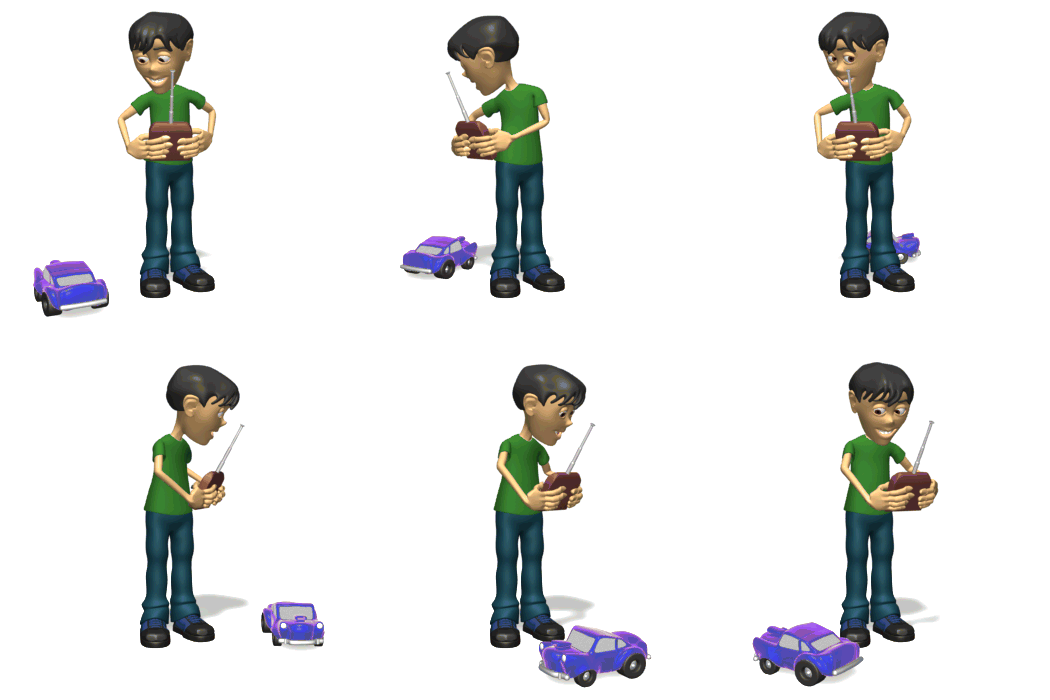
Circular Motion Equations
Centripetal Acceleration, Velocity, and Force

Do Now

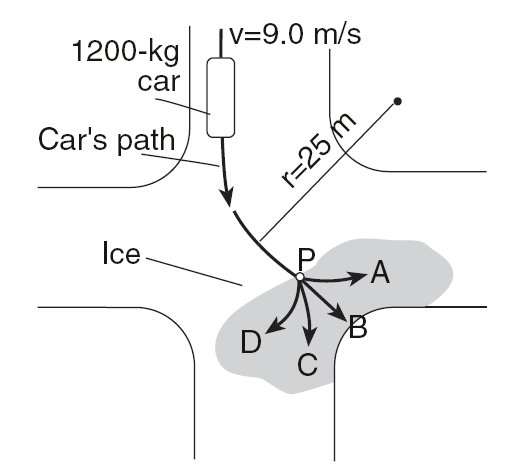
At point P, the car hits an area of ice and loses all frictional force on its tires. Which path does the car follow on the ice?
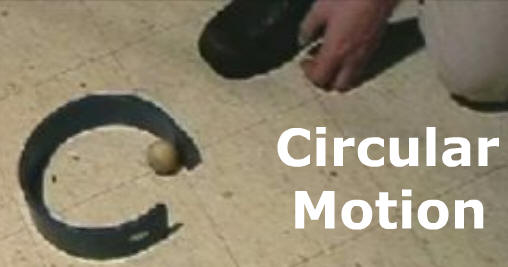
June 2001 Regents
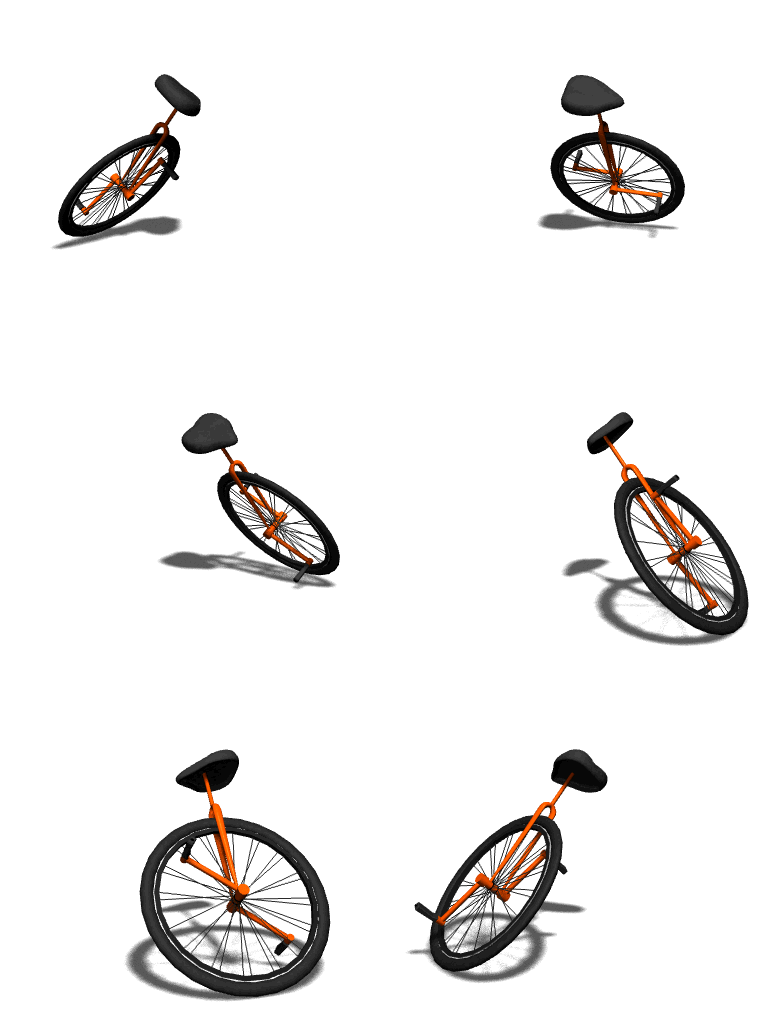
A. Equations & Vectors
Review
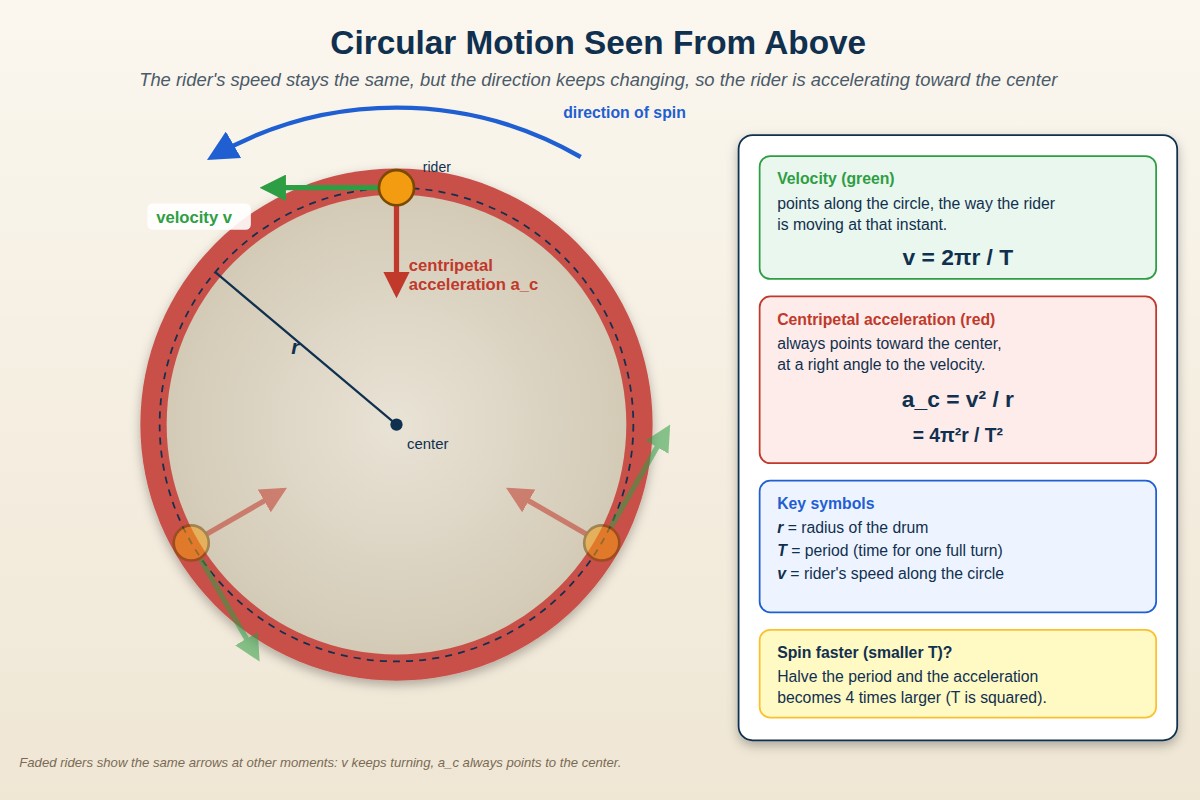
Why is an object moving at constant speed in a circle considered to be accelerating?
1. Centripetal Acceleration (ac) - acceleration toward center of curvature
r - radius,
V - velocity
b) (V) Instantaneous Velocity - tangent to circle, in the direction of the motion
c) Centripetal Force (Fc) - force directed toward the center of the circle

Ex
A car moving in a circular path with a radius of 2.0 m has a velocity of 8.0 m/s.
Find: the centripetal acceleration of this car.

Circular Velocity Game (Flash)
[ HTML5 ] Game


Check Your Understanding
5 quick questions — pick an answer to see if you’re right.
1. Why is an object moving at constant speed in a circle considered to be accelerating?
2. A car moves in a circle of radius 2.0 m at 8.0 m/s. What is its centripetal acceleration?
3. What is the direction of the centripetal acceleration of an object in uniform circular motion?
4. An object moves at 10 m/s in a circle of radius 5.0 m. What is its centripetal acceleration?
5. A car on a curved track hits ice at point P and loses all friction. Which path does it follow?