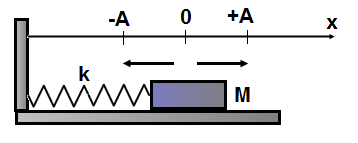
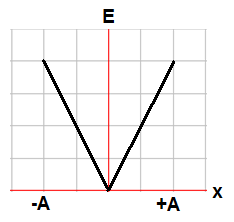
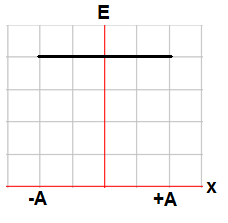
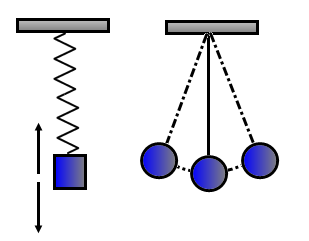
repetitive movement back and forth through an equilibrium, or central, position,
max. displacement on one side of this position is = max. displacement on the other side.
Force on the object is proportional to the distance to the equilibrium position
Spring Constant Review
I. Vibrating Mass on a Spring
$$KE_1 + PE_1 = KE_2 + PE_2$$
Where is the acceleration the greatest? Why?
Smallest? Why?
Teacher CER Answer Key
Reasoning: Acceleration is proportional to displacement. Maximum at amplitude, zero at equilibrium.
Quick Check
3 questions on 1. SHM Intro — pick an answer to check yourself.
1. A mass oscillates on a spring. Where is its acceleration greatest?
2. A 0.50 kg mass on a spring (k = 200 N/m) is pulled 0.10 m from equilibrium and released. What is its acceleration at release?
3. As an oscillating mass on a spring passes through its equilibrium position, it has…
II. Period
Period - time for one full
determined by .... and
$$T = 2\pi\sqrt{\frac{m}{k}}$$
III. Energy Changes – Conservation of Energy
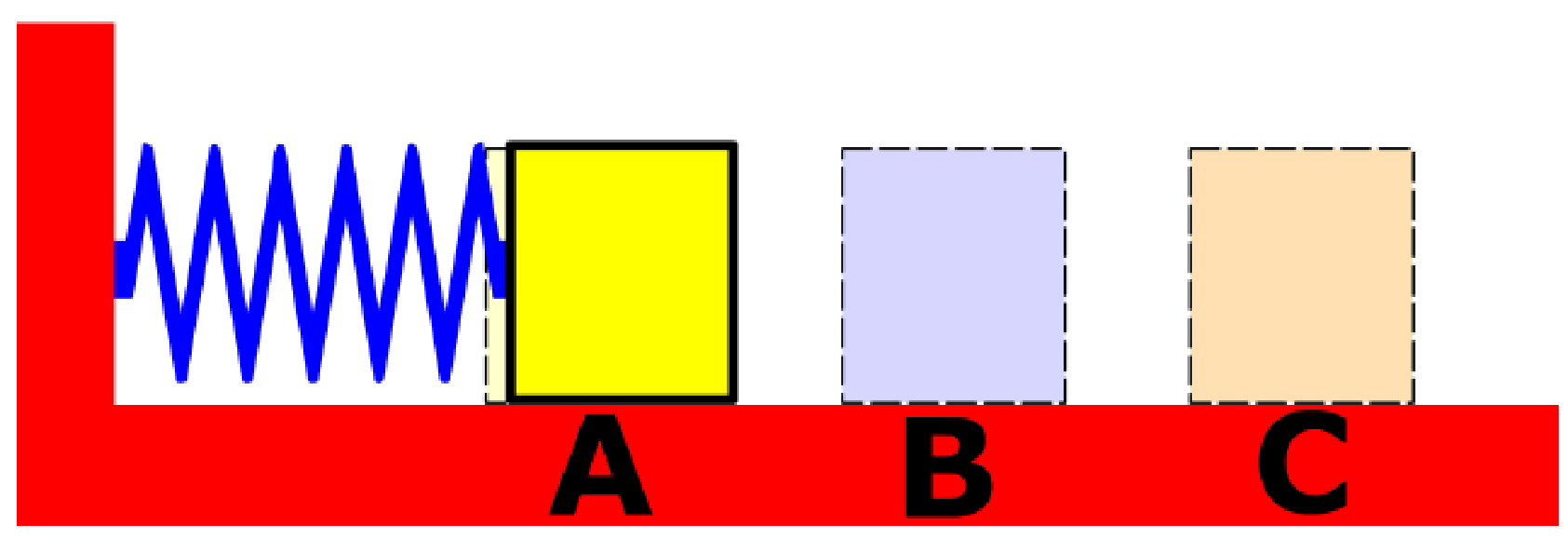
PE at C equals .....
Ex) Mass M is attached to a spring with a spring constant k. If the maximum displacement of a mass M from its equilibrium position is A, find the velocity of the mass at B:
Quick Check
3 questions on 2. Period/Energy — pick an answer to check yourself.
1. The mass on a spring is made 4 times larger. The period of oscillation…
2. A mass on a spring is pulled back twice as far before release. What happens to its period?
3. A 0.50 kg mass on a spring (k = 200 N/m) oscillates with amplitude 0.10 m. What is its maximum speed?
Ranking TaskNo calculator
Ranking Periods
Each block is attached to a spring on a frictionless horizontal surface. Each block is pulled out to the amplitude $A$ shown and released from rest. The mass of each block and the spring constant of each spring are given.
Rank the oscillators by their period, from longest to shortest. If any are equal, show the tie. If the ranking cannot be determined, say so.
3 questions on 3. Position Equations — pick an answer to check yourself.
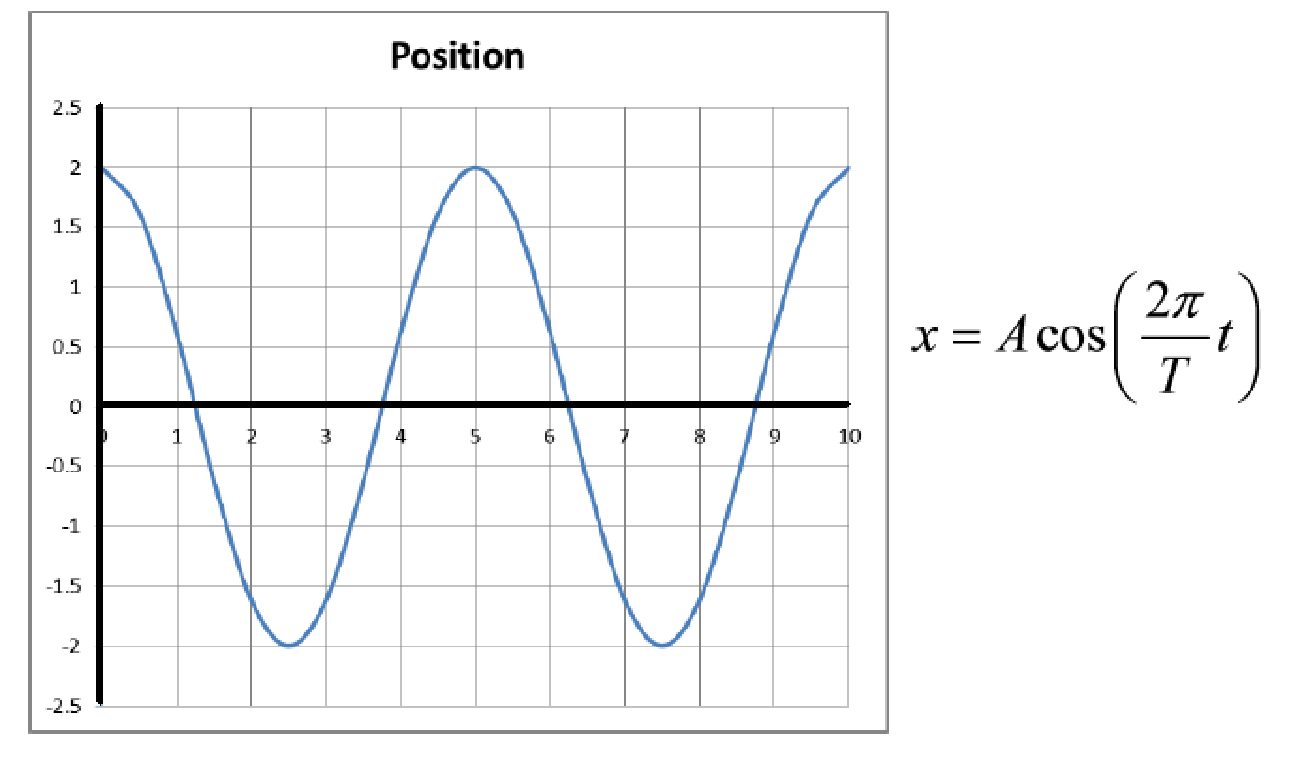
1. In the equation x = A cos(ωt) for simple harmonic motion with period T, ω equals…
2. An oscillator follows x = A cos(ωt) with A = 0.10 m and T = 2.0 s. What is x at t = 1.0 s?
3. A position-vs-time graph is a cosine curve swinging between +0.20 m and −0.20 m, completing 3 full cycles in 6.0 s. What are the amplitude and period?
Changing RepresentationsNo calculator
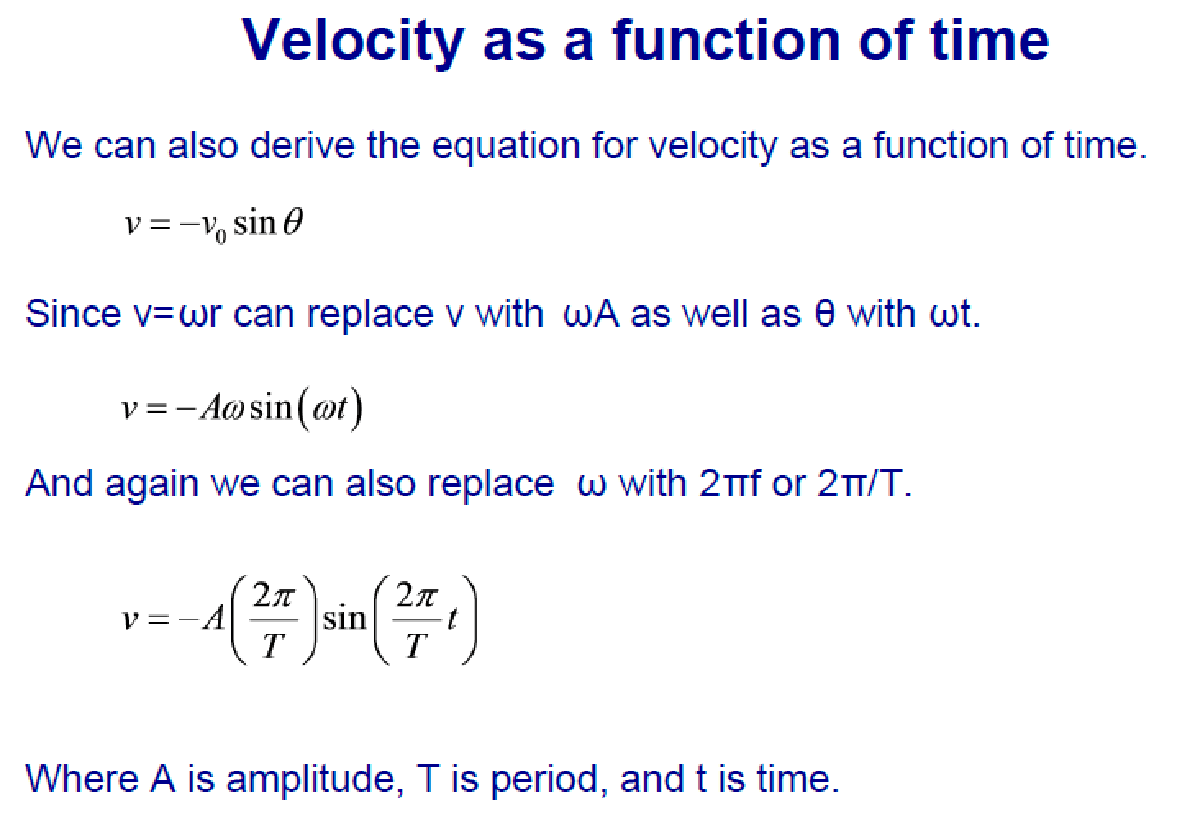
From x–t to v–t and a–t
The graph shows the position of a block oscillating on a spring.
Sketch the velocity vs. time and acceleration vs. time graphs on the blank axes below. You don't need numbers on the vertical axes, but mark where each quantity is maximum, zero, and minimum.
At $t = 2\ \text{s}$, the block is at $x = -0.20\ \text{m}$. Which way does its acceleration point? What is its velocity?
A student says, "The velocity graph should look just like the position graph, because the block is fastest when it's farthest out." Respond to the student.
1. Where is the block located when its velocity is a maximum in magnitude?
A) x = 0
B) x = ±A
C) x = +A/2
D) x = -A/2
2. Where is the block located when its potential energy is a maximum?
A) x = 0
B) x = ±A
C) x = +A/2
D) x = -A/2
3. Where is the block located when its acceleration is a minimum in magnitude?
A) x = 0
B) x = ±A
C) x = +A/2
D) x = -A/2
4. What is the period of the system if the amplitude is doubled?
A) 2T
B) 4T
C) T
D) 1/2T
5. What is the period of the system when it is located on the Moon?
A) 6T
B) T/6
E) T
D) $T/\sqrt{6}$
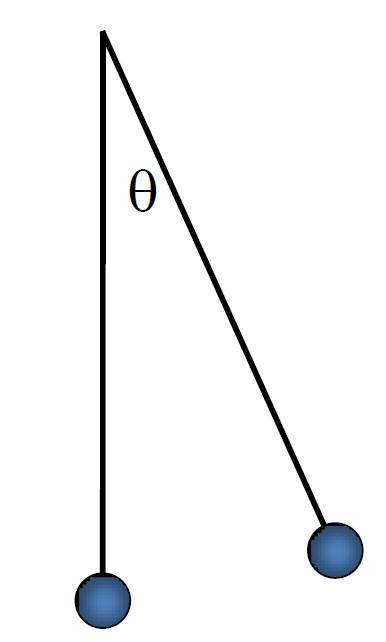
S.H.M. – Pendulum
(T) Period of a Pendulum
Determined by ....
Equation
Frequency
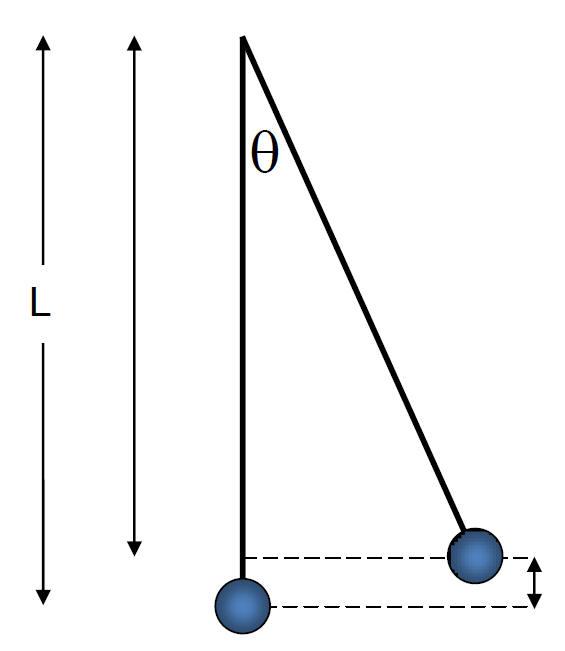
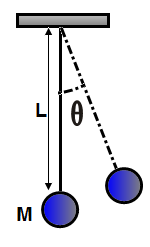
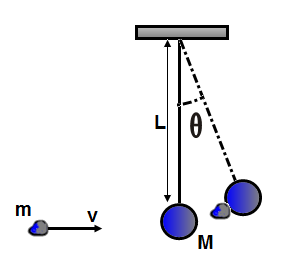
Finding the height of a pendulum with a length of L and an angle $\theta$:
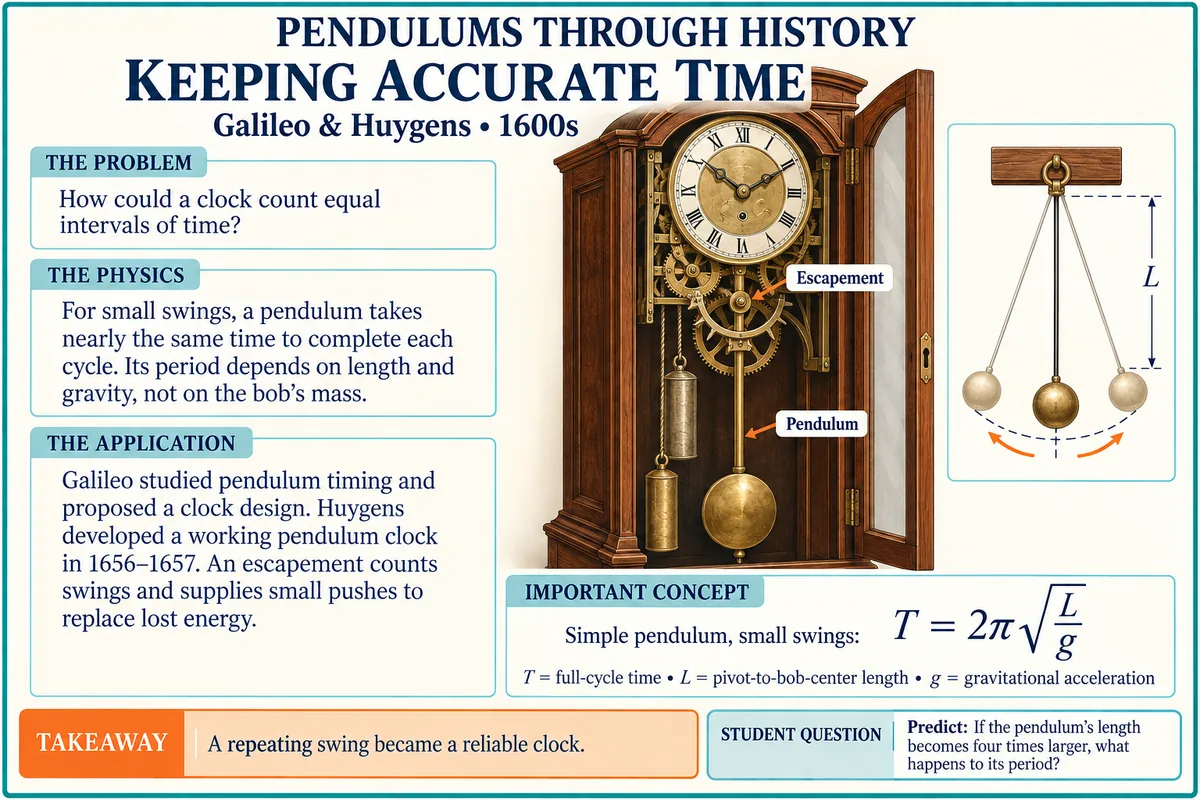
$$T_p = 2\pi\sqrt{\frac{L}{g}}$$
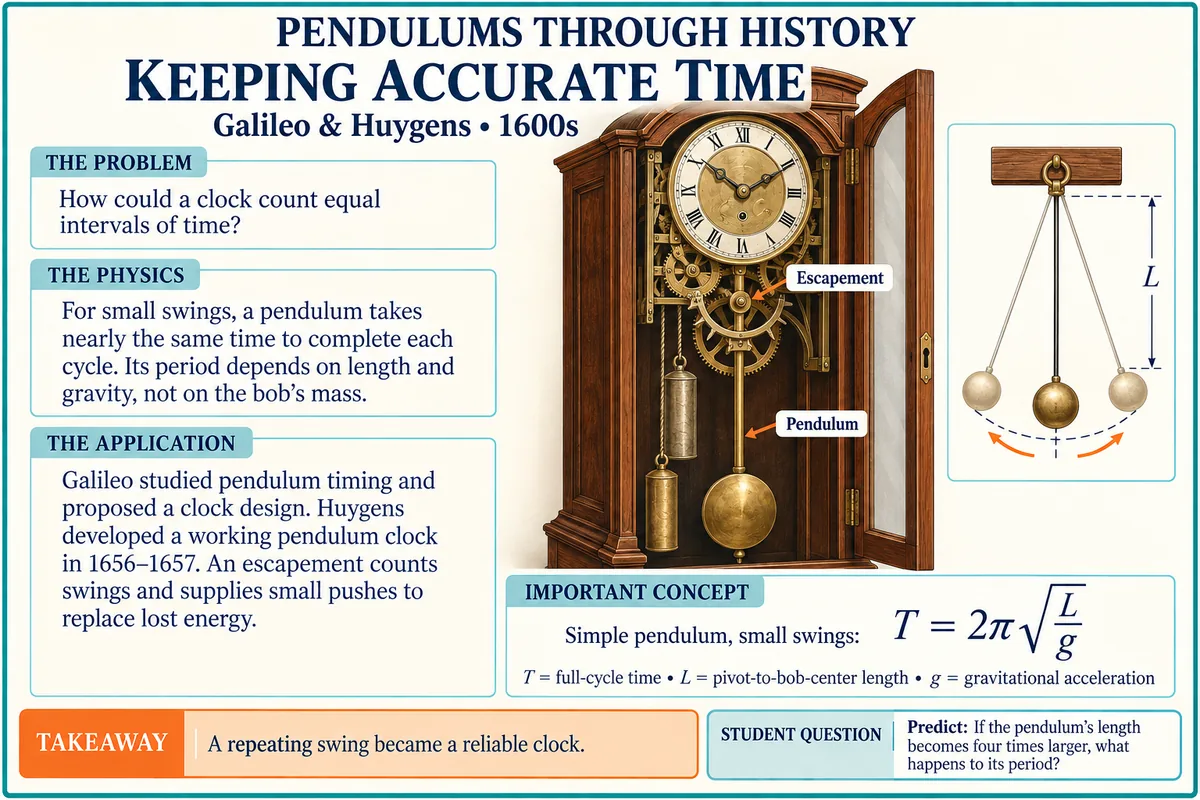
This is exactly the formula Galileo studied and Huygens used in 1656–1657 to build the first working pendulum clock. Click the image for a larger view.
Pendulum MCQ Set
1. If the mass of the pendulum is doubled what is the new period of the pendulum?
A) T/2
B) 2T
C) T
D) $\sqrt{2}T$
E) $T/\sqrt{2}$
2. If the length of the pendulum is doubled what is the new period of the pendulum?
A) T/2
B) 2T
C) T
D) $\sqrt{2}T$
E) $T/\sqrt{2}$
3. What is the length of a simple pendulum if it oscillates with a period of 2.0 s?
A) 2.0 m
B) 1.0 m
C) 0.50 m
D) 0.4 m
E) 0.10 m
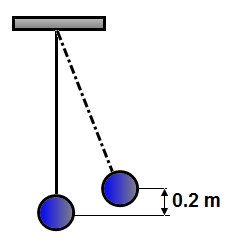
4. Displaced up by a distance 0.2 m. What is the maximum speed?
A) 1 m/s
B) 2 m/s
C) 3 m/s
D) 4 m/s
E) 5 m/s
5. Speed of the ball at the lowest point?
A) 2gL
B) $\sqrt{2gL}$
C) $\sqrt{2mgL}$
D) $\sqrt{2gL(1-\cos\theta)}$
E) $\sqrt{1gL\cos\theta}$
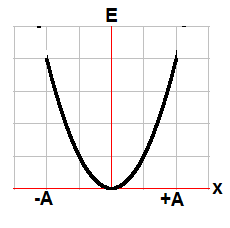
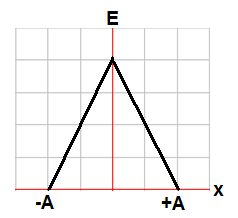
6. A block of mass M is attached to a horizontal spring k. The block undergoes SHM with amplitude of A. Which of the following graphs represents the elastic potential energy as a function of position x?
Graph A
Graph B
Graph C
Graph D
Graph E
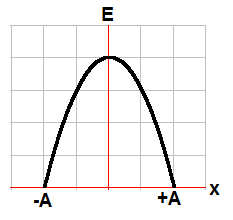
7. A block of mass M is attached to a horizontal spring k. The block undergoes SHM with an amplitude of A. Which of the following graphs represents the kinetic energy as a function of position x?
Graph A
Graph B
Graph C
Graph D
Graph E
8. A 0.9 kg block is attached to an unstretched spring with a spring constant of 10 N/m. The block is released from rest. How long does it take for the block to return to its initial position?
A) 0.3π s
B) 0.5π s
C) 0.4π s
D) 0.9π s
E) 0.6π s
Free Response Problems
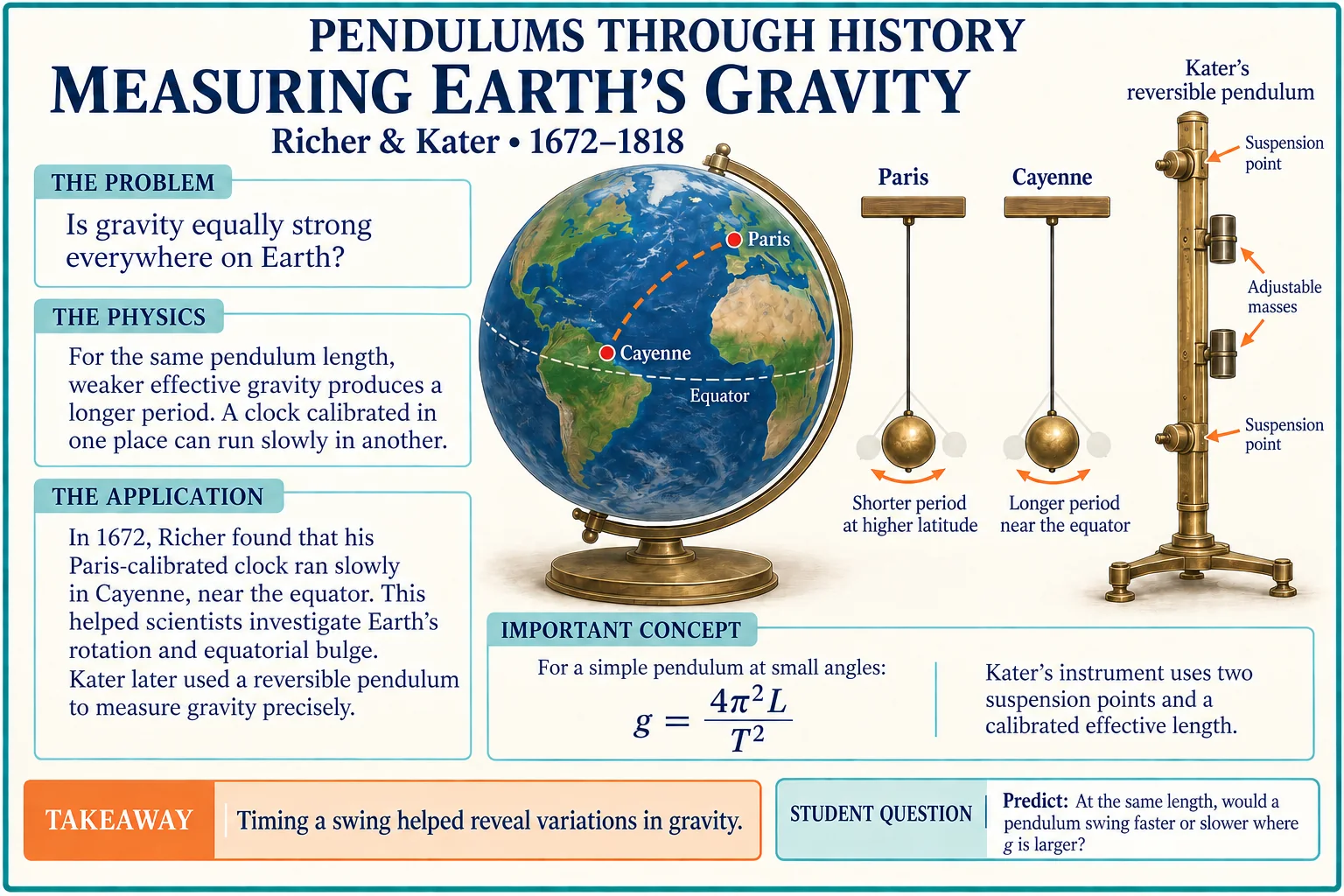
How do we know gravity is a little stronger at the poles than at the equator? In 1672, Jean Richer noticed his pendulum clock ran slow near the equator — the first evidence that Earth's gravity isn't perfectly uniform. Click the image for a larger view.
1. Potential Energy Graph Analysis
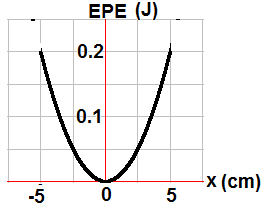
A 0.4 kg object is attached to a horizontal spring undergoes SHM with the total energy of 0.2 J. The potential energy as a function of position presented by the graph below:
What is the amplitude of oscillations?
What is the spring constant?
What is the kinetic energy of the system at point x = 2.5 cm?
Indicate point or points where the kinetic energy equals the potential energy of the system.
What is the maximum speed of the object?
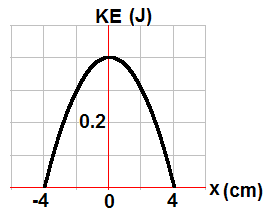
2. Kinetic Energy Graph Analysis
A 0.20 kg object attached to a horizontal spring undergoes SHM with total energy of 0.40 J. The kinetic energy as a function of position presented by the graph below:
What is the maximum displacement from equilibrium?
What is the maximum speed of the object?
What is the spring constant?
Indicate point or points where the kinetic energy equals the potential energy of the system.
What is the potential energy of the system at point x = 2 cm?
Quick Check
3 questions on 6. Energy FRQs — pick an answer to check yourself.
1. A 0.40 kg mass on a spring oscillates with total energy 0.20 J. What is its maximum speed?
2. A mass-spring oscillator has amplitude A and total energy E. At x = A/2, what is its kinetic energy?
3. A spring oscillator has total energy 0.40 J and amplitude 0.10 m. What is the spring constant?
Free Response: Collisions
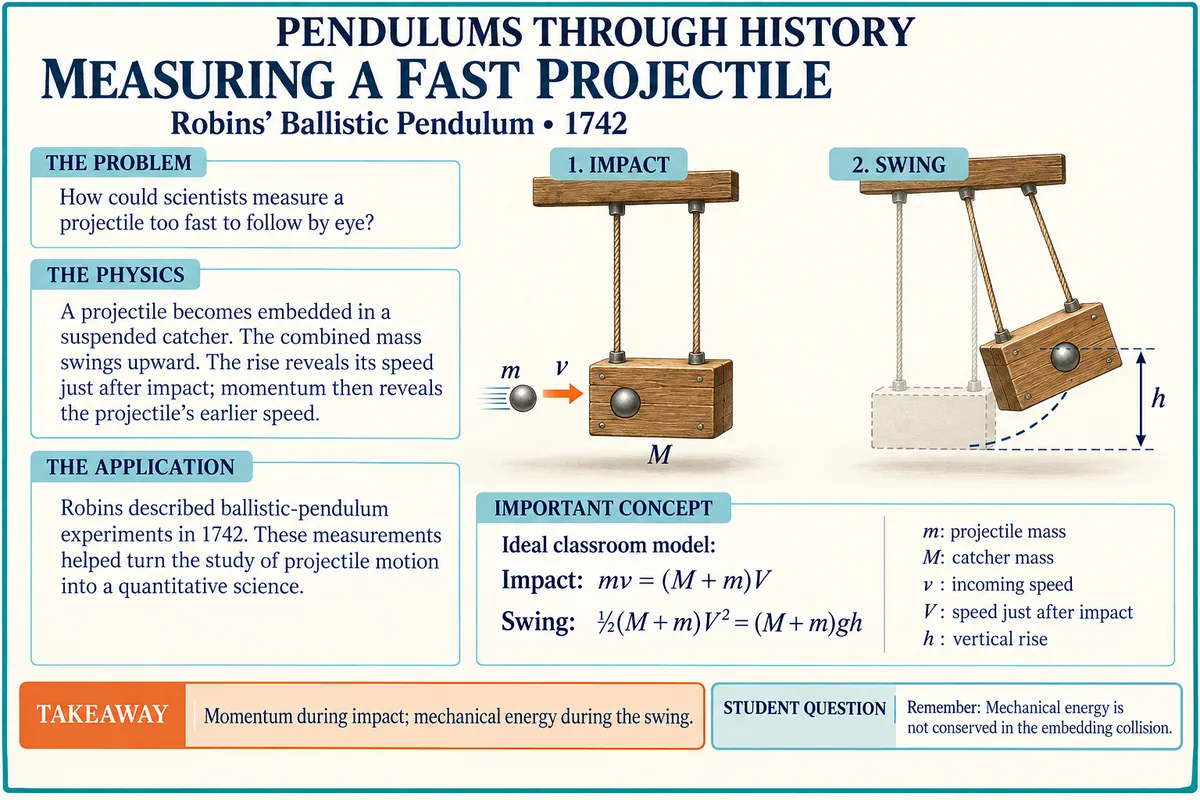
A ballistic pendulum, like the one Benjamin Robins used in the 1740s, applies this same collision-then-oscillation idea to measure projectile speed. Click the image for a larger view.
3. Clay-Pendulum Collision
A 20. g piece of clay moving at a speed of 50. m/s strikes a 500. g pendulum bob at rest. The length of a string is 0.80 m. After the collision, the clay-bob system starts to oscillate as a simple pendulum.
What is the speed of the clay-bob system after the collision?
What is the maximum angular displacement of the pendulum?
What is the period of the clay-bob oscillating system?
What is the total energy of the oscillating system?
The pendulum bob makes one complete oscillation and the string breaks at the lowest point.
What is the maximum horizontal distance of the bob when it strikes the floor 0.70 m below?
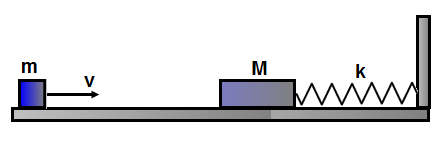
4. Inelastic Spring Collision
A small block moving with a constant speed v collides inelastically with a block M attached to a spring k. Find speed and amplitude after collision:
Quick Check
3 questions on 7. Collisions — pick an answer to check yourself.
1. A piece of clay hits a hanging pendulum bob and sticks. What is conserved during the brief collision itself?
2. A 20 g piece of clay moving at 50 m/s sticks to a 500 g pendulum bob at rest. What is their speed just after the collision?
3. After the collision, the clay-bob system swings on a 0.80 m string. What is its period of oscillation? (g = 9.8 m/s²)
Instructional Video II & Wave Analysis
6. A block with a mass M is attached to a vertical spring with a spring constant k. When the block is displaced from equilibrium and released its period is T. A second identical spring k is added to the first spring in parallel. What is the period of oscillations when the block is suspended from two springs?
A) 2T
B) 4T
C) T
D) $\sqrt{2}T$
E) $T/\sqrt{2}$
7. Two oscillating systems: spring-mass and simple pendulum undergo SHM with an identical period T. If the mass in each system is doubled, which of the following is true about the new period?
Option Choice
Mass-spring
Simple pendulum
A
$T$
$T$
B
$\sqrt{2}T$
$T$
C
$T$
$\sqrt{2}T$
D
$\sqrt{2}T$
$\sqrt{2}T$
E
$T/2$
$T$
8. An object undergoes SHM and position as a function of time is presented by the following formula: $x = (0.1\text{ m})\sin(4\pi t)$. What is the period of oscillations?
A) 2 s
B) 1 s
C) 0.5 s
D) 0.1 s
E) 4 s
9. An object undergoes SHM and position as a function of time is presented by the following formula: $x = (0.5\text{ m})\cos(\pi t)$. What is the amplitude of oscillations?
A) 2 m
B) 1 m
C) 0.5 m
D) 0.1 m
E) 4 m
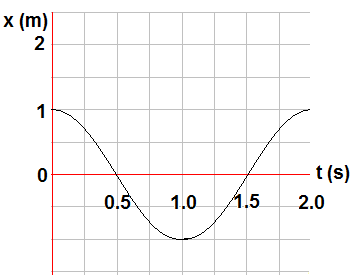
10. The position as a function of time of a mass-spring oscillating system is presented by the graph. Which of the following is true about velocity and acceleration at the time 1.5 s?
Option
Velocity
Acceleration
A
$v > 0$
$a < 0$
B
$v = 0$
$a = 0$
C
$v = 0$
$a > 0$
D
$v > 0$
$a = 0$
E
$v < 0$
$a = 0$
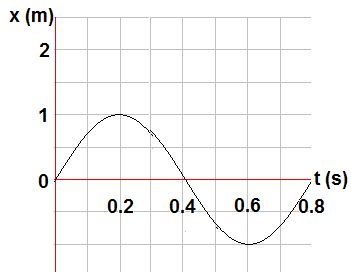
11. A particle undergoes SHM represented by the graph. Which of the following is true about the amplitude and period of oscillations?
Option
Amplitude
Period
A
1 m
0.1 s
B
2 m
0.5 s
C
1 m
0.6 s
D
1 m
0.8 s
E
2 m
0.4 s
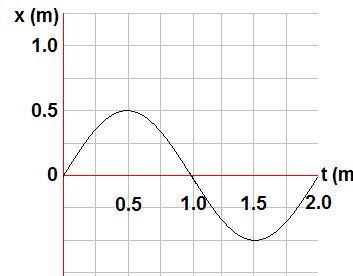
12. An object oscillates at the end of a spring. The position as a function of time is presented by the graph. Which of the following formulas represent the position and velocity of the object?
A) $x = (0.5)\sin(\pi t)$$v = (0.5\pi)\sin(\pi t)$
B) $x = (0.5)\sin(\pi t)$$v = (0.5\pi)\cos(\pi t)$
C) $x = (0.5)\cos(\pi t)$$v = (0.5\pi)\sin(\pi t)$