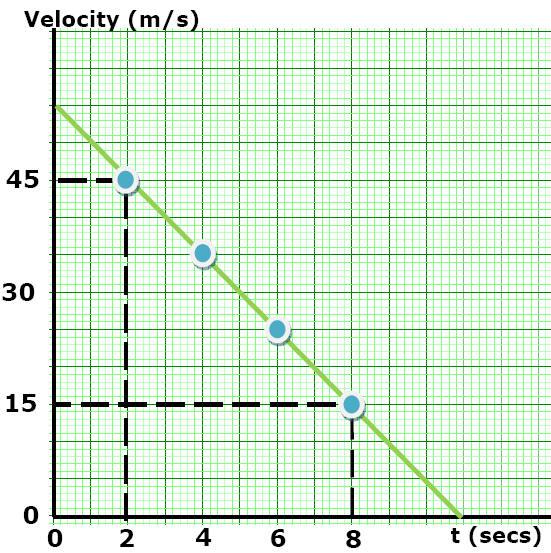
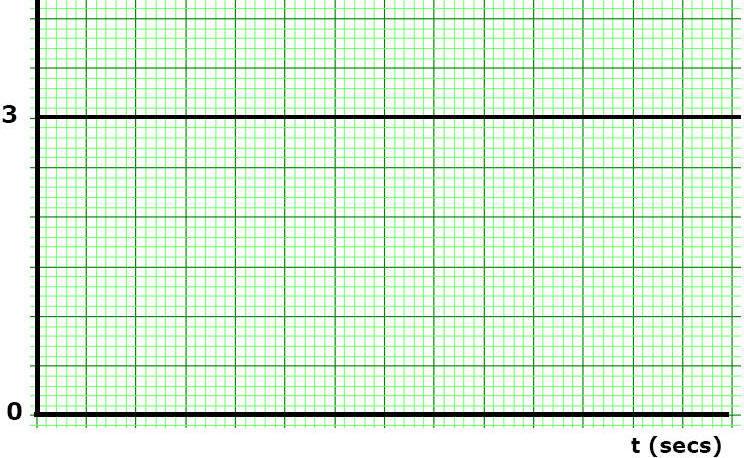
Concept 1) A car on cruise control moves at a constant 25 m/s. What is its acceleration? Which equation would you use to find how far it travels in 8 s?
Start with $\Delta d = V_i t + \tfrac{1}{2}at^2$. With $a = 0$ it becomes $\Delta d = vt$
Substitute: $\Delta d = (25 \text{ m/s})(8 \text{ s})$
$\Delta d = 200 \text{ m}$
Concept 2) If an object's acceleration is zero, can it still be moving? If an object's velocity is zero at one instant, must its acceleration be zero? (Think: a ball at the top of its path.)
Concept 3) Car A passes a stop sign at a constant 20 m/s. At that same instant Car B starts from rest at the sign and accelerates at 4 m/s². When do the cars have the same velocity? Has Car B caught up to Car A at that moment? Explain.
Given: Car A $v_A = 20 \text{ m/s}$ (constant). Car B $V_i = 0$, $a = 4 \text{ m/s}^2$
Same velocity when $V_B = 20 \text{ m/s}$: $V_f = V_i + at \;\Rightarrow\; 20 = 0 + (4)t$
$t = \dfrac{20}{4} = 5 \text{ s}$
Car A at 5 s: $\Delta d_A = vt = (20 \text{ m/s})(5 \text{ s}) = 100 \text{ m}$
Car B at 5 s: $\Delta d_B = V_i t + \tfrac{1}{2}at^2 = 0 + \tfrac{1}{2}(4)(5)^2 = 50 \text{ m}$
No: they have the same velocity at 5 s, but A is 50 m ahead, so B has not caught up yet
Concept 4) For constant velocity, $V_f^2 = V_i^2 + 2a\Delta d$ reduces to $V_f = V_i$. Why is this equation no help for finding distance when $a = 0$?
Teacher Answer Key
Analysis: If velocity is constant, $\mathbf{a = 0 \text{ m/s}^2}$.
Equations: Using $a = 0 \text{ m/s}^2$ in kinematic formulas:
1. $V_f = V_i + (0)t \implies \mathbf{V_f = V_i}$.
2. $\Delta d = V_it + 0.5(0)t^2 \implies \mathbf{\Delta d = V \cdot t}$.
Logic: Constant velocity means zero acceleration, reducing the displacement formula to a direct product of velocity ($m/s$) and time ($s$).
Concept 1: $a = 0 \text{ m/s}^2$. Use $\Delta d = v t$ $= (25 \text{ m/s})(8 \text{ s})$ $= 200 \text{ m}$.
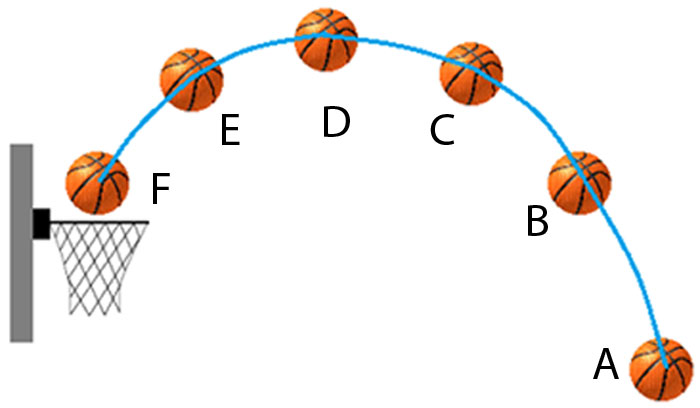
Concept 2: YES – zero acceleration means constant velocity, not zero velocity. NO – a ball thrown up has $v = 0 \text{ m/s}$ at the top, but $a = 9.8 \text{ m/s}^2$ down the whole time.
Concept 3: Same velocity when $V_f = at$: $20 \text{ m/s} = (4 \text{ m/s}^2)t$ $\Rightarrow t = 5 \text{ s}$. NO – at 5 s, A has gone $(20 \text{ m/s})(5 \text{ s}) = 100 \text{ m}$ and B only $\frac{1}{2}(4 \text{ m/s}^2)(5 \text{ s})^2 = 50 \text{ m}$. B was slower the whole time until then, so A is still ahead. (B catches A at $t = 10 \text{ s}$, 200 m from the sign.)
Concept 4: With $a = 0$ the $2a\Delta d$ term is zero, so $\Delta d$ drops out of the equation – it no longer contains distance. Use $\Delta d = v t$ instead.
Quick Check
3 questions on Equations — pick an answer to check yourself.
1. An object moves with constant velocity. What is its acceleration?
2. A car cruises at a constant 15 m/s for 4.0 s. How far does it travel?
3. A runner moves at constant velocity. Which statement is true?
I. Speed and Velocity are Different
Animation: Velocity vs Speed (Curve Ball)
a) Displacement – Distance and from to finish
b) Speed = Distance/time VECTOR or SCALAR???
c) Velocity is speed in a VECTOR or SCALAR
Ex) A curve ball has one speed but velocities because it moves
d) Velocity Equation =
Teacher Answer Key
Equation: Average Velocity $\vec{v} = \Delta \vec{d} / \Delta t$.
Ratio (g): $\Delta d = 0.5gt^2$. At $3 \text{ s}$, distance is $0.5(10)(9) = 45 \text{ m}$. At $1 \text{ s}$, distance is $5 \text{ m}$. It falls 9 times further.
Logic: Gravity affects all objects equally regardless of mass; the ratio of displacement is proportional to the square of the time ($t^2$).
NYSSLS Reading Passage · 1D Motion
The Physics of the Plunge: Force, Acceleration, and Terminal Velocity
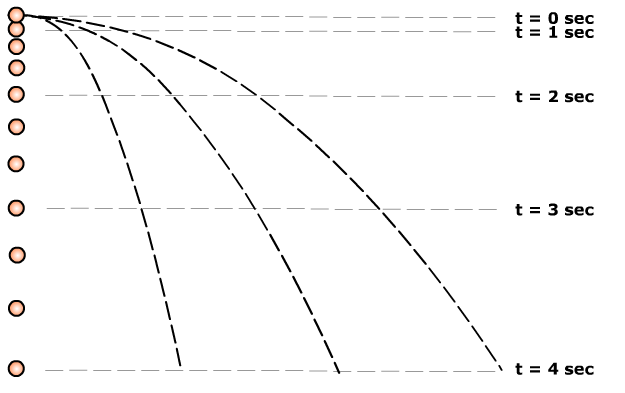
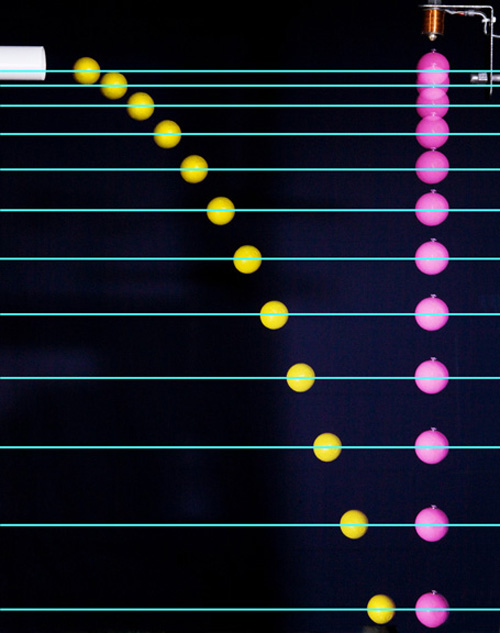
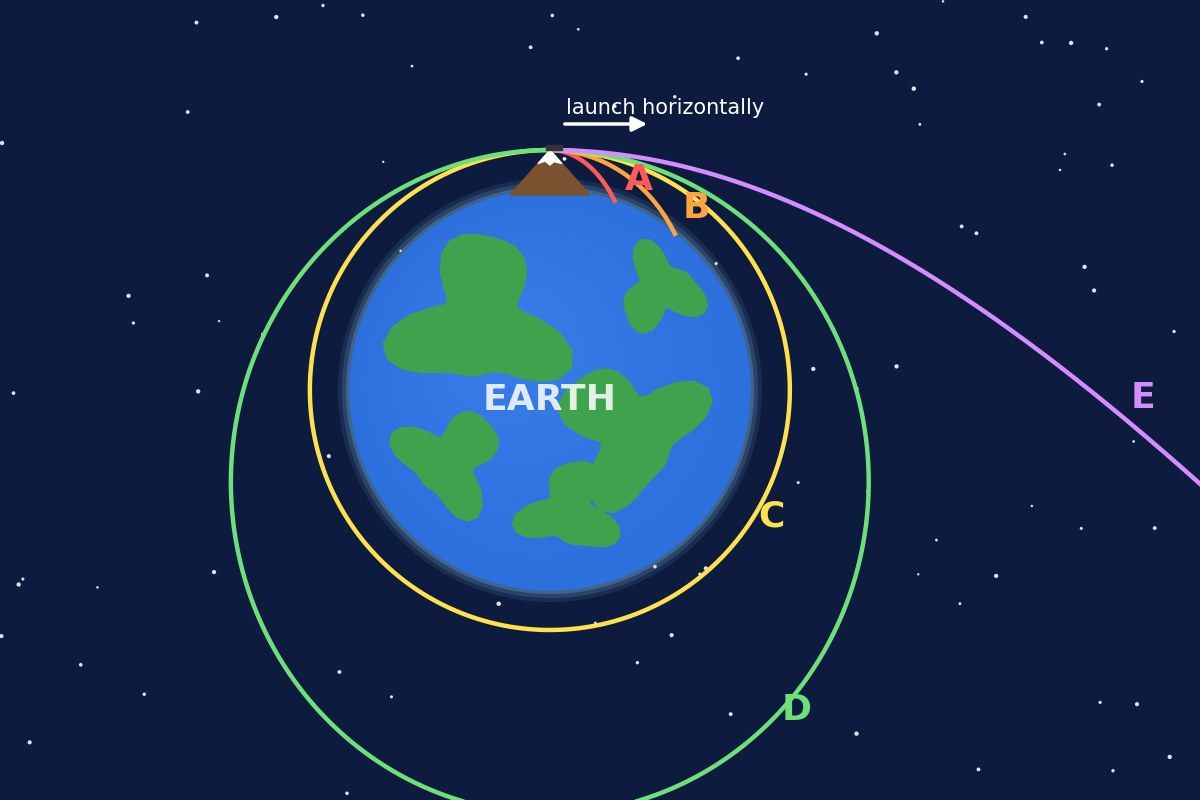
Ex 2) A sphere is dropped from the same height as 3 spheres are projected horizontally. Show where the 3 spheres will be each second.
2. When solving problems in 2 dimensions, we must the x info from the
Object Projected Horizontally Equations
Equation (modify for X and Y)
X Direction $a_x = $ $V_x$ is
Y Direction $a_y = $ $V_{iy} = $
$\Delta d = \dfrac{[V_f + V_i]}{2}t$
$\Delta d = V_it + \tfrac{1}{2}at^2$
$V_f = V_i + at$
$V_f^2 = V_i^2 + 2a\Delta d$
Practice Problems
1. Bob throws a lacrosse ball horizontally off a 40.0-meter-high cliff. How fast did he throw the lacrosse ball if it hit the ground 45.0 meters from the base of the cliff?
Logic: Perpendicular components are independent. Gravity only alters the vertical velocity ($m/s$), while horizontal velocity ($m/s$) remains constant.
Quick Check
3 questions on Horizontal Projectiles — pick an answer to check yourself.
1. A ball is thrown horizontally at 30 m/s off a cliff. Ignoring air resistance, what is its horizontal velocity 3.0 s later?
2. A ball rolls horizontally off a 20 m high cliff at 5.0 m/s. How far from the base does it land? (g = 10 m/s²)
3. From the same height, one ball is dropped while another is thrown horizontally very fast. Ignoring air resistance, which lands first?
Projectile Motion
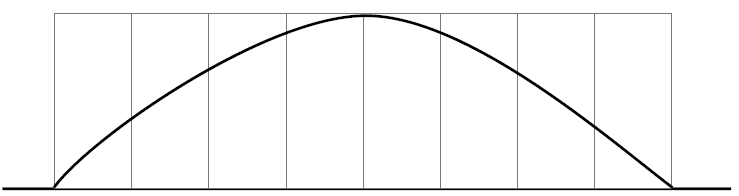
Range - Show it on the drawing above.
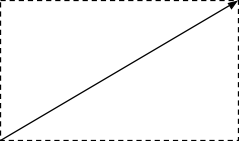
Solving Projectile using Components: We always solve projectile problems by resolving the velocity vectors into x and y components. Draw and label Vx and Vy in the picture below.
B) $100 \text{ m/s}$ at $30^\circ$ below the horizontal (same speed and angle as launch, on level ground)
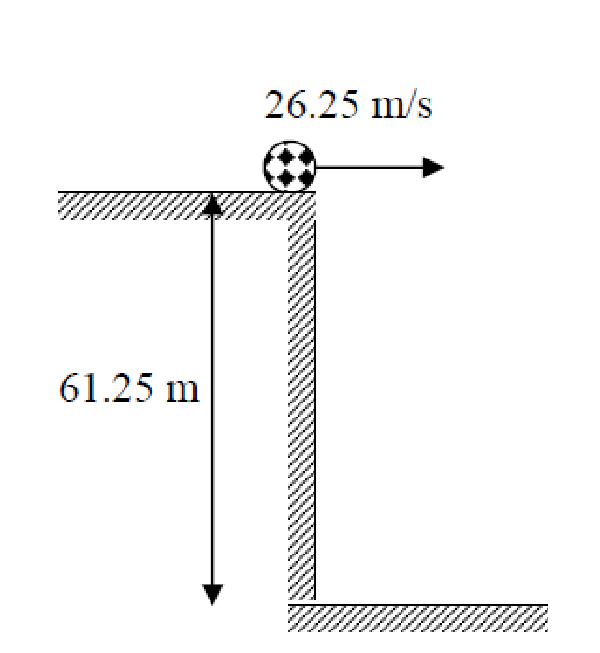
Ex 2) $V_{iy} = 0$, $\;V_x = 26.25 \text{ m/s}$, $\;d_y = 61.25 \text{ m}$. Find the time in the air, the range, and the magnitude and direction of the velocity when the ball hits the ground.
$43.8 \text{ m/s}$ at $53.1^\circ$ below the horizontal
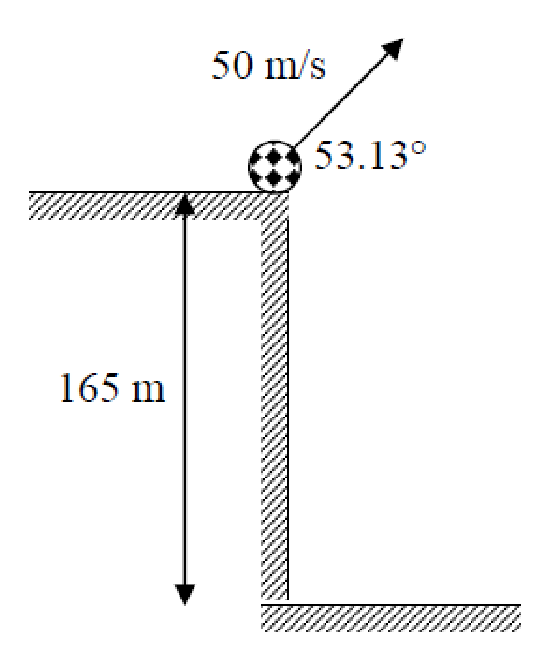
Ex 3) A ball is launched at $50 \text{ m/s}$ at $53.13^\circ$ above the horizontal from the top of a $165 \text{ m}$ cliff. Find the time in the air, the range, and the magnitude and direction of the velocity when the ball hits the ground.
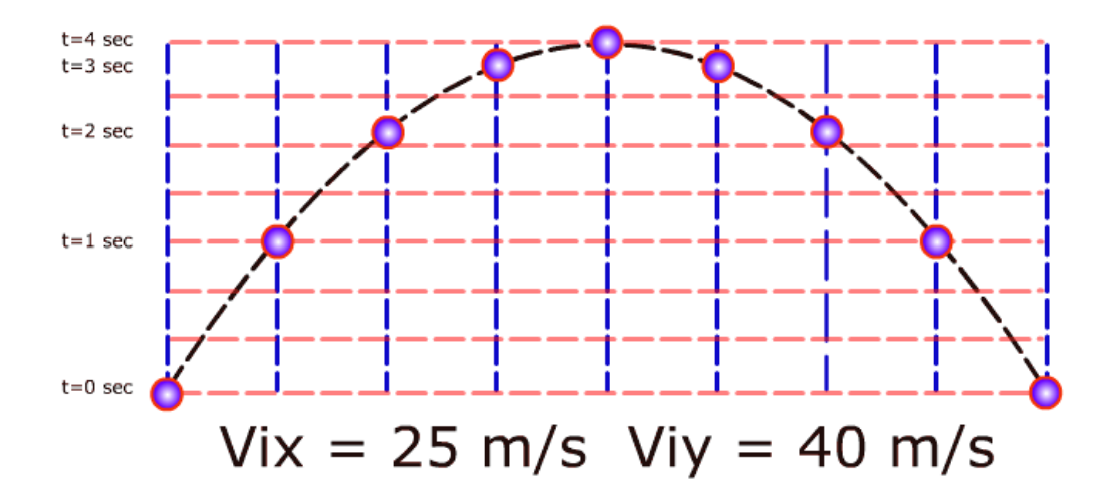
Logic: Launch $V_{iy} = 40 \text{ m/s}$ takes $\mathbf{4 \text{ s}}$ to reach peak where $V_y = 0 \text{ m/s}$. Total time is symmetric, so total $= \mathbf{8 \text{ s}}$.
Level Ground Ex 1: $V_x = 86.6 \text{ m/s}$, $V_{iy} = 50.0 \text{ m/s}$. $t_{peak} = 5.00 \text{ s}$, total $= 10.0 \text{ s}$. Range $= (86.6)(10.0) = \mathbf{866 \text{ m}}$. Lands at $\mathbf{100 \text{ m/s}, \ 30^\circ}$ below the horizontal.
Ex 2: $t = \sqrt{2(61.25)/10} = \mathbf{3.50 \text{ s}}$. Range $= (26.25)(3.50) = \mathbf{91.9 \text{ m}}$. $V_{fy} = 35.0 \text{ m/s}$, so $v = \mathbf{43.8 \text{ m/s}}$ at $\mathbf{53.1^\circ}$ below the horizontal.
Ex 3: $V_x = 30.0 \text{ m/s}$, $V_{iy} = 40.0 \text{ m/s}$. $-165 = 40t - 5t^2 \Rightarrow t = \mathbf{11.0 \text{ s}}$. Range $= \mathbf{330 \text{ m}}$. $V_{fy} = -70.0 \text{ m/s}$, so $v = \mathbf{76.2 \text{ m/s}}$ at $\mathbf{66.8^\circ}$ below the horizontal.
Quick Check
3 questions on Angled Projectiles — pick an answer to check yourself.
1. At the very top of a projectile's path over level ground (no air resistance), which statement is true?
2. A ball is launched over level ground with Vix = 25 m/s and Viy = 40 m/s. Using a = −10 m/s², what is its total time in the air?
3. Same ball (Vix = 25 m/s, Viy = 40 m/s, a = −10 m/s²). What is its speed at t = 2.0 s?
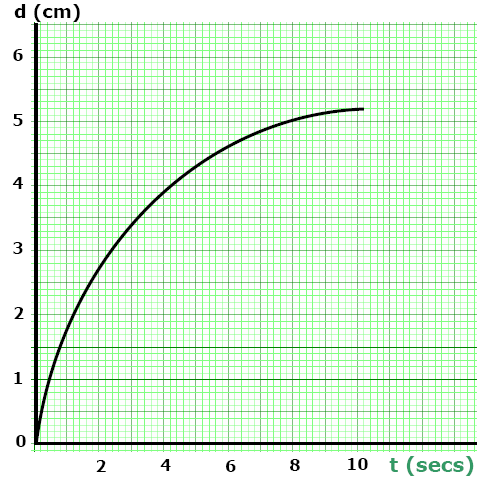
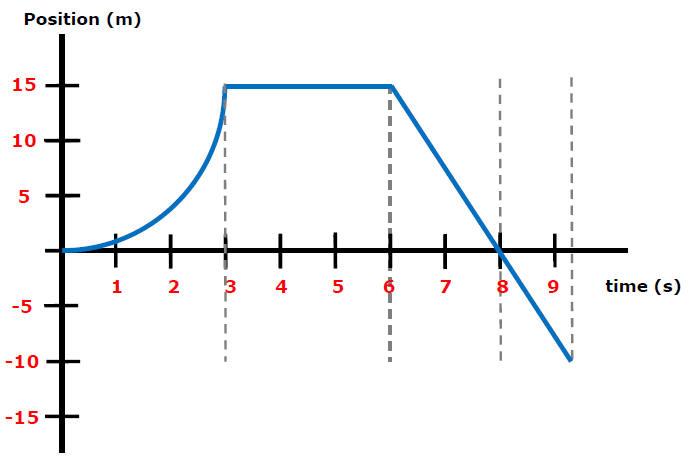
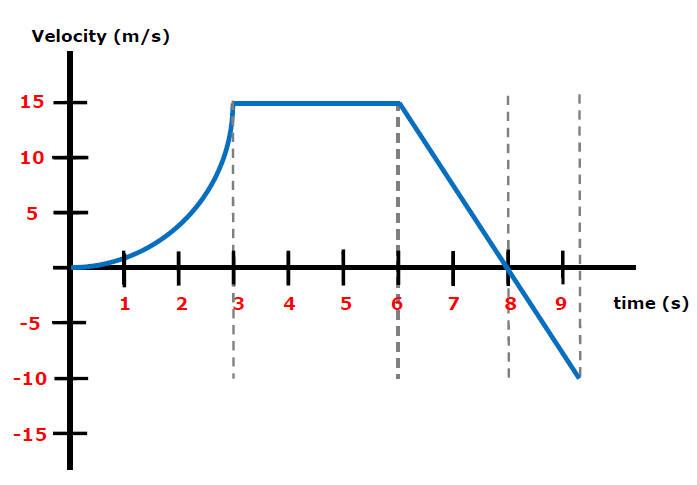
Ex 5) Describe the motion that produced this plot.
Ex 6)
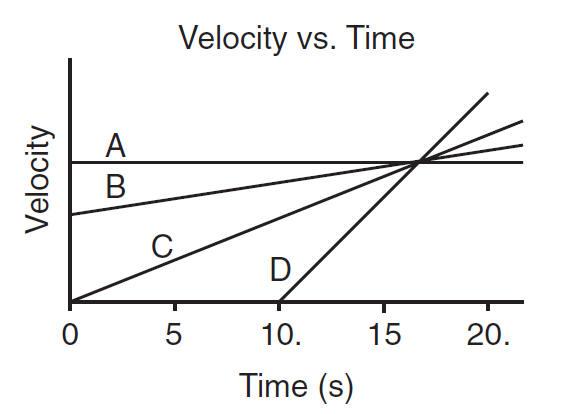
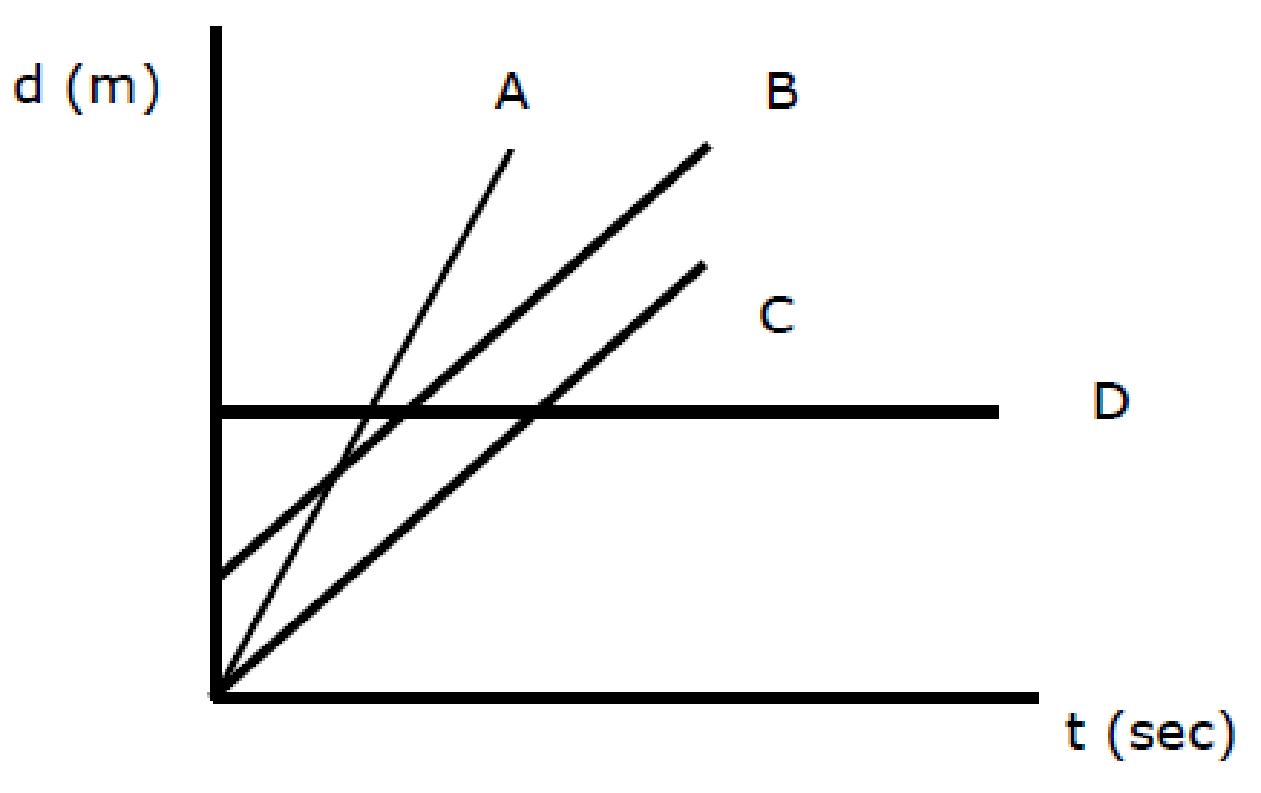
a) Rank the accelerations from largest to smallest.
b) Explain D
Teacher Answer Key
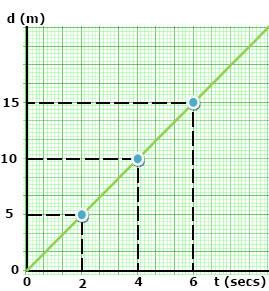
Rule: Slope of position graph = Velocity (m/s). Slope of velocity graph = Acceleration (m/s²).
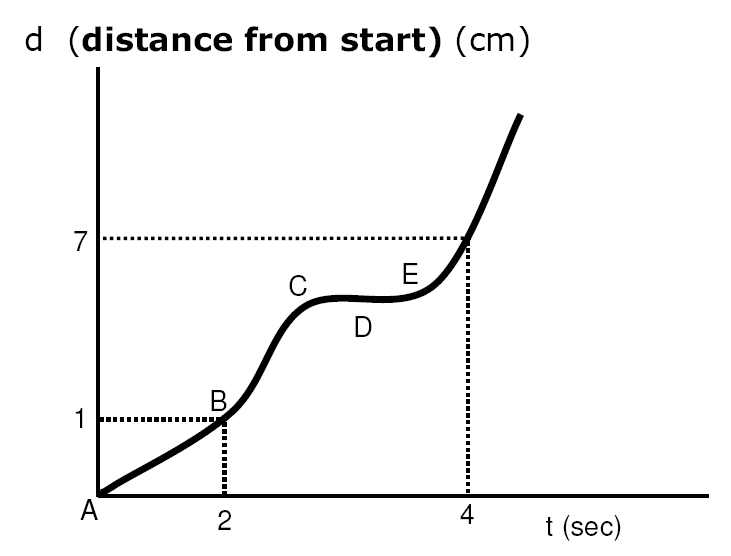
Ex 3: From A to B the line is straight, so the slope (velocity) is constant and $a = 0$. After B the curve bends, so the slope is changing. Changing velocity = Acceleration: around C, D and E, and again after $t = 4 \text{ s}$ as the curve gets steeper. Between C and D, $d$ decreases, so the car does move backward briefly.
Logic: Backward motion requires a negative slope (decreasing $d$). The graph slopes down only between C and D, so that is the only time the velocity is negative and the car moves backward. Everywhere else the slope is positive or zero.
Quick Check
3 questions on Motion Plots — pick an answer to check yourself.
1. What does the slope of a velocity vs. time graph represent?
2. A straight-line position vs. time graph goes from 2 m at t = 0 to 14 m at t = 4.0 s. What is the object's velocity?
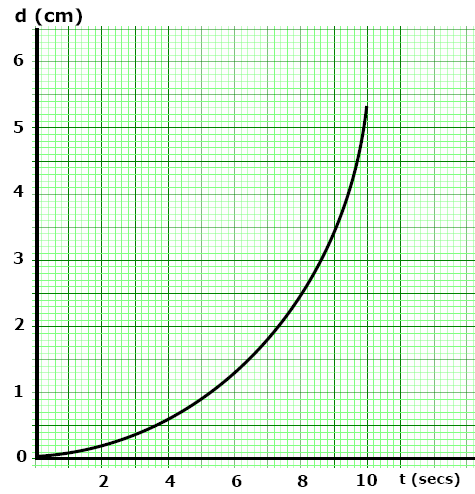
3. A position vs. time graph always rises and curves upward, getting steeper over time. What is the object doing?
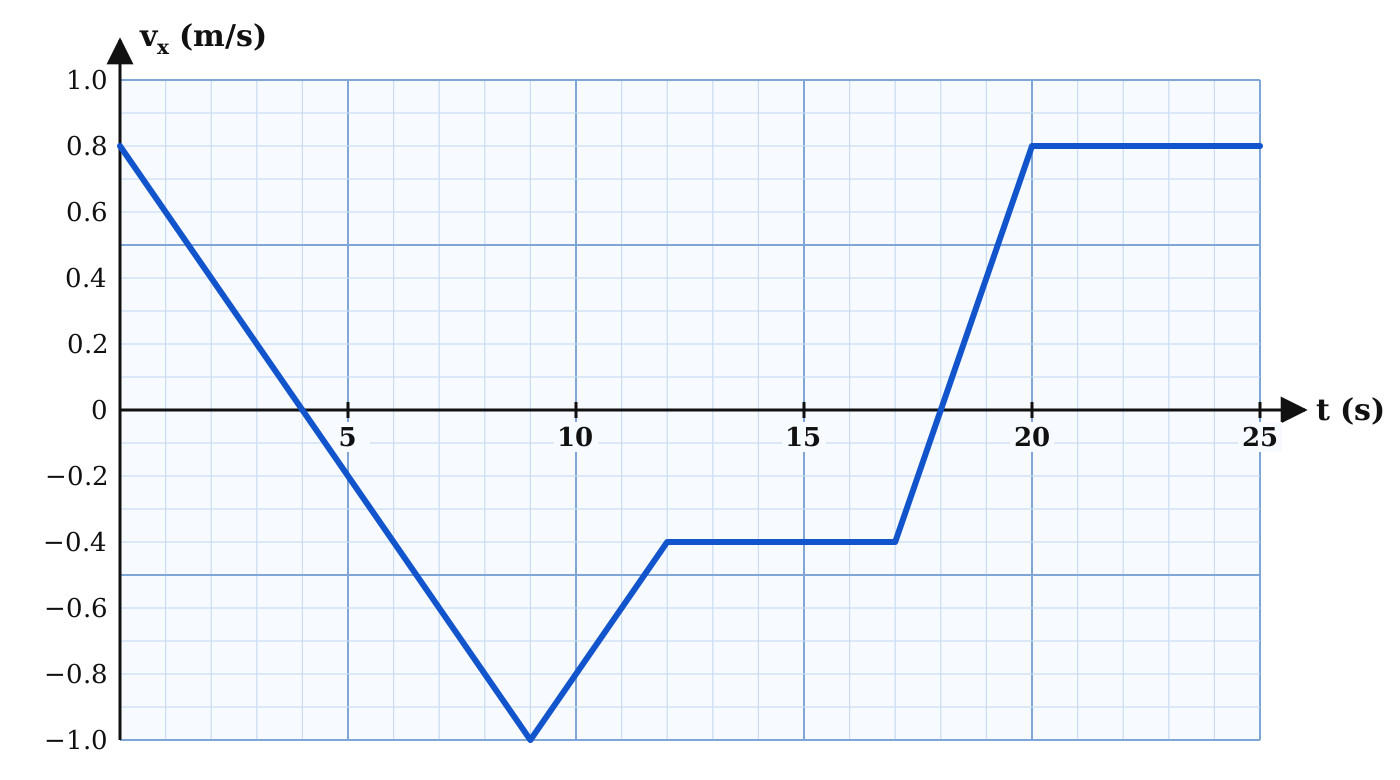
2. A 0.50 kg cart moves on a straight horizontal track:
(a) Indicate every time $t$ for which the cart is at rest:
(b) Indicate every time interval for which the cart's speed (magnitude of velocity) is increasing:
(c) Determine the horizontal position $x$ of the cart at $t = 9.0$ s if the cart is located at $x = 0$ at $t = 0$:
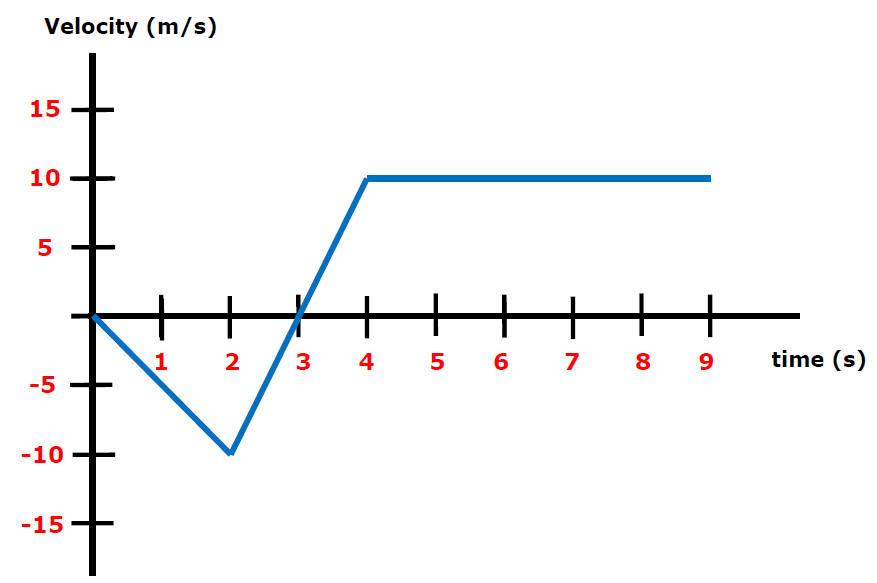
Displacement = area under the $v$-$t$ graph (area below the axis is negative)
Position at 4 s: $-10 - 5 + 5 = -10 \text{ m}$ (10 m behind the start)
After 4 s, $v = +10 \text{ m/s}$: time to cover 10 m $= \dfrac{10 \text{ m}}{10 \text{ m/s}} = 1 \text{ s}$
It is back at the start at $t = 4 + 1 = 5 \text{ s}$
Teacher Answer Key
Claim (Graph 1 - Cart): The cart is at rest at $\mathbf{t = 0 \text{ s}, \ 5.0 \text{ s}, \text{ and } 13 \text{ s}}$ (points a, c, e). Speed increases over $\mathbf{0\text{-}3.0 \text{ s}, \ 5.0\text{-}8.0 \text{ s}, \text{ and } 13\text{-}18 \text{ s}}$. $a_{a\text{-}b} = \mathbf{1.0 \text{ m/s}^2}$ and $a_{b\text{-}d} = \mathbf{-1.6 \text{ m/s}^2}$.
Evidence (Graph 1 - Cart): $V = 0 \text{ m/s}$ only where the line crosses the T-axis: $t = 0, 5.0, 13 \text{ s}$. $|V|$ grows away from zero on three legs: a→b ($0 \to 3.0 \text{ m/s}$), c→d ($0 \to -5.0 \text{ m/s}$), and e→f ($0 \to 5.0 \text{ m/s}$). $a_{a\text{-}b} = \frac{3.0 - 0}{3.0 - 0} = \mathbf{1.0 \text{ m/s}^2}$. $a_{b\text{-}d} = \frac{-5.0 - 3.0}{8.0 - 3.0} = \frac{-8.0}{5.0} = \mathbf{-1.6 \text{ m/s}^2}$.
Reasoning (Graph 1 - Cart): "At rest" means $V = 0 \text{ m/s}$, which happens only at the T-axis crossings. Speed (the magnitude of $V$) increases whenever the line moves away from the T-axis, whether $V$ is positive or negative, so a-b, c-d, and e-f all count even though b-d passes through zero at c. Acceleration is the constant slope $\Delta V / \Delta t$ of a straight segment, so the single value $-1.6 \text{ m/s}^2$ describes the whole b-d segment despite the direction reversal at c.
Claim (Graph 2 - 0.50 kg Cart): (a) The cart is at rest at $\mathbf{t = 4.0 \text{ s and } 18 \text{ s}}$. (b) Speed increases over $\mathbf{4.0\text{-}9.0 \text{ s}}$ and $\mathbf{18\text{-}20 \text{ s}}$. (c) From $t = 0$ to $9.0 \text{ s}$ the displacement is $\mathbf{\Delta x = -0.90 \text{ m}}$, and the cart starts at $x = 0$, so at $t = 9.0 \text{ s}$ it is at $\mathbf{x = -0.90 \text{ m}}$ (0.90 m behind its starting point).
Evidence (Graph 2 - 0.50 kg Cart): $v_x = 0$ where the line crosses the $t$-axis: at $4.0 \text{ s}$ (falling from $+0.8$ to $-1.0 \text{ m/s}$ with slope $-0.20 \text{ m/s}^2$, so $0.8/0.20 = 4.0 \text{ s}$) and at $18 \text{ s}$ (rising from $-0.4$ to $+0.8 \text{ m/s}$ with slope $+0.40 \text{ m/s}^2$, so $17 + 0.4/0.40 = 18 \text{ s}$). $|v_x|$ grows from $0$ to $1.0 \text{ m/s}$ over $4.0\text{-}9.0 \text{ s}$ and from $0$ to $0.8 \text{ m/s}$ over $18\text{-}20 \text{ s}$. Area $0\text{-}4.0 \text{ s}$: $\tfrac{1}{2}(4.0)(0.8) = +1.6 \text{ m}$. Area $4.0\text{-}9.0 \text{ s}$: $\tfrac{1}{2}(5.0)(-1.0) = -2.5 \text{ m}$. Total $= \mathbf{-0.90 \text{ m}}$.
Reasoning (Graph 2 - 0.50 kg Cart): At rest means $v_x = 0$, which happens only at the axis crossings. Speed increases when the line moves away from the $t$-axis, whether $v_x$ is positive or negative; from $12\text{-}17 \text{ s}$ and $20\text{-}25 \text{ s}$ the line is flat, so speed is constant there. Displacement is the area under the $v$-$t$ graph, with area below the axis counting as negative, so the cart moves forward $1.6 \text{ m}$, then back $2.5 \text{ m}$, ending $0.90 \text{ m}$ behind where it started: $x = 0 + (-0.90 \text{ m}) = -0.90 \text{ m}$.
Area Rule: Displacement $\Delta d \text{ (m)} = \text{Area under } v-t \text{ curve}$.
Return to Start: After $4 \text{ s}$ the object moves at a constant $+10 \text{ m/s}$, so it covers the $10 \text{ m}$ back to the start in $1 \text{ s}$: it returns to the starting point at $\mathbf{t = 5 \text{ s}}$. (Area $4\text{-}5 \text{ s}$: $(1 \text{ s})(10 \text{ m/s}) = +10 \text{ m}$, so $\Delta d_{total} = 0$.)
Quick Check
3 questions on Graph Analysis — pick an answer to check yourself.
1. On a velocity–time graph, when is an object's speed increasing?
2. A cart's velocity changes steadily from +3.0 m/s at t = 3.0 s to −5.0 m/s at t = 8.0 s. What is its acceleration?
3. A cart speeds up uniformly from rest to 10 m/s in 4.0 s, then moves at a constant 10 m/s for 5.0 s. What is its total displacement?
Claim: Starting at $x_i = +5 \text{ m}$ with $V_i = -10 \text{ m/s}$, the object has constant acceleration $\mathbf{a = 5 \text{ m/s}^2}$ from $t=0$ to $t=6 \text{ s}$ (it momentarily stops and reverses direction at $t = 2 \text{ s}$), then moves at constant velocity ($\mathbf{a = 0 \text{ m/s}^2}$) from $t=6 \text{ s}$ to $t=8 \text{ s}$, ending at $x = \mathbf{75 \text{ m}}$.
Area Formula: $\Delta d = \text{Area under } v\text{-}t \text{ curve}$. The line is one continuous slope from $(0,-10)$ to $(6,20)$, so $a = \Delta V/\Delta t = 30/6 = \mathbf{5 \text{ m/s}^2}$ the whole way, even though $V$ crosses $0$ at $t=2 \text{ s}$.
1. $0\text{-}2 \text{ s}$ (triangle below axis): $\Delta d = 0.5(2 \text{ s})(-10 \text{ m/s}) = \mathbf{-10 \text{ m}}$. Pos $= 5 - 10 = \mathbf{-5 \text{ m}}$.
2. $2\text{-}6 \text{ s}$ (triangle above axis): $\Delta d = 0.5(4 \text{ s})(20 \text{ m/s}) = \mathbf{40 \text{ m}}$. Pos $= -5 + 40 = \mathbf{35 \text{ m}}$.
3. $6\text{-}8 \text{ s}$ (rectangle, $a=0$): $\Delta d = (2 \text{ s})(20 \text{ m/s}) = \mathbf{40 \text{ m}}$. Pos $= 35 + 40 = \mathbf{75 \text{ m}}$.
Logic: A single straight slope means constant acceleration even as $V$ passes through zero — that crossing is just a turnaround (direction change), not a change in $a$. Area below the $t$-axis is negative (backward) displacement, which is why the object ends up at $x=-5 \text{ m}$ (behind its $+5 \text{ m}$ start) before the $2\text{-}6 \text{ s}$ and $6\text{-}8 \text{ s}$ intervals push it forward to $\mathbf{75 \text{ m}}$. From $t=6$ to $8 \text{ s}$ the graph is flat, so $a=0 \text{ m/s}^2$ there.
NYSSLS Reading Passage · 2D Motion
Newton's Cannonball: The Thought Experiment That Explained Orbits