Static Equilibrium

Pre-Class Questions 1 - 3 Instruction Video [1] Instruction Video [2]
Defined - Resultant - Single force equivalent to all vectors acting on an object.
1. Angle between vectors below = ______________
$F_{net} = $
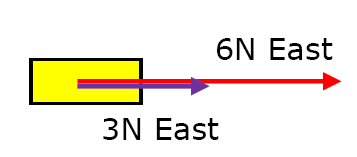
$F_{net} = $
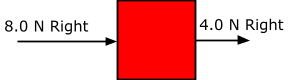
2. Angle between vectors below = ______________ _____________
$F_{net} = $
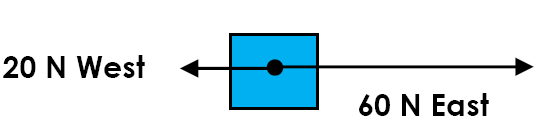
Claim: The magnitude of a resultant force depends on the relative orientation (angle) between input vectors.
Evidence:
Parallel ($0^\circ$): $5\text{ N} + 7\text{ N} = 12\text{ N}$.
Opposite ($180^\circ$): $|5\text{ N} - 4\text{ N}| = 1\text{ N}$.
Perpendicular ($90^\circ$): $\sqrt{3^2 + 4^2} = 5\text{ N}$.
Reasoning: At $0^\circ$, vectors act in unison, so magnitudes add. At $180^\circ$, they act in direct opposition, so magnitudes subtract. At $90^\circ$, they act as independent legs of a right triangle, necessitating the Pythagorean theorem.
3 questions on Finding Resultants — pick an answer to check yourself.
1. A 3 N force and a 4 N force act on an object at 90° to each other. What is the resultant?
2. As the angle between two equal forces increases from 0° to 180°, the magnitude of their resultant…
3. A 5 N force pulls east and a 4 N force pulls west on the same object. What is the resultant?
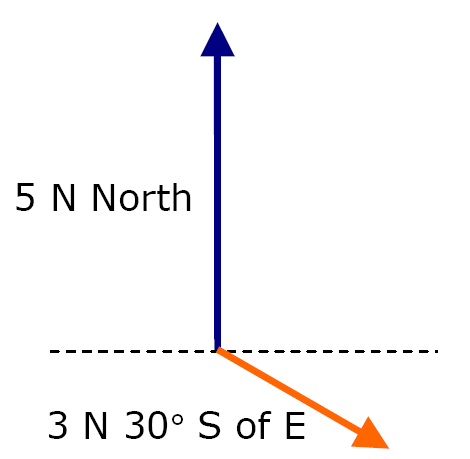
3. Naming Direction with Angles - The vector on the upper right is 50. degrees N of E.
Name the rest of the directions.
________________________
________________________
________________________

4. Angle between vectors = 90. degrees. Use TRIG to find the direction VIDEO
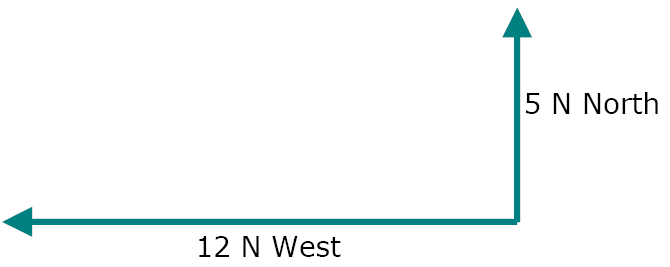
What trig. function helps you find the $F_{net}$ direction? ________
$F_{net} = $ _____ ___ degrees _____ of _______
5. 10. nt east and 10. nt south acts on an object.
Find $F_{net}$
$F_{net} = $ _____ ___ degrees _____ of _______
Claim: Resultant directions are described by the angle made relative to a primary axis (N, S, E, W).
Evidence: For Problem 5, the forces are $10\text{ N}$ E and $10\text{ N}$ S.
Calculation: $R = \sqrt{10^2 + 10^2} = 14.1\text{ N}$.
Angle: $\theta = \tan^{-1}(10/10) = 45^\circ$.
Reasoning: The tangent function relates vertical displacement to horizontal. Since the South and East components are identical, the resultant splits the difference perfectly at $45^\circ$ South of East.
3 questions on Naming Directions — pick an answer to check yourself.
1. Forces of 10 N east and 10 N south act on an object. What is the net force?
2. Two perpendicular forces act on an object. Which tool is used to find the direction (angle) of the net force?
3. Forces of 30 N east and 40 N north act on an object. What is the net force?
X and Y Components Intro Video AP Finding Resultants II
6. In AP Physics it is more useful to find $F_{net}$ using components

| Vector | X (Newtons) | Y (Newtons) |
|---|---|---|
| Vector A | ||
| Vector B | ||
| $F_{net}$ |
$F_{net}$ = _________ N _______ degrees _______ of ____
7. Find $F_{net}$ By Adding Components and using Tangent. Make a Table! Video
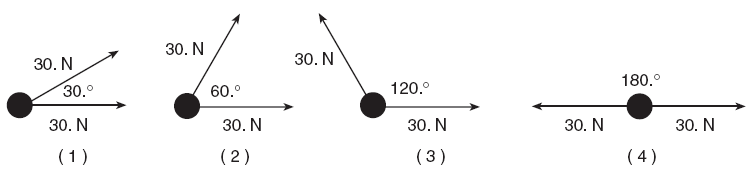
8. Which pair of vectors has the greatest resultant?
What’s the TAKEAWAY Here? ______________________________
9. Relative to the ground, an airplane gains speed when it encounters wind from behind, and loses speed when it encounters wind head-on. When it encounters wind at a right angle to the direction it is pointing, its speed relative to the ground below:
A. increases. B. decreases. C. is the same as if there were no wind. D. Need more information.
1. As the angle between two vectors increases from 0 degrees to 180 degrees, the magnitude of the resultant force ________________________.
Equilibrant - defined - Single force that when added to a system of forces, puts the system in equilibrium. (Net force = 0)
2. The equilibrant is ______________ in magnitude and ______________ in direction to the resultant.
3. Example: If the resultant is 20. N East, the equilibrant is ________________.
Claim: 2D vector addition is solved by resolving all forces into independent $x$ and $y$ effects and balancing the final resultant with an equilibrant.
Evidence:
Analysis Q9: Resultant speed $V_g = \sqrt{V_a^2 + V_w^2}$ is always larger than $V_a$.
Magnitude Trend: At $0^\circ$, $R = A+B$; at $180^\circ$, $R = |A-B|$. Thus magnitude decreases as angle increases.
Equilibrant: Opposite direction ($180^\circ$ shift) of Resultant.
Reasoning: Airplane ground speed increases with crosswinds because the side-push of the wind adds a vector leg that increases the total length of the velocity vector (the hypotenuse). The equilibrant is the "stabilizer" force needed to zero-out the net effect of all other vectors.
3 questions on Component Method — pick an answer to check yourself.
1. Two forces act on an object: 3.0 N east and 4.0 N north. What is the net force?
2. Two 10 N forces act on an object. As the angle between them increases from 0° to 180°, the resultant…
3. The forces on a ring have a resultant of 20 N east. What single force puts the ring in equilibrium?
I. Static Equilibrium means …
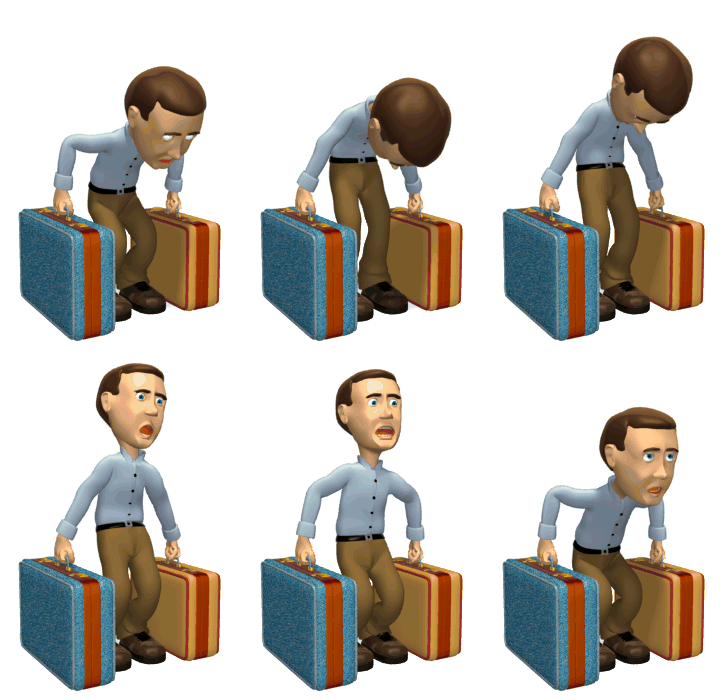
1. ________________ 2. _______________ 3. _____________
A. Most of the time it is useful to write:
$\sum F_x = $ ________
$\sum F_y = $ ________
1. Show all the forces acting on the body below each picture
2. Show Equation and Solve
FBD
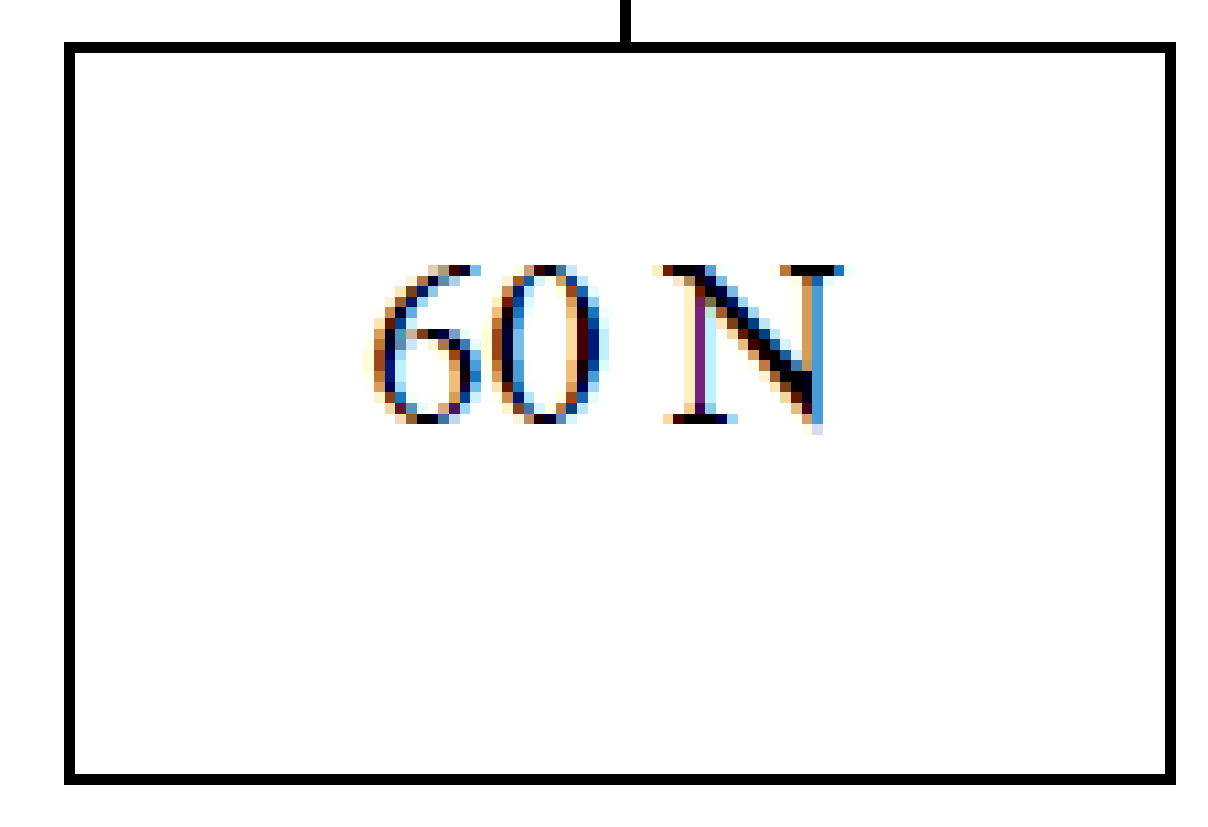
FBD
1. Show all the forces acting on all the bodies in each picture
2. Show the Equation and Solve
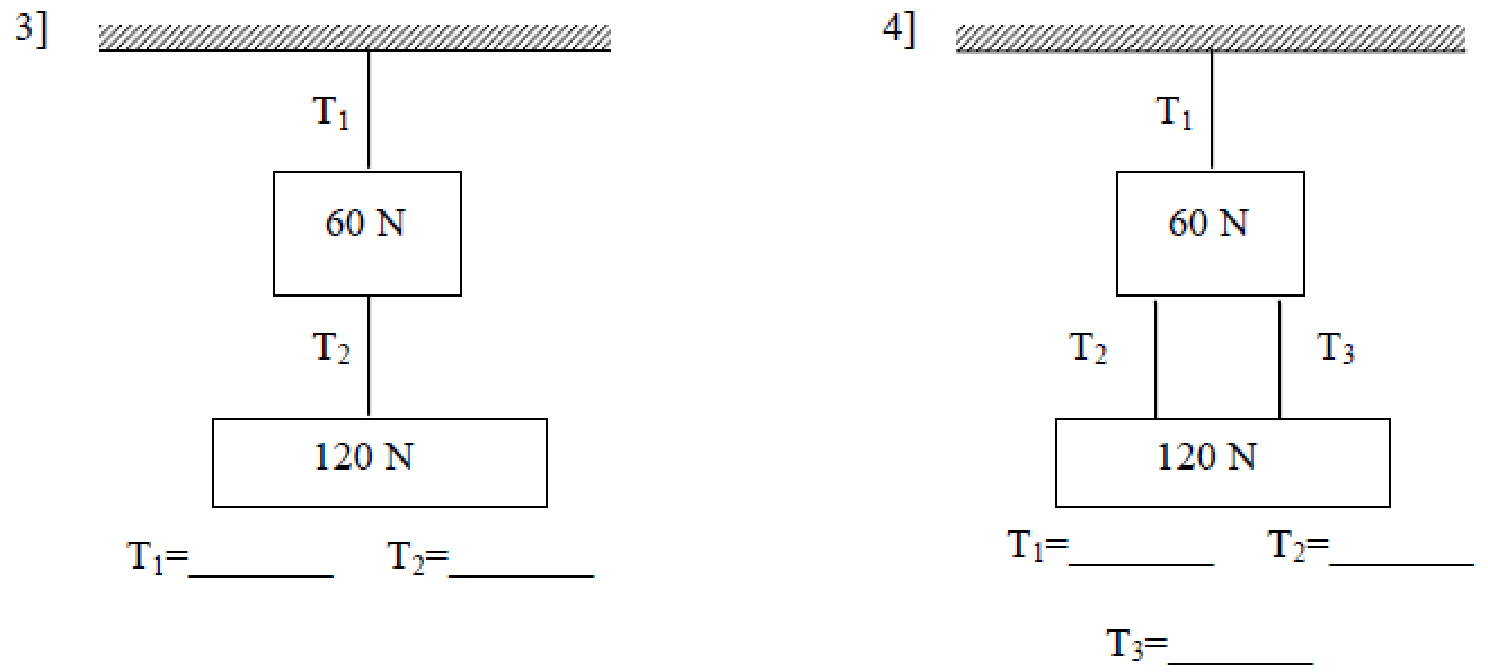
Solve these without a Free Body Diagram:
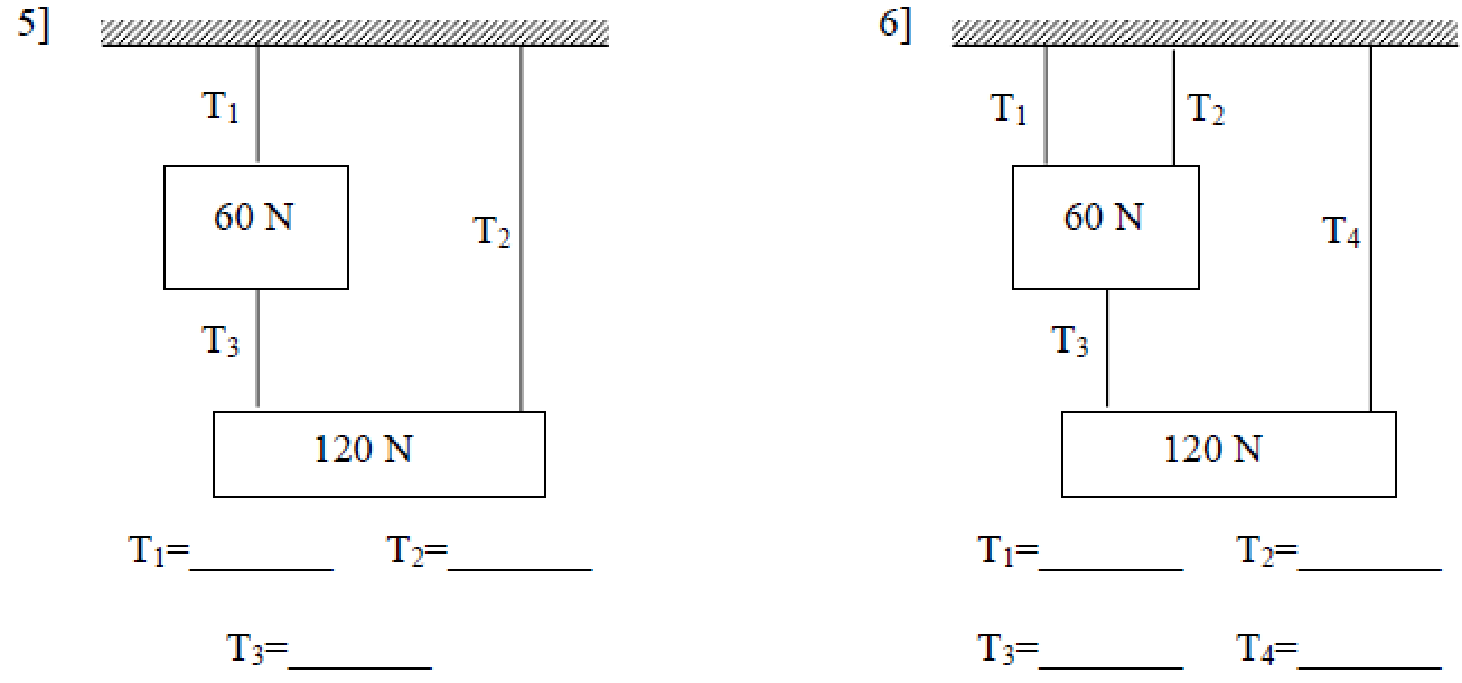
a) Draw the Free Body Diagram for each problem
b) Write the equation / Solve for T
7. An orb of mass 5.0 kg is hanging from the ceiling. Find the tension of the string (T)

8. If mass M is at rest on a rough table, find a) tension T b) M in terms of m



a) T = ____________ b) M = ________________
Sq.jpg)
Claim: In static equilibrium, the sum of all forces is zero, meaning every applied force is canceled by a supporting or reaction force.
Evidence:
Problem 7: $F_g = mg = 5\text{ kg} \times 10\text{ m/s}^2 = 50\text{ N}$. Since $\sum F_y = 0$, $T = 50\text{ N}$.
Problem 8: For the hanging mass $m$, $T = 10m\text{ N}$. For mass $M$, the friction force must equal this tension ($f_s = 10m\text{ N}$).
Reasoning: Newton's First Law dictates that an object at rest must have balanced forces. If gravity pulls the orb down with $50\text{ N}$, the string must pull up with $50\text{ N}$ to prevent acceleration. In the table system, the tension transferred by the rope from the hanging mass acts as a sliding force on mass $M$, which is balanced by the static friction of the table.
3 questions on Static Equilibrium Intro — pick an answer to check yourself.
1. An object is in static equilibrium. Which statement must be true?
2. A 5.0 kg orb hangs at rest from a single string attached to the ceiling. Using g = 10 m/s², what is the tension in the string?
3. Block M rests on a rough table, tied by a string over a pulley to a hanging mass m. Nothing moves. What is the static friction force on M?
Video Instruction (For #1)

1. a) Draw the FBD
b) Show ALL Equations
c) Solve unknowns
2. a) Draw the FBD
b) Show ALL Equations
c) Solve unknowns
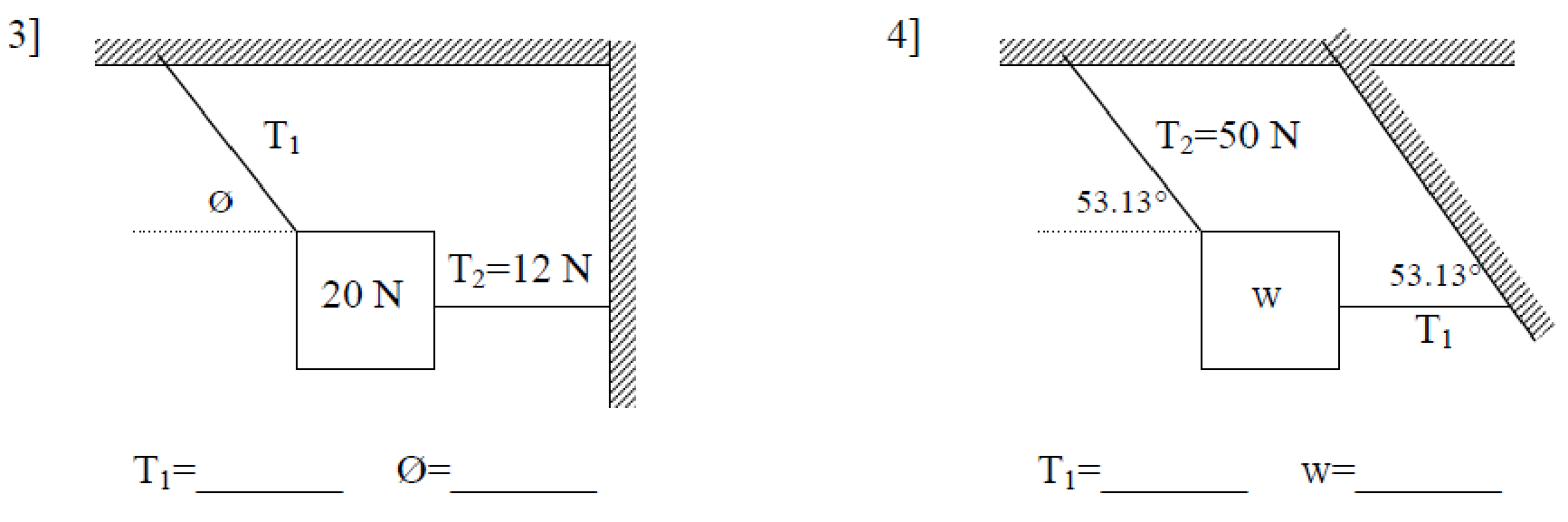
3. a) Draw the FBD
b) Show ALL Equations
c) Solve unknowns
4. a) Draw the FBD
b) Show ALL Equations
c) Solve unknowns
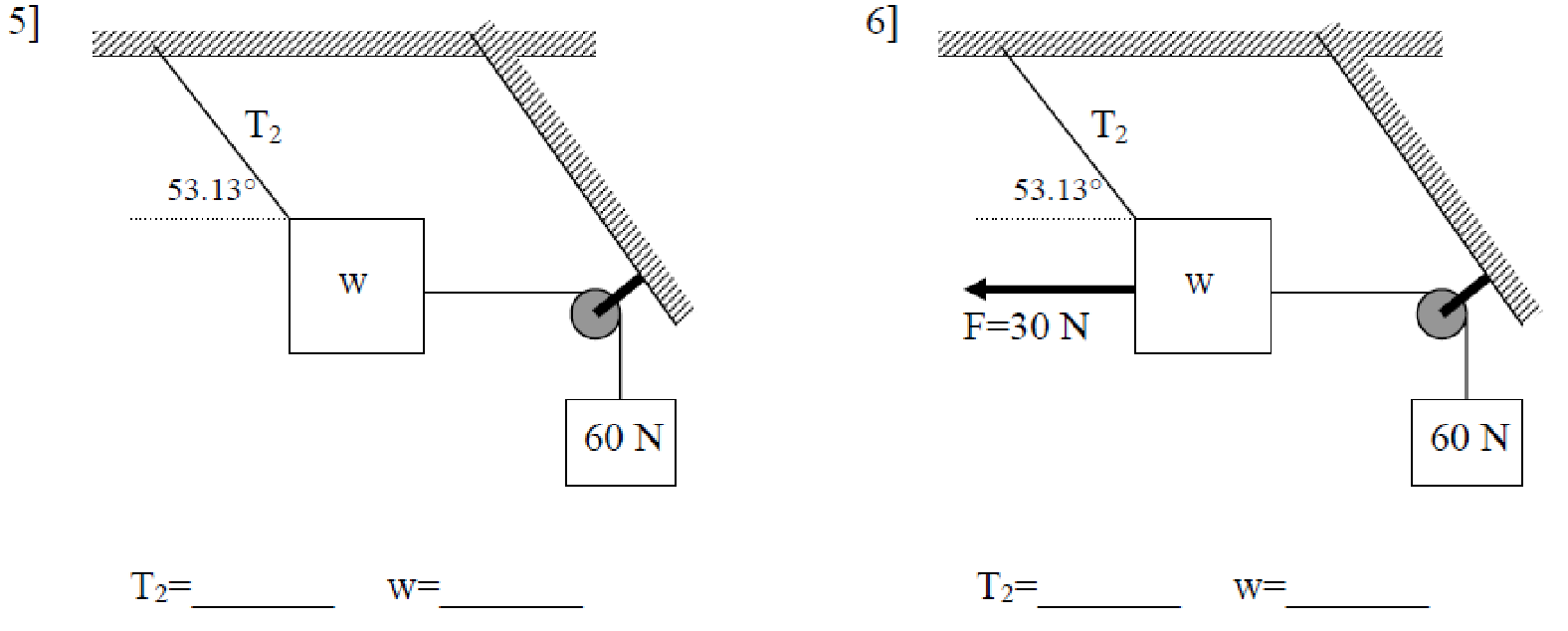
5. a) Draw the FBD
b) Show ALL Equations
c) Solve unknowns
6. a) Draw the FBD
b) Show ALL Equations
c) Solve unknowns
Claim: Tension in a two-string suspension increases exponentially as the angle with the horizontal approaches zero.
Evidence:
Equations: $\sum F_y = 2T \sin\theta - mg = 0$.
Derivation: $T = mg / (2 \sin\theta)$.
For $10\text{ kg}$ at $30^\circ$: $T = (10\text{ kg} \times 10\text{ m/s}^2) / (2 \times 0.5) = 100\text{ N}$.
Reasoning: Gravity only acts in the $y$-axis. Only the vertical components of the tension strings counteract gravity. Because $T_y = T \sin\theta$, when $\theta$ is small, the sine is small. This requires a much larger total tension vector just to provide the minimum vertical lift needed to balance the weight.
3 questions on Acute Angle Statics — pick an answer to check yourself.
1. A 10 kg mass hangs from two strings, each making 30° with the horizontal. What is the tension in each string? (g = 10 m/s²)
2. The same mass hangs from two strings. If the strings are made flatter (smaller angle with the horizontal), the tension in each string…
3. For a mass hanging motionless from two angled strings, what balances the object's weight?
Pre - Class Questions
Video Instruction
Interactive Incline Component Simulator
Ramp Angle: 30°
1. The weight force on the block below acts ON the ramp and DOWN the ramp.
The force the box exerts ON the ramp is a component called:
$F_{perpendicular}$ OR $F_{parallel}$? (Circle one)

2. What ramp angle would cause the box’s force on the ramp to be:
a) the greatest? _____ degrees b) the smallest? ______ degrees
3. What ramp angle would cause the force that the box exerts ON the ramp to be equal to the force that the box exerts down the ramp to be equal?
a) __________________ degrees
4. What ramp angle would the Normal Force of the ramp equal the weight force of
the box?_______
Normal Force - upward ______________________________________________
5. The larger the ramp angle, the SMALLER or LARGER the Normal Force (circle)
Ex 1) A 5.0 kg box slides on a 20. degree frictionless ramp
The box’s force on the ramp equals the ramp’s force ___________________
The ramp’s upward force on the box is called the ___________ force
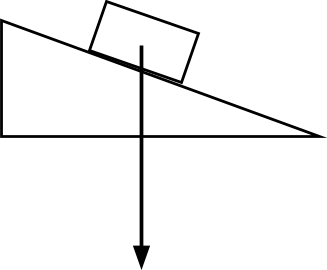
$F_{box}$ on-ramp = _________________
$F_{box}$ parallel = _________________
Ex 2) a) Sketch the weight force and the ball below. Let the mass of the ball = 5.0 kg and angle = 45 degrees.
Ex 3) Mass is 5.0 kg and ramp angle = 15 degrees (label all ramp angles)
a) F parallel = ______________________________
b) F perp. = ______________________________
c) Sketch the normal force on the box
Ex 4) Mass is 5.0 kg, and ramp angle = 70 degrees

Ex 5) Mass 5.0 kg and ramp angle =______ degrees
Ex 6) Mass is 5.0 kg and ramp angle = _______ degrees

Claim: On an inclined plane, the normal force and the sliding force are vector components of gravity determined by the cosine and sine of the angle of inclination.
Evidence:
1: $F_{\perp}$ is the component pressing into the ramp.
2: Greatest $F_{perp}$ is at $0^\circ$ (full weight), smallest is at $90^\circ$ (zero weight).
3: Equal at $45^\circ$ ($\sin 45 = \cos 45$).
Ex 1 ($5\text{ kg}, 20^\circ$): $F_{\perp} = 50 \cos 20^\circ \approx 47\text{ N}$. $F_{||} = 50 \sin 20^\circ \approx 17.1\text{ N}$.
Reasoning: As a ramp becomes steeper, the gravity vector stays vertical, but its projection onto the ramp surface (sine component) increases, while its projection into the ramp (cosine component) decreases. This explains why objects slide faster on steeper slopes and why the "grip" or normal force weakens as the angle increases.
3 questions on Inclined Planes — pick an answer to check yourself.
1. A box rests on a ramp. As the ramp angle is increased, the normal force on the box…
2. A 5.0 kg box sits on a frictionless 30° ramp. What is the component of its weight parallel to the ramp? (g = 10 m/s²)
3. At what ramp angle are the parallel and perpendicular components of a box's weight equal?
1. The box on a frictionless ramp is held at rest by the tension force. The mass of the box is 20. kg. a) Draw a force diagram for the mass. B) Determine the value of the tension force.
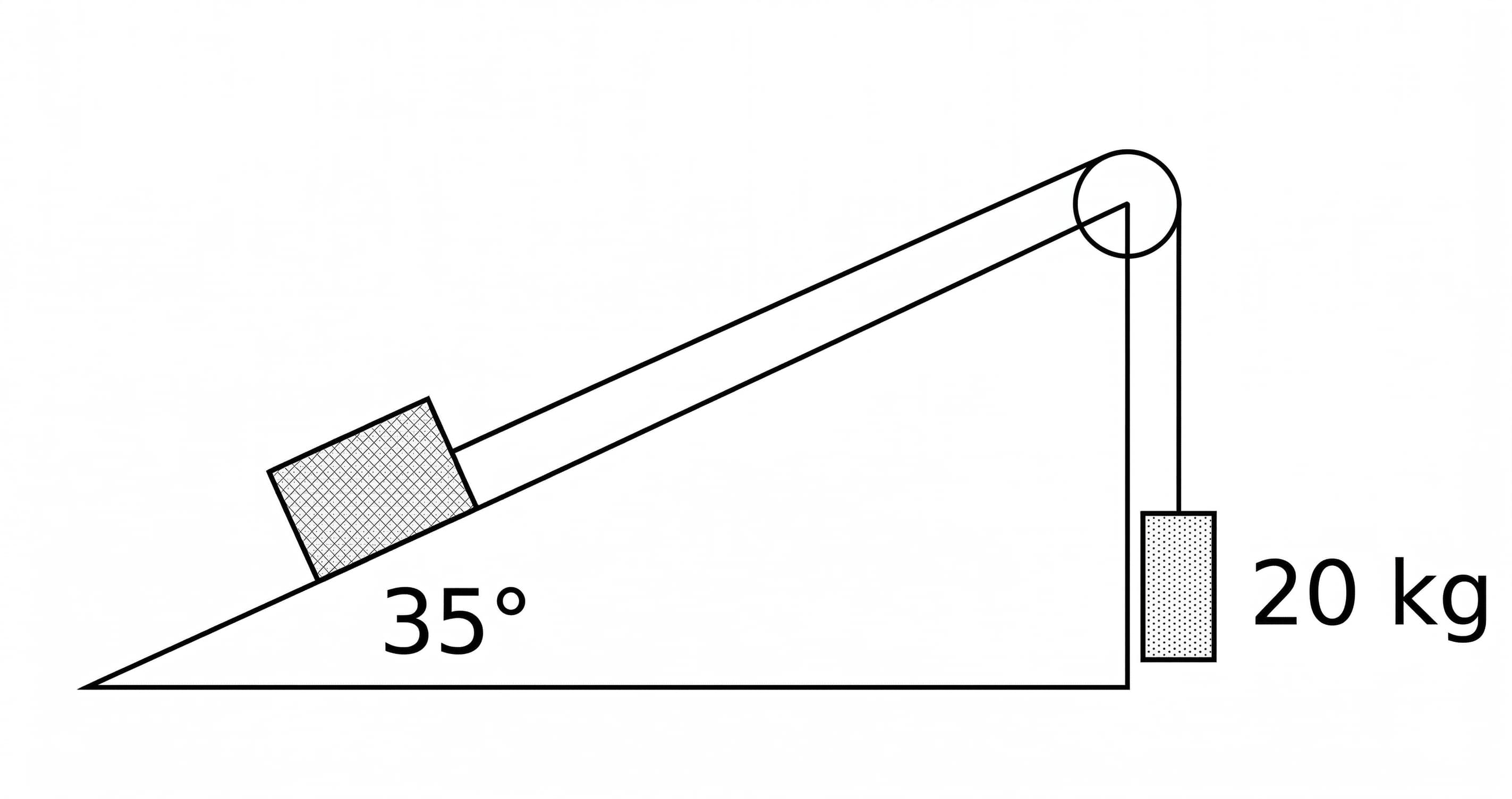
2. In the system below, the pulley and ramp are frictionless, and the block is in static equilibrium. First, draw a force diagram for the block on the ramp and hanging mass and then determine its mass.
3. Ed is sledding down an ice-covered hill inclined at an angle of 15 degrees with the horizontal. If Ed and the sled have a combined mass of 54 kg, what is the force pulling them down the incline? (Ignore frictional effects here.)

4. A brick is held on a frictionless incline by a rope with a tension of T.
a) Draw the FBD
b) Find the tension T in terms of the mass m
Challenge: A brick at rest on a smooth ramp attached to a hanging mass.
1. Draw the FBD for each body.
Solve for M in terms of m

Claim: On a frictionless slope, the component of gravity pulling the object down the ramp is calculated by $mg \sin\theta$.
Evidence:
Problem 1 ($20\text{ kg}, 30^\circ$): $T = 20 \times 10 \times \sin 30^\circ = 100\text{ N}$.
Problem 3 ($54\text{ kg}, 15^\circ$): $F_{parallel} = 54 \times 10 \times \sin 15^\circ \approx 139.8\text{ N}$.
Reasoning: By rotating the coordinate axes to align with the ramp surface, we see that the parallel weight component acts as the "net force" attempting to slide the object. To remain stationary (static equilibrium), an external force (like tension) must perfectly oppose this component.
3 questions on Incline Worksheet — pick an answer to check yourself.
1. A 20 kg box rests on a frictionless 30° incline, held by a rope parallel to the incline. What is the tension? (g = 10 m/s²)
2. A sled slides down a frictionless 15° hill. If the hill were 30° instead, the force pulling the sled down the slope would…
3. For a block on a frictionless incline of angle θ, the normal force on the block equals…
(friction, not zero)
1. While being unloaded from a moving truck, a 10. kg box is placed on an incline plane angled at 37 degrees. When placed on the ramp, the box does not move. What is the coefficient of static friction between the box and the ramp? What is the friction force on the block?

2. The coefficient of static friction between a box and an inclined plane is 0.25. What minimum angle is required for the box to begin sliding down an incline?

Claim: The coefficient of static friction ($\mu_s$) is equal to the tangent of the slope's angle at the moment sliding begins.
Evidence:
Equation: $f_s = F_{||} \rightarrow \mu_s F_N = mg \sin\theta \rightarrow \mu_s (mg \cos\theta) = mg \sin\theta$.
Simplify: $\mu_s = \tan\theta$.
Problem 1: $\mu_s = \tan 37^\circ \approx 0.75$.
Problem 2: $\theta = \tan^{-1}(0.25) \approx 14^\circ$.
Reasoning: Both the pulling force (gravity parallel) and the holding force (friction) are proportional to the object's mass and local gravity. Because these factors cancel out in the ratio, the "slip point" angle is independent of the object's weight and depends only on the surface materials.
3 questions on Static Friction — pick an answer to check yourself.
1. A box is just about to slide on an incline when the angle reaches θ. If a box twice as heavy (same surfaces) is used, at what angle will it start to slide?
2. A box resting on a ramp begins to slide just as the ramp angle reaches 37°. What is the coefficient of static friction? (sin37° ≈ 0.60, cos37° ≈ 0.80)
3. A 10 kg box sits at rest on a 37° ramp. What is the static friction force on it? (g = 9.8 m/s², sin37° ≈ 0.60, cos37° ≈ 0.80)
1. Two 10. N forces act on an object. What is the maximum possible resultant? _________ What is the minimum possible resultant? _________
2. A 5.0 kg box is at rest on a horizontal floor. What is the Normal Force? ____________
3. A 5.0 kg box is at rest on a 30. degree ramp. What is the Normal Force? ____________
4. A 10. N force and a 10. N force act on an object at 90. degrees. What is the Resultant? ____________
5. A 5.0 kg box is hanging from the ceiling by two strings at 30. degrees to the horizontal. What is the Tension in each string? ____________
Claim: Static equilibrium laws remain consistent regardless of whether the system is 1D (floor) or 2D (inclines/hanging strings).
Evidence:
1: Max ($0^\circ$) = $20\text{ N}$, Min ($180^\circ$) = $0\text{ N}$.
2: $F_N = mg = 50\text{ N}$.
3: $F_N = 50 \cos 30^\circ \approx 43.3\text{ N}$.
4: $R = \sqrt{10^2 + 10^2} = 14.1\text{ N}$.
5: $T = 50 / (2 \sin 30^\circ) = 50\text{ N}$.
Reasoning: This module confirms that once forces are resolved into components, the math follows Newton's Second Law ($\sum F = 0$). Using $g=10$ simplifies classroom demos and helps students focus on vector concepts.
3 questions on Final Review — pick an answer to check yourself.
1. Two 6.0 N forces act on an object. What are the maximum and minimum possible resultants?
2. A 5.0 kg box rests on a 30° ramp. What is the normal force on it? (g = 10 m/s²)
3. A 5.0 kg box sits at rest on a horizontal floor. What is the net force on the box?
Review Incline: Instructional Video
Parallel Component of the box’s weight force = __________________
Perpendicular Component of box’s weight force = _______________
(Workspace for drawing FBD with a ruler and pencil)
If the weight force of the block is $F_g$ , what is the magnitude of the parallel component?
1. What happens to the magnitude of an object's parallel and perpendicular components on a ramp when the angle is increased?
____________________________________________________________
____________________________________________________________
____________________________________________________________
2. At what ramp angle is the parallel component of a box on a ramp at its minimum magnitude?
____________________________________________________________
____________________________________________________________
____________________________________________________________
Claim: The distribution of weight into orthogonal components is a deterministic geometric relationship governed by $\sin\theta$ and $\cos\theta$.
Evidence:
Formulas: $F_{||} = mg \sin\theta$, $F_{\perp} = mg \cos\theta$.
Minimum: $F_{||}$ is zero when $\theta = 0^\circ$ because $\sin 0 = 0$.
Reasoning: On a flat surface, the parallel component is zero because the weight vector is exactly perpendicular to the ground. As the angle increases, the weight vector tilts relative to the surface normal, shifting magnitude from the cosine leg to the sine leg until the ramp is vertical ($90^\circ$), where $F_{||}$ equals the full weight of the object.
5 quick questions — pick an answer to see if you’re right.
1. A 3 N force and a 4 N force act on an object at 90° to each other. What is the resultant?
2. As the angle between two forces increases from 0° to 180°, the magnitude of the resultant
3. The resultant of a set of forces is 20. N East. What is the equilibrant?
4. A plane flies with a crosswind blowing at a right angle to its heading. Its speed relative to the ground
5. A 5.0 kg orb hangs at rest from a string attached to the ceiling. What is the string tension? (g = 10 m/s²)