AP Momentum
and Impulse
Momentum / Impulse
Review – Momentum is a mathematical concept useful in
Momentum is in all interactions
Momentum -
e) Impulse = =
Find the $\Delta p$ for an object with the F vs t plot:
Same Δp, different stopping times: the area under the F vs t graph stays the same while the peak force changes.
3 questions on I. Definitions & Basics — pick an answer to check yourself.
1. The same change in momentum is given to a cart, but the force acts for twice as long. The average force is…
2. A 2.0 kg ball speeds up from 3.0 m/s to 7.0 m/s in the same direction. What is its change in momentum?
3. A net force on an object increases steadily from 0 N to 2.0 N over 2.0 s. What impulse does it deliver?
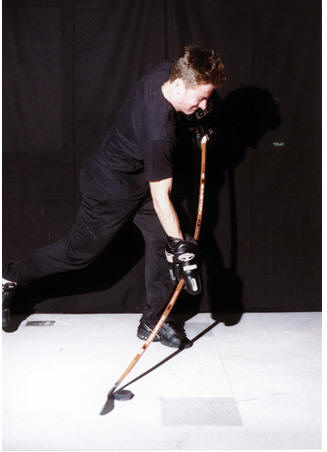
Ex 1) Two tennis players hit an overhead smash on the 'sweet spot' of their tennis rackets. The player who returned the ball with the greatest velocity applied a smaller force than the other player. How is this possible?
Ex 2) Explain why automobiles have airbags, and describe how they work. Include the relevant equations.
Ex 3) A hockey player is standing still on a frictionless frozen lake. Her friend throws a bowling ball straight at her. In which of the following cases is the largest momentum transferred to the hockey player?
(a) The hockey player catches the bowling ball and holds on to it.
(b) The hockey player catches the bowling ball momentarily, but then drops it vertically downwards.
(c) The hockey player catches the bowling ball, holds it momentarily, and throws it back to her friend.
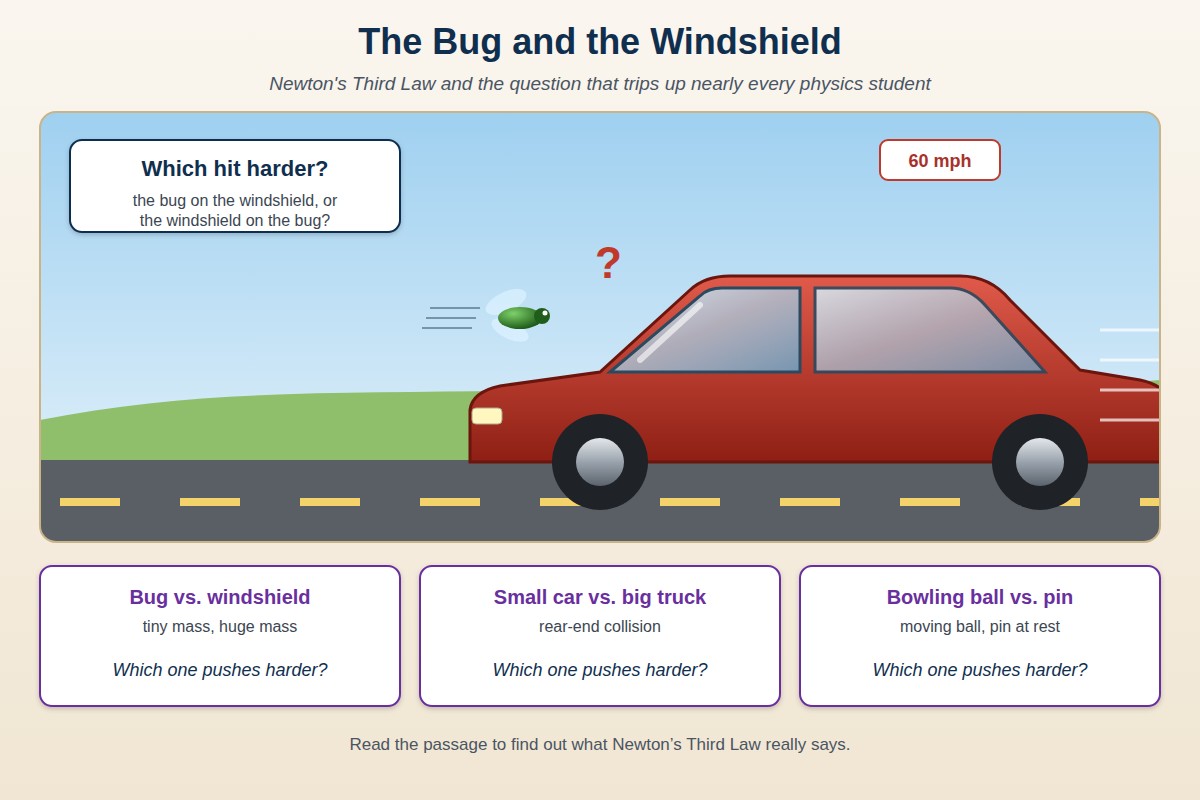

NYSSLS Reading Passage · Dynamics
The Bug and the Windshield: What Newton's Third Law Really Says
Open Reading Passage →3 questions on II. Conceptual Analysis — pick an answer to check yourself.
1. Why does an airbag reduce the force on a passenger in a crash?
2. A 0.060 kg ball arrives at 20 m/s and leaves in the opposite direction at 30 m/s after 0.010 s of contact. Average force on the ball?
3. A skater on frictionless ice is thrown a heavy ball. In which case does she gain the most momentum?
Ex 4) A 2.0-kilogram lead brick is moving at a velocity of 6.0 m/s. What size force is needed to bring the lead brick to rest in $7.0 \times 10^{-4}$ seconds?

Ex 5) A 0.15 kg ball is thrown with a speed of 20.0 m/s. It is hit straight back at the pitcher with a final speed of 22.0 m/s.
(a) What is the impulse delivered by the bat to the ball?
(b) Find the average force exerted by the bat on the ball if the two are in contact for $2.0 \times 10^{-3}$ s
Ex 6) An 82.0-kilogram Olympic diver drops from rest from a diving board 3.00 m above the surface of the water and comes to rest .550 s after reaching the water. What is the net force acting on the diver as he is brought to rest? (Magnitude and direction)
Ex 7) A 2240 kg car traveling west slows down uniformly from 20.0 m/s to 5.00 m/s. If the force acting on the car was a constant 8410 N to the east, how far and in what direction does the car move during the deceleration?
3 questions on III. Impulse Calculations — pick an answer to check yourself.
1. An object's change in momentum stays the same, but the stopping time is doubled. The average stopping force becomes…
2. A 0.15 kg ball arrives at 20 m/s and is hit straight back at 22 m/s. What is the magnitude of the impulse from the bat?
3. What average force stops a 2.0 kg brick moving at 6.0 m/s in 7.0 × 10⁻⁴ s?
Conservation of Momentum - When 2 objects interact, the momentum before the interaction equals
The conservation of momentum comes from Newton's Law.
Derive the conservation of momentum from:
$F_{net} = F_{net}$
Finding Total Momentum / Assume no friction
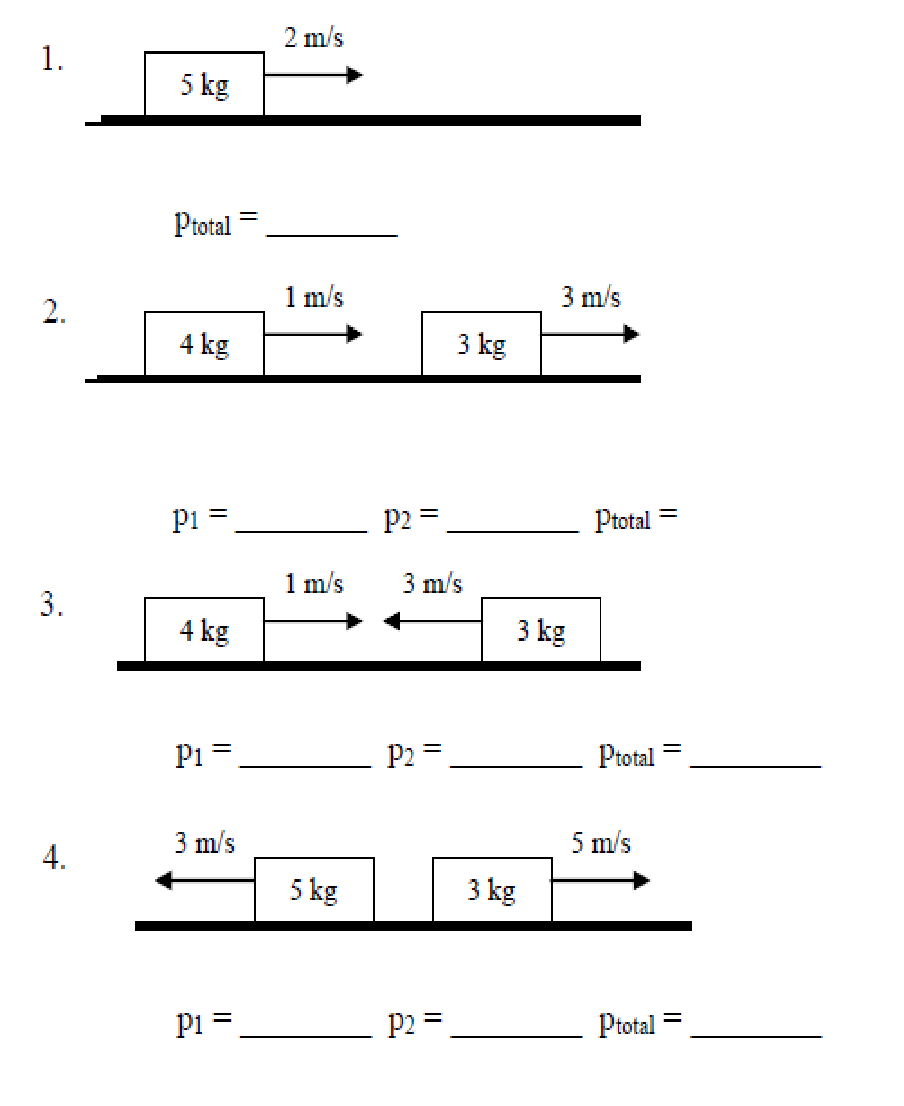
Objects . Assume no friction.
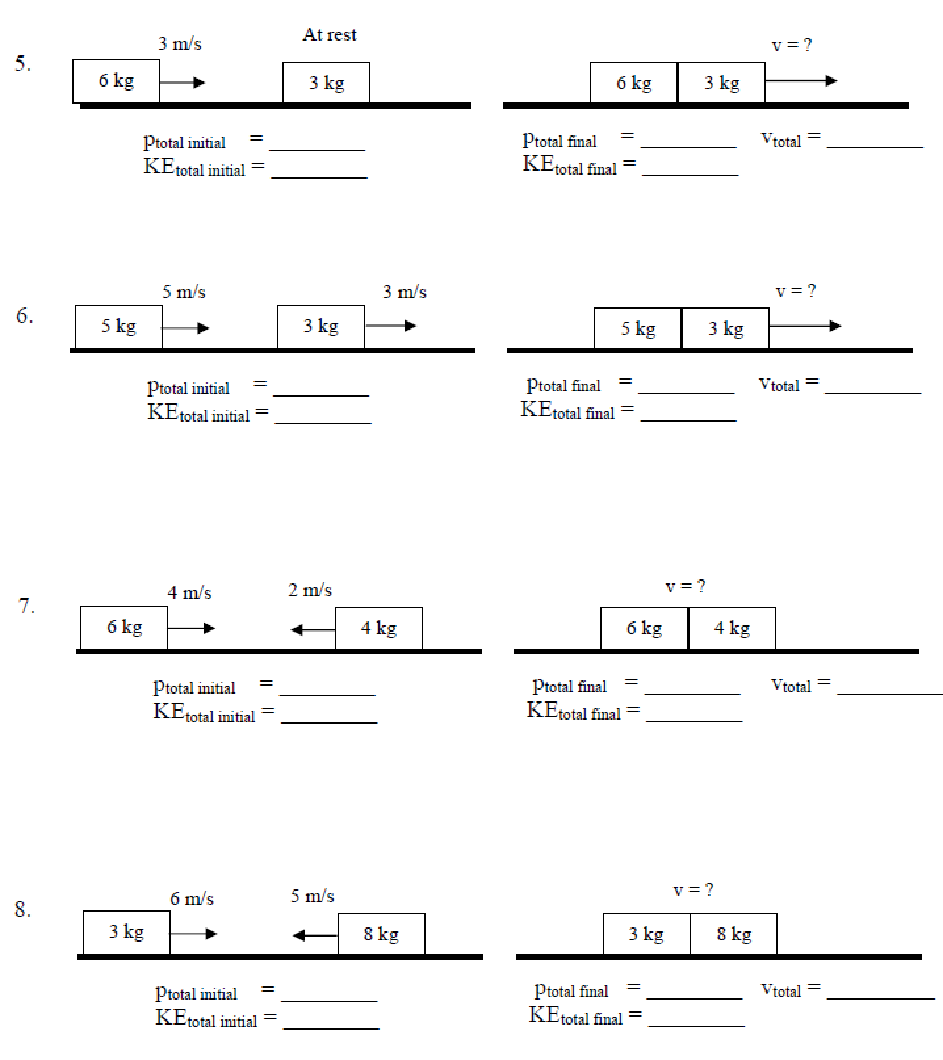
What is the momentum of the attached carts?
Kinetic Energy in a Collision: In an inelastic collision, KE is because
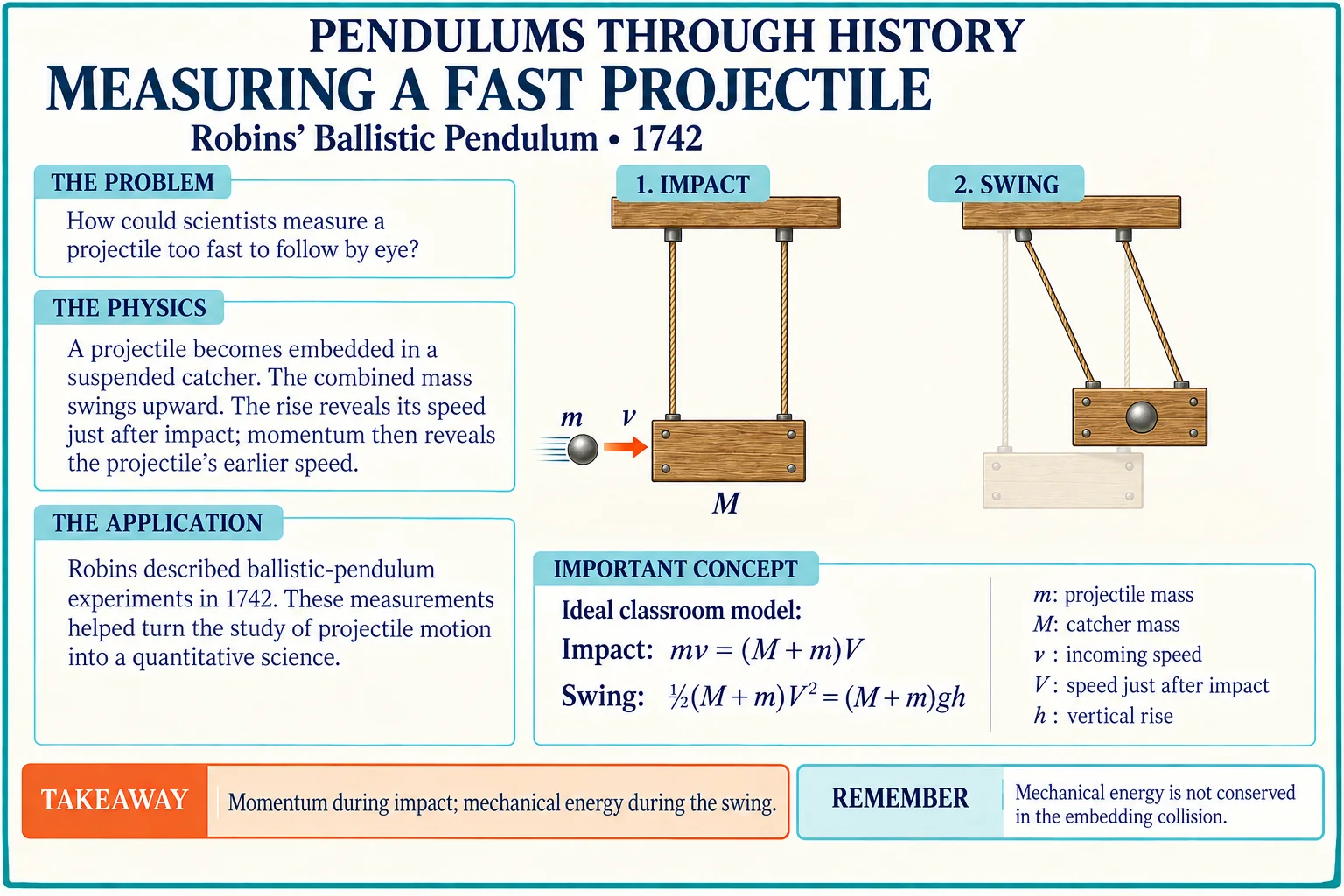 Measuring a Fast Projectile
Click to enlarge: the ballistic pendulum
Measuring a Fast Projectile
Click to enlarge: the ballistic pendulum
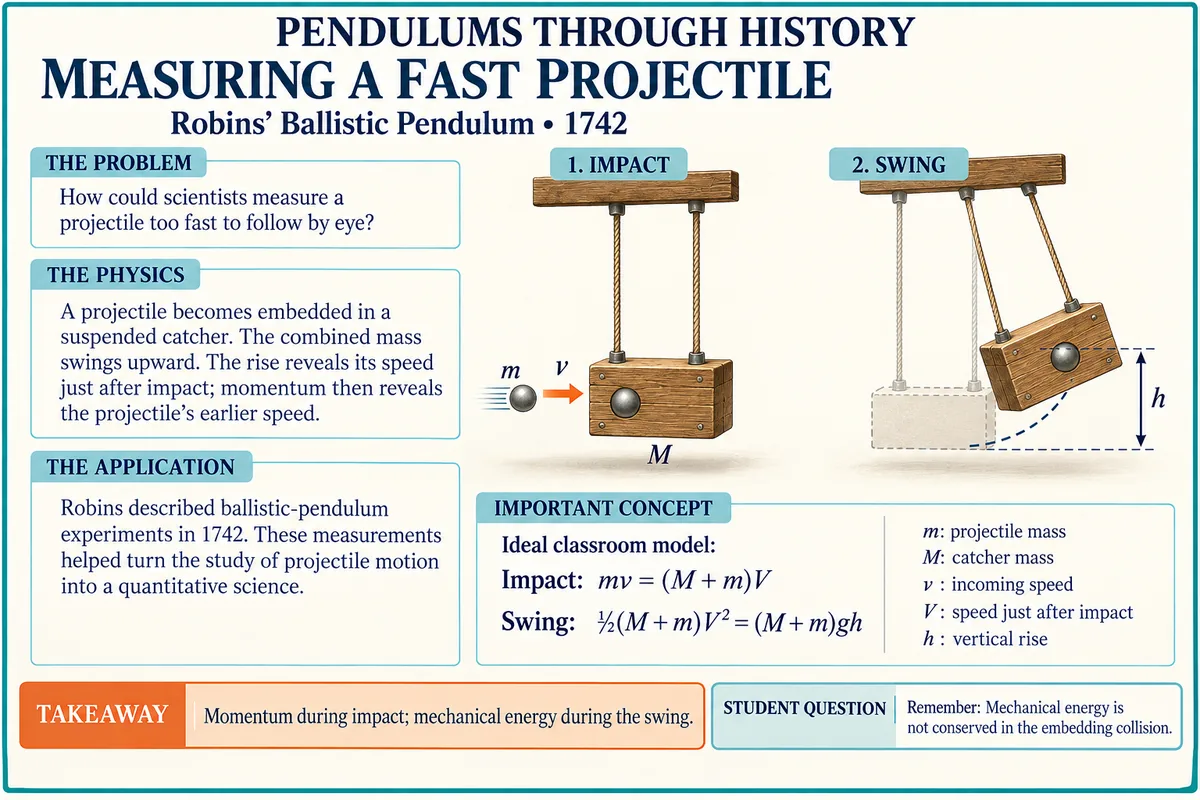
History: Benjamin Robins invented this device in 1742 — before chronographs existed, it was the only way to measure a musket ball's speed. Click the image for a larger view.
Elastic Collision /
Review KE =
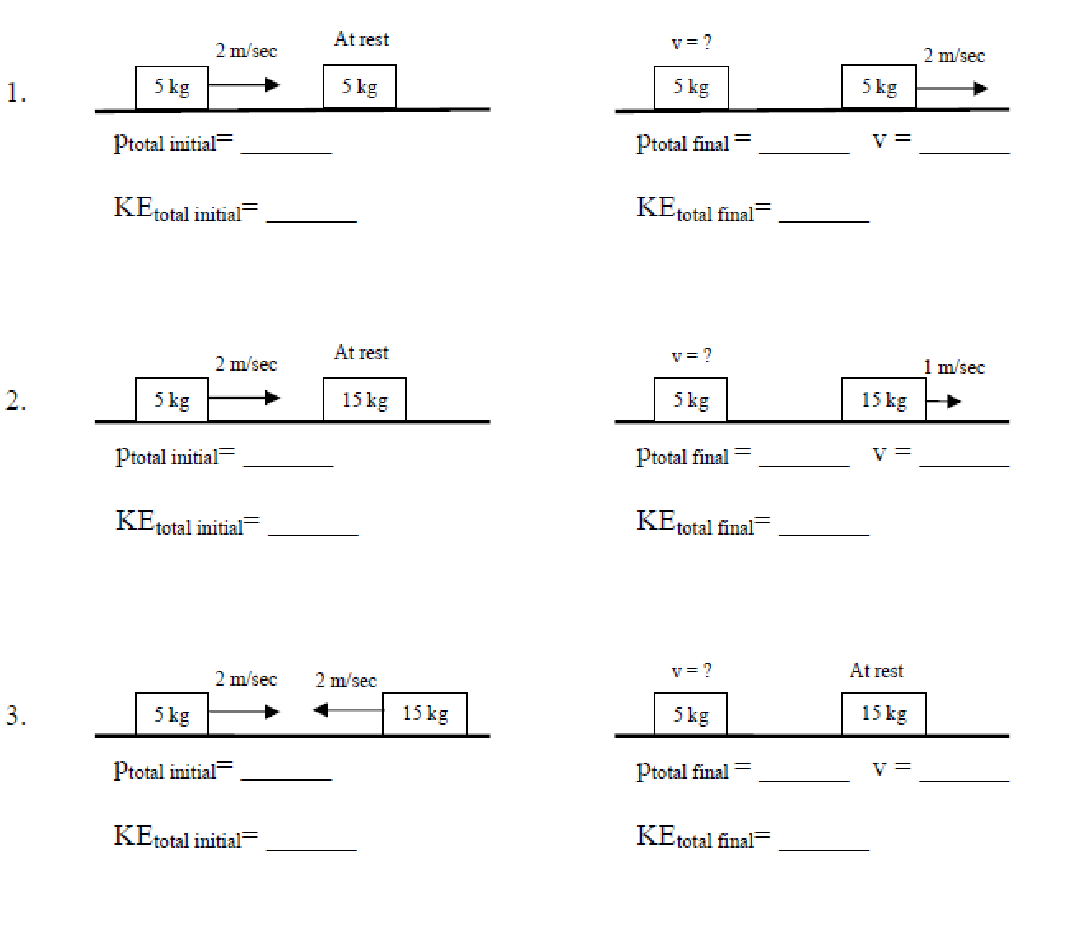
KE not conserved in all problems – Which collision, if any, is perfectly elastic?
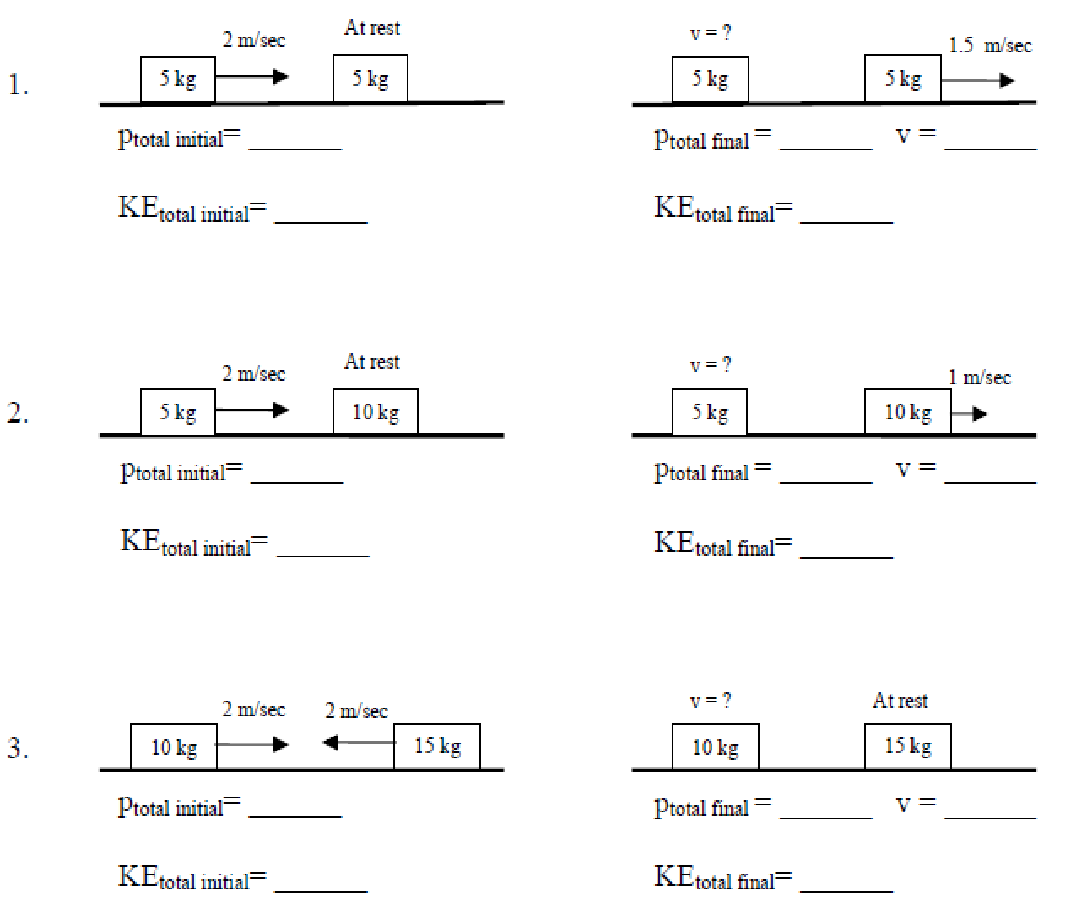
3 questions on IV. Conservation Principles — pick an answer to check yourself.
1. A 2.0 kg cart moving at 3.0 m/s hits a stationary 1.0 kg cart on a frictionless track, and they stick together. What is their final speed?
2. In a collision where two carts stick together (no friction), which is true?
3. Conservation of momentum in a collision follows most directly from which of Newton's laws?
1. A bullet with a mass of .0080-kg (8.0-gram) is fired horizontally into a stationary 9.0-kg block of wood on a frictionless horizontal surface. The bullet sticks into the block of wood and after the impact, the block has a speed of 0.40 m/s.
a. What was the initial velocity of the bullet?
b. If the bullet came to rest inside the block in 3.0 milliseconds ($3.0 \times 10^{-3}$ sec), what force did the block of wood apply on the bullet?
c. What is the force on the block of wood?
d. What is the change in momentum of the bullet-block system?
2. A 2.0-kilogram brick is moving at a speed of 6.0 meters per second. How large a force is needed to bring the brick to rest in $7.0 \times 10^{-4}$ seconds?
3. A 40,000. kg freight car is coasting at a speed of 5.0 m/s along a straight track when it strikes a 30,000. kg stationary freight car and couples to it. What will be the speed after impact?
4. Two balls of equal mass, moving with a speed of 3.0 m/s, collide head-on. Find the velocity of each after the impact for each of the following situations.
a. They have an inelastic (stick) collision.
b. They have a perfectly elastic collision (KE conserved).
5. Four 50. kg girls are sitting in a boat at rest. They simultaneously dive horizontally in the same direction at 2.5 m/s from the same side of the boat. The empty boat has a speed of 0.1 m/s afterward.
a. What is the mass of the boat?
b. What is the change in mechanical energy of the system?
6. A 4,000. kg truck is moving eastward through a frictionless intersection at 3.00 m/s. A second truck, with a mass of 8,000. kg is moving northward through the same intersection at 2.00 m/s. They collide and stick together.
a. What is their speed immediately after impact?
b. What is the change in mechanical energy of the system?
c. Name at least two places the energy went.
3 questions on V. Collision Worksheet — pick an answer to check yourself.
1. A 40,000 kg freight car moving at 5.0 m/s strikes and couples to a stationary 30,000 kg car. What is their speed afterward?
2. Two balls of equal mass, each moving at 3.0 m/s, collide head-on and stick together. What is their velocity after the collision?
3. A bullet embeds in a 9.0 kg wooden block, and the block exerts a 1200 N force on the bullet. What force does the bullet exert on the block?
1. One of those Civil War cannons is fired. The cannon has a mass of 875 kg. It fires a 35.0 kg cannonball at a velocity of 145 m/s at an elevation angle of 35.0°. The length of the barrel is 2.10 m.
(a) What is the recoil velocity of the cannon?
(b) What is the KE of the cannonball as it leaves the cannon?
(c) How far does the cannonball travel in the horizontal direction?
(d) What is its momentum at the top of the cannon ball's trajectory?
2. A 0.15 kg ball is thrown with a speed of 20.0 m/s. It is hit straight back at the pitcher with a final speed of 22.0 m/s.
(a) What is the impulse delivered by the bat to the ball?
(b) Find the average force if $t = 2.0 \times 10^{-3}$ s
c) Force exerted by the ball on the bat?
3. A railroad car of mass $2.00 \times 10^4$ kg moving at 3.00 m/s collides and couples with two coupled railroad cars, each of the same mass as the single car and moving in the same direction at 1.20 m/s.
(a) What is the speed of the three coupled cars after the collision?
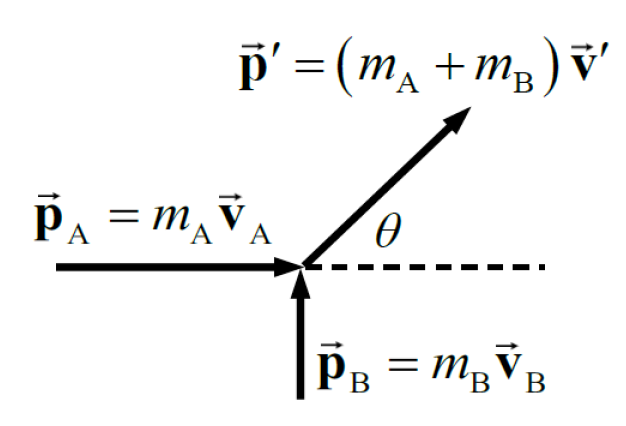
Momentum is conserved in and directions
Total Mom in direction before = Total Mom in direction after
Total Mom in direction before = Total Mom in direction after
1. If the angle between 2 objects = 90 degrees ...
Add momentum vectors using ....
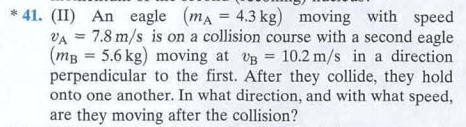
1. Textbook - p. 190) 41
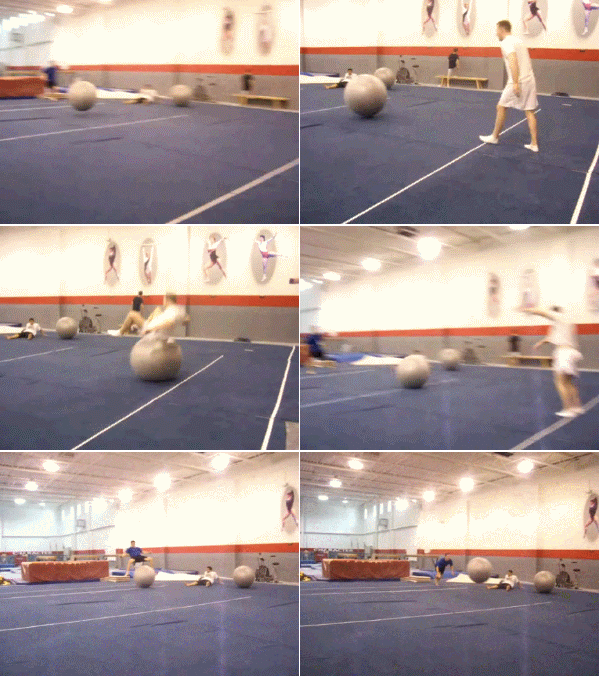
2. # 42 - Billiard Ball Instructional Video
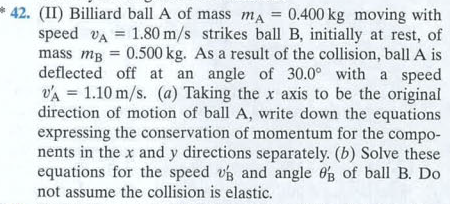
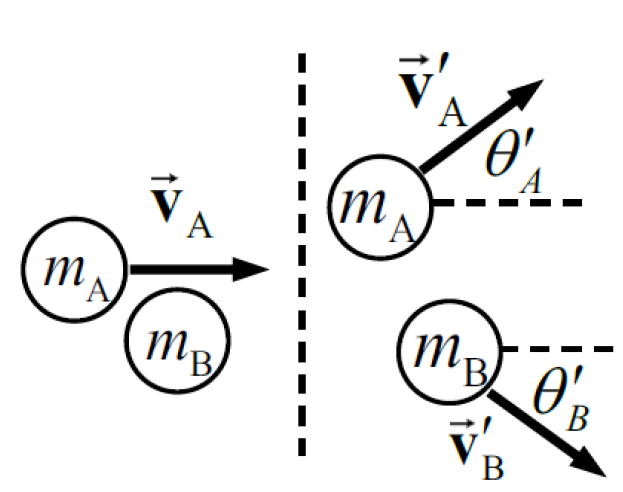
Before $M_a$ = $V_a$ = $M_b$ = $V_b$ =
After $M_a$ = $V_a$ = $\theta_a$ = $M_b$ = $V_b$ =
Total momentum X before = Total mom. x After?
Total momentum Y before = Total mom. Y after?
NYSSLS Reading Passage · Dynamics
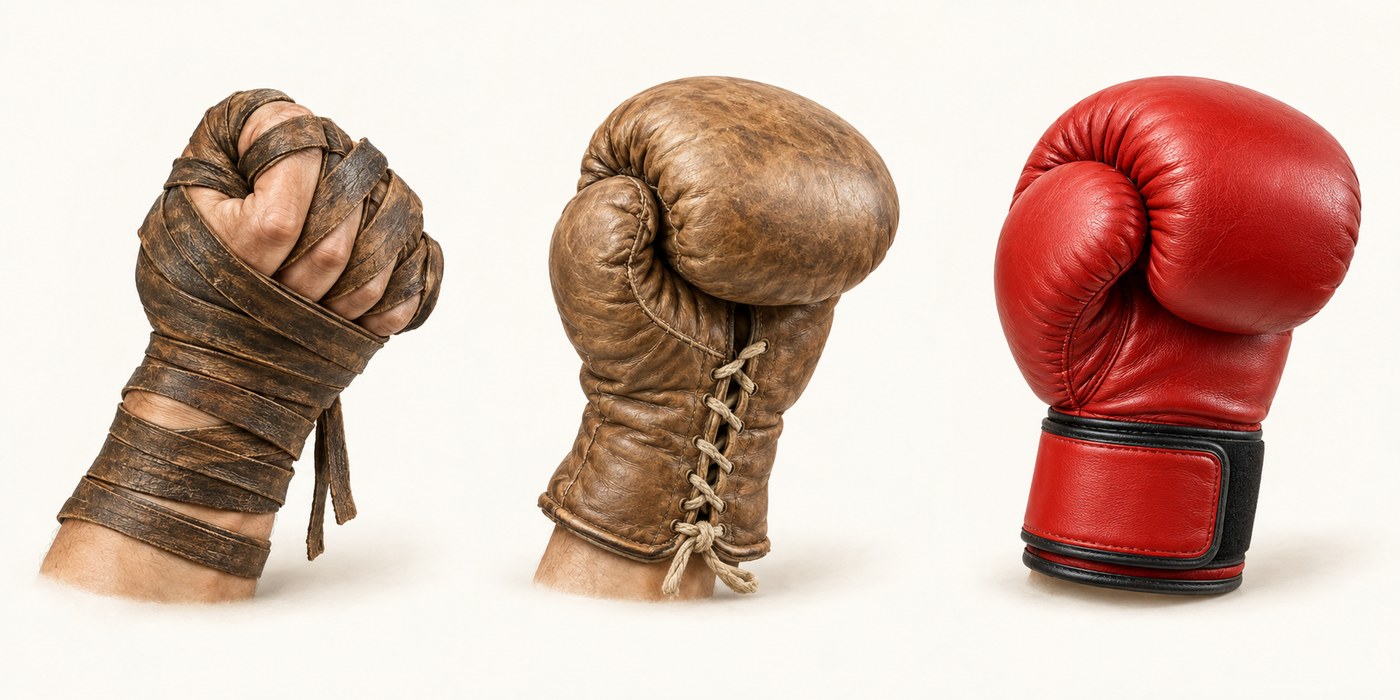
The Physics of the Fist: Force, Impulse, and the Evolution of the Boxing Glove
Open Reading Passage →5 quick questions — pick an answer to see if you’re right.
1. Impulse on an object is equal to…
2. How does an airbag reduce the force on a passenger in a crash?
3. A 0.15 kg ball moving at 20.0 m/s is hit straight back at 22.0 m/s. What is the magnitude of the impulse from the bat?
4. A 40,000 kg freight car at 5.0 m/s strikes and couples to a stationary 30,000 kg car. What is their speed after impact?
5. In an inelastic collision where two carts stick together, which quantities are conserved?
A cannon on wheels sits at rest on level ground (ignore friction). It fires a small cannonball to the right, and the cannon rolls back to the left. A student draws the forces during the firing:
Student: "The explosion pushes harder on the ball than on the cannon, which is why the ball flies away so much faster. Before firing, the total momentum is zero. After firing, the total momentum equals just the ball's momentum, because the ball is the only thing really moving."
What, if anything, is wrong? If something is wrong, explain the error and fix it. If nothing is wrong, explain why it is correct.
More Momentum Concept Challenges →